Showing posts with label development. Show all posts

Sunday, February 14, 2016

Affordable housing and non profits (video snip)

Here's a very brief snippet from the Occupy AltBank talk on zoning and affordable housing last week posted on facebook by Sumumba Sobukwe, an active member of AltBank and cocreator of Occu-Evolve.

Here again is the presentation in the form of blogposts:

The origins and history of zoning and the Amenities Dilemma

Zoning with a conscience

Contextual zoning and "affordable" housing

Collusion between gov't, developers and non profits: the cooptation of the left

the current mayor's plan

Friday, February 05, 2016

Collusion between gov't, developers and tenant advocacy non profits

By using zoning to limit developable space, and allowing that space to be bought and sold, gov't created property literally out of thin air -- out of the words of the zoning text. By creating a market the raw resource of which was created by the gov't, gov't could exert influence, manipulate and extort from developers. If a developer wanted more space than was available in the zoning, he had to go beg it of gov't, and gov't could grant the additional space for a favor. This market was the beginning of the end of gov't directly building affordable housing and instead drawing the developer into building it for the public.

Housing projects were widely viewed as a failure. A new generation of planners followed Jane Jacobs' broad criticism of tower-in-the-park construction, which she viewed as anti-urban, generating wastelands of non commercial, semi-abandoned and dangerous, isolated space. The reality was more complex. After all Stuyvesant Town is a housing project but no one complains that it's a failure. If anything, it's become to successful, too attractive as its management tries to replace older tenants with tenants eager to pay much higher rents there. But Stuy Town was middle-income, well maintained, with residents who were also well served by gov't and the economy in many ways. The low-income housing projects relied on inadequate gov't funding streams and the community was consistently underserved whether by the education system for its children or the employment opportunities for its parents, health services, sanitation and the maintenance of the grounds. If it failed, it failed because of the lack of social and financial investment in the human capital of the community. But that failure could easily be dressed up instead as a failure of urban and architectural planning and design.

Zoning incentives replaced housing projects. Developers would be given additional space to develop in return for building a modest percent of affordable housing that would be managed by a non profit tenant advocacy group. This model brought together gov't, developers and affordable housing non profits: gov't offered bulk space incentives to the developers while giving the non profits funding to manage the affordable housing. The developers needed to cooperate with both gov't and the non profits. And critically, the tenant advocacy groups were now compelled to work with and for both gov't and developers. 

In order to obtain affordable housing, the tenant advocacy non profits had to sell upzonings to their community, otherwise the non profit wouldn't get the affordable housing or their funding from the gov't. Since the affordable housing brings with it market-rate development, the result is gentrification, investment, opportunity for more investment and a feeding frenzy of tenant harassment. At the end of the day, affordable housing through zoning nets a loss of affordable housing. And since the affordable housing is given to people who are not currently living in the neighborhood, to call this "community preservation" is Orwellian doublespeak. 

Those in the community who are aware of the consequences of the affordable cooptation of the non profits, are placed in the ugly position of having to protest affordable housing. The gov't has effectively driven a wedge between affordable housing advocates and anti-gentrificationists by this Sophie's choice dichotomy of affordable housing (+market-rate housing) or else no development (+no new affordable housing). 

If you go to a City Planning hearing you can see the wedge in living color. The state-funded affordable housing non profits arrive with their employees and clients -- the tenants they work with in their tenant advocacy -- all in bright orange or yellow T-shirts. They don't testify, since they are brought to the hearing to pad the audience. Their leaders testify in favor of the upzoning on the grounds that it will bring affordable housing to the community. The rest of the audience is comprised by ordinary residents dressed all diversely, unorganized and unfunded. They do testify, one by one. They testify against the upzoning, expressing their concern about gentrification and community displacement. The Planning Commission ignores them because the city wants development -- it's revenue for the city. The people lose, and the sham continues. 

Thursday, February 04, 2016

Contextual zoning and inclusionary housing

As we saw last time, by limiting the developmental rights -- the allowable floor area -- in every zone, zoning created a market of space. By the same token, it made it possible for the gov't to create property out of air, out of words in the zoning text. Upzone a neighborhood -- allow more floor area per lot -- the owner now not only can build more actual rental space but, if he doesn't have the financial resources to construct, can sell the unbuilt floor area to another developer who does. This gives the gov't powerful leverage on developers.

We also saw that while the small landowners benefit form the sale of developmental rights ("air rights"), their property becomes developmentally inert and in the long run, less profitable, and because the nearby skyscraper has raised the local real estate taxes, the property may become a source of discontent. In addition, the Modernist model of surrounding tall, dense buildings with park space instead of integrating residences with commercial storefronts aligned on the streetscape turned out to be a disaster in the so-called "projects." Modernist ideals were replaced with a belief in value of the urban integrated streetscape -- storefronts on the street-level which would bring lively commerce and businesses that would clean and protect the street. This led to a reaction against the tower-in-the-park zoning which created disjointed, discontinuous streetscapes.

The response was the current model of zoning called "contextual." The city added another innovation, this in the measure of space: the height cap. Zoning would now provide a floor space allowance, but also a height cap, so a developer could no longer buy unused developmental rights ("air rights") to build out-of-scale skyscrapers in low- or mid-rise zones.

Meanwhile, the gov't got out of the business of constructing low-income housing (projects) using instead its leverage through zoning to get developers to build affordable housing. The Bloomberg model worked so:

1. Designate a height cap in a zone that is higher than is needed for the designated floor area.
2. Offer the developer additional floor area if the developer built some affordable housing there.

So it's an incentive deal made to the developer. If he builds affordable housing in addition to the market rate units he wants, the city will allow him more space to build additional market rate units. The market rate bonus wasn't much, but it was more than nothing. Typically, the ratio was something like 4 units affordable, 1 unit market rate. The developer might be allowed, in other words, to build another  25% more space, but the total building would have to be 20% affordable, so the market rate bonus was just 5%.

Not many developers bothered with the bonus. De Blasio claimed that they didn't want the bonus because in order to squeeze in the affordable units within the height cap, the entire building had to have low ceilings. So the Department of City Planning came up with a fix: raise all the contextual heights so that developers didn't have to sacrifice ceiling height for the affordability bonus. The developer could build high ceilings for the luxury clients and still have room for affordable housing plus the market rate bonus incentive. The developer could eat his cake and the city could have it too.

De Blasio also proposed that wherever there's an upzoning, affordable housing would have to be included -- if the developer gets an increase in floor area, the developer must build 20% of the building as affordable housing. Since this mandatory inclusionary housing doesn't apply unless there's an upzoning, de Blasio's proposal is similar to the Bloomberg model. But under the Bloomberg model developers might advocate to get an upzoning and not bother with the bonus affordability incentive. Under the de Blasio model, the developers might think twice about advocating for an upzoning since the affordability would be forced on them.

Next up, the role of affordable housing non profits and the community boards.

Wednesday, February 03, 2016

Zoning with a conscience (the talk'll be up at Columbia University in the Foreign Affairs building, 420 W. 118th Street, room 409, 2pm Sunday)

In 1961, the city updated its zoning. This time, the city's planners responded to the Modernist movement which had been around since 1910 or so, but gov't isn't exactly avant garde, so it takes time for gov't to catch on.

The principles of Modernism reflect deep social awareness, with its origins in socialism at a time when socialism was not only respectable, but viewed as the best means, perhaps the only means, towards social justice. Rather than merely serving the investors' financial interests, Modernist architects intended to design an ideal world for all. They developed manifestos and principles of design, competed intellectually for innovations that would improve humanity, not just the developer or his rich clients. Stylistically, they rejected the ostentatious flaunting of wealth that characterized the design fashions of their predecessors. Ornamentation signaled useless vanity. Modernism replaced the show of wealth with purely functional form -- no eyebrows over the windows, no more columns and terra cotta. Steel girders and glass walls -- the structural elements -- were left bare in rectangular shapes of structural support: the Seagrams Building is its most insistent and elegant expression.

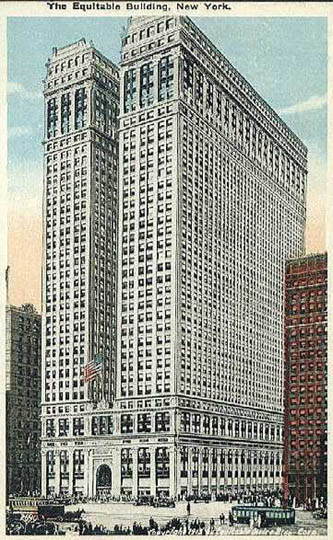
You'll notice that unlike the Equitable Building that covered the lot completely, and unlike the Empire State Building that attenuates towards its spire, this building rises straight up but doesn't cover the lot. Instead of setbacks to bring light to the street, the new zoning required that as the building grows taller, its footprint must attenuate, not its tower. The result is an empty space surrounding the building, which then can be used by the public as a park or plaza. The method of bringing light to the street is shifted from the top of the building to the bottom where the public can benefit both from the light and from the space. 

The new zoning also introduced a method of restricting the bulk or size of a building. Previously, buildings could be built to whatever height, allowing overwhelming and oppressive density. City Planning Commission came up with a measure of density that still allowed for flexibility of height. The measure of size is the floor area. By zoning for floor space rather than for height, developers were allowed to choose the height of the ceiling freely. 
The New Museum has the same floor area and zoning as its nextdoor neighbor
but because its ceiling heights are 20'+ it dwarfs the buildings on the street.
But their innovation served much more than that. It was now possible to limit the bulk of all the existing or potential buildings in a specific zone. And it allowed landowners to sell their bulk allowance to other landowners who might want to build more than the zoning had given them. The new zoning created a market of space. 

It also had a preservationist consequence for owners who sold their bulk allowance in excess of their existing building. Once an owner has sold his excess bulk allowance -- his developmental rights, sometimes called "air rights" -- the owner can't develop anything larger than the building he already has, so there's no reason for him ever to redevelop his building. The result is a kind of preservationist balance: for every tall skyscraper built by buying developmental rights of small buildings nearby, those smaller buildings are preserved. The new ensures the old. 

It also ensures that the old, small owner loses the value of his property, can't sell it easily, since who wants a building that can't be redeveloped for increased rents, while the skyscraper next door increases the real estate values of the neighborhood and therefore the real estate taxes. The small owner may have gotten a one-time windfall from selling the air rights, but in the long run, he's losing. 

Next up, the current model and how it plays into affordable housing. 

Tuesday, February 02, 2016

Talking this Sunday at OWS Altbank (Alternative Banking) Group on zoning and displacement

I'll be giving a talk on zoning, its consequences and how it plays out in local politics. Here's a brief outline.

The Amenties Dilemma

I'll be starting with what I call the "amenities dilemma": whenever some amenity that improves the quality of life is brought into a low-income neighborhood or ethnic enclave, whether it's better plumbing or a nicer sidewalk, it raises real estate values and attracts investment. It's not just a quantity of money that flows into the neighborhood, but the color of money, which is not green. Money in America is white, and it has an affinity as well as a color: it's drawn to more whiteness. Any improvement in a low-income neighborhood tends to whiten it and drive out the color. It's called gentrification and its consequence, community displacement.

Why should money harass the color out of a neighborhood? Is it greedy maximization of profit?

I dislike the use of "greed" as an economic explanation. It implies that there are some defective people who are to blame for what's wrong in the world. That sort of psychological essentialism -- some people are greedy, others not -- leads to a misunderstanding of how economies and societies work, and leads away from any meaningful solutions to its problems. What we call greed may be less affective, personal or psychological than mere opportunity. If there is no opportunity to make money out of some place, thing or person, people are pretty chill about that person, place or thing. It's when there's some kind of opportunity to gain from a place, person or thing that the feeding frenzy begins.

When the Lower East Side was an abandoned slum, it took my landlord eight months to bother to try to evict me for non payment, because the rent was so low that getting the rent or replacing me with another low renter was hardly worth the trouble. Today if I am five days late with my rent, the landlord files eviction proceedings and assesses a late fine onto my rent. Where there's money to be made, the pressure becomes irresistible and fierce.

The amenities dilemma -- leaving the ghetto in poverty preserves the community but ensures their poverty, while improving the ghetto just shifts the community to a new place of poverty (the dilemma was observed way back by Friedrich Engels in his "The Housing Question")  -- is the big problem for zoning designed to create affordable housing. That's what the talk is mostly about. But first I want to look at how zoning came about, what its goals were and are, and how it works.


The origin of zoning

In 1915, Equitable Life built an office tower designed to be the largest such space in the world. Taking up a huge lot, the building rose straight up 38 stories, casting a shadow a quarter of a mile. This was a time before Wall Street was covered with skyscrapers. The buildings there were much more modest and natural light was still available. Commercial buildings were structured to use natural light. Cast iron, favored for commercial buildings, allowed maximal window coverage with minimal structural support. The Equitable Building's shadow instantly depressed real estate values all around it. Landlords and real estate speculators throughout the city were terrified and infuriated, not just over the building, but the possibility that other corporate giants would build near their lots. The real estate industry demanded that the city respond with a permanent fix so that this never happen again.
The very next year the city implemented its first zoning law. Note that the city responded immediately. The disastrous 1879 Tenement Housing Act that created dangerous and unsanitary conditions in the ghetto wasn't fixed for twenty-two years. Zoning took a matter of months. The difference? Money and investors vs immigrant labor. Note also that the housing need for the ghetto was dangerous and unsanitary structural designs inducing life-threatening diseases and fire; the needs of the real estate industry were investment.

The zoning had two new requirements. One was a restriction on types of uses so that factories couldn't be built along residences. Factories bring noise and stench and worse, laborers, who are also noisy and smelly that destroy the real estate value of a residential neighborhood. The city came up with the idea of creating residential zones where commerce was allowed but not manufacturing. There'd also be commercial zones where some residences were allowed, and manufacturing zones where manufacturing and some commercial buildings but not residential buildings could be built.

The second idea was a design innovation. Any tall building had to attenuate -- as it grew higher, it had to be more slender. The idea was to prevent the skyscraper from blocking out all the sunlight, while still allowing developers to build big to cash in on rental space. This requirement of attenuation is easily visible in the most familiar and identifiable NYC skyscrapers. The Empire State Building took its design not from any fashion, but from the strictures of the law. In fact, the real estate industry hired an architectural draftsman, Hugh Ferriss, to interpret the legalese to the architects.

These gradual attenuations are called setbacks.

Both of these innovations were specifically designed to protect the interests of real estate industry -- landowners and developers.

Next up, tower-in-the-park zoning, modernism -- design with a social conscience and unintended consequences -- and developmental rights or how gov't creates property and value for the landowner out of thin air.

Friday, January 29, 2016

The inverse law of ghetto real estate

Prior to mass transit trains across the five boroughs, the labor force were compelled to dwell near their source of work, back then mostly concentrated around the docks of the Lower East Side of Manhattan. Growth could not then spread horizontally like suburbia or a Los Angeles. It could grow only vertically to preserve proximity. As a result, the increasing population of the labor force is directly reflected in the bulk and height of the successive structures that housed them.

At first town houses were refitted for multiple families, often expanding the fourth floor servants' quarters attic into a full floor for two apartments. As space became dearer, the houses were built higher with an additional backhouse behind the one facing the street. Why build backhouses rather than building even higher or building deeper into the lot? Either of those options would have saved the space of a second stairwell and a second backyard space.

The design of a town house allows natural light into the front room and the back room, each about twenty feet deep. If the building is built deeper to accommodate more rooms for more families, the interior room would have no light at all. Who would rent such a space, when there are other town house rooms elsewhere with natural light? A dark interior room would have no market, so the only benefit to a deeper structure would be deeper rooms, which would give more space to a renting family, but not more families to rent.

As long as the demand for naturally lit rooms did not exceed the supply, there was no reason to build deeper. It made more sense to build a back house with naturally lit rooms. That would allow more families to rent, more rents per lot.

When the labor population increased demand for local residences, the civility of natural light could be disregarded. It became marketable to build one structure deep into the lot, with only one stairwell and only one small backyard and with dark interior rooms for poorer families or borders.
The white section represents the building footprint, the blue is the backyard space
It was only after 1901 that a progressive housing law required adequate natural light and yard space. Until then, the story of housing followed a monopolistic law. If the consumer is captive, the market is not "free" to follow amenities with their money. In a free market, amenities attract higher prices with the result that the market reflects a range of values. In housing, that plays out with a range of modest houses to magnificent mansions. But where the consumer-renter is restricted in place, and the supply is restricted as well, the developer can jack up rents without offering any amenities. The history of the tenement show the opposite of the free market character. When demand was lower in the 1840's, amenities were reasonable -- natural light and spacious rooms. By the 1880's, during a huge increase in labor population, the rooms were smaller, darker and more crowded with more families living together, despite the higher rents. As demand increased, price increased and amenities lowered. The range of housing remained unchanged. In the 1880's and 90's tenements were built at the rate of about two thousand per year, all of them designed on one model. The interior of the tenement was as uniform as the exteriors were wildly diverse.
The ghetto law of a captive market:
S/D=S/P=A (as supply decreases over demand and price, amenities lower).
In the ghetto, as rents go up, amenities like space, light, fresh air and privacy go down -- the opposite of the free market where money chases amenities upward. This desperate exploitation of a captive market -- immigrants not only had to live near the workplace, but as immigrants were not welcomed in "respectable" neighborhoods -- eventually led to successive housing reforms, though not until after the four-day immigrant labor uprising known as the 1863 Draft Riots. Along with a political revolution led by the populist mayor Fernando Wood, Tammany Hall, relying on Catholic labor for its constituency, recognized that housing was the essential problem to be solved for New Yorkers. Plus รงa change...

The politics of housing requires its own post.

Thursday, January 28, 2016

Ghetto real estate

I'm cheating here. I posted this about a year ago, but it fits into the series exactly right here, and I'm short of time anyway. It starts the story of how landowners --the original New York City gentry -- encountered a vast landless immigrant labor force drawn to an industrializing city...

Concerning the history of real estate in the slum

Trying to attribute gentrification to the real estate industry, Neil Smith came up with an analysis that distinguished ground rent from building rent. It's an echo of David Ricardo, whose brilliant analysis of rent distinguished the value of the land from the value it produced in an agricultural economy. Smith's distinction is inventive and imaginative, but maybe not reflective of any economic reality. I think he conflated potential with real. To explain why I think so, I'm going back in time to the roots of slum real estate.

In her Manhattan for Rent (Cornell 1989)Elizabeth Blackmar recounts how Henry Rutgers, in the 18th century, leased out a piece of his land to a contractor, specifying exactly the size of the house the contractor could build. Too small a house might attract poorer tenants, too large might attract boarders, in either case altering the character of the neighborhood for the worse, degrading the value of his land.

In old New York, the gentry leased land to a contractor who would build a structure and rent it out to a single-family tenant. The building owner then extracted the rent on the residential tenant and in turn paid rent on the land to the landowner. Rutgers' specifications recognize that the value of land depends not just on the rent of whatever structure is built on it, but on the value of the land itself. For Ricardo, the value of the land depended on the demand for the best soil for cultivation. In a city, and for Rutgers, it's the demand for the best neighborhood, the cultivation of preferred neighbors.

So far Smith's analysis works well. The value of the land can be discussed independently from the rent of whatever is built on it. What I question is whether the value of the land can differ from the value of the buildings on it or their revenue.

The drawing at the top shows the Five Points neighborhood, lower Manhattan's notorious slum of the mid-19th century. The artist gives the impression of the topsy-turvy discord of the place, a kind of bizarro-New York. Wooden houses are sinking into the ground at different rates, street fights abound, a white gentleman is kicking a woman, presumably a prostitute, into the street while the only dignified character is the black gentleman in a top hat. Prominent among the incongruities is a tenement building, standing like a Trump Tower amidst a tattered Detroit street.

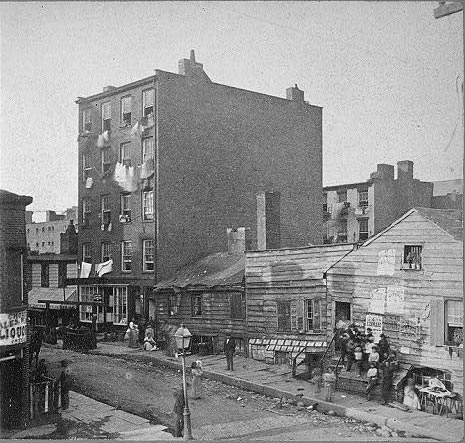
Here's a photo of the same street taken probably a few years later. You can see that the shack next to the tenement has sunk even deeper. In the drawing it's a two story structure, but the photo shows the ground floor window below the street level.


Charles Dickens had visited this very corner only seven years prior. He complains about the knee-high garbage in the gutter, and that's actually how this photo can be dated. The streets of Five Points were so filthy the city decided to "scrape" them clean in 1855. The story goes an Irish immigrant commented on seeing the newly washed streets of her neighborhood, "I had no idea there was cobblestones down there."

The cleaning of the foulest quarter of New York must have been quite the news. Five Points was not just the city's troubling social problem -- no one had ever seen such poverty, density or desperation in the city before, not to mention the concentration of Catholicism -- the place had also become a curiosity, a circus-like attraction. This photo was the instagram of its day -- The streets of Five Points have been cleaned?!? Definitely got to check that out and record it! -- and here it is, Five Points recorded ironically at its only clean moment, no doubt misleading many viewers today to think "It wasn't as bad as the literary accounts of it." Among the misled may be the viewers of Scorcese's Gangs of New York which reproduces dusty but barren streets, very much like the one in the photo. Here's what the streets of Five Points normally looked like:

Easier to see with this photo of a nearby East Side street lined with ca.1865 tenements, taken prior to 1894 when Colonel Waring finally got the streets of New York clean:

Not pretty. Dickens' complaint was no literary exaggeration. (Btw, if you look at photos of NYC streets in the late 1890's, you'll typically see cute little piles of horse shit here and there. They don't indicate that the streets weren't clean effectively. They're actually the mark of Waring's success. Priorly, you couldn't tell the horse shit from the heaps of excrement of all types, as above.)

Now take a close look at the tenement in the Five Points photo and drawing, in particular, what's behind the tenement in its lot. There's a back tenement -- a smaller tenement behind the main building. That little building tells all. I'll say a lot more about the reason for and the structure of the back tenement, but for now, let's just consider the mere fact that it's there.

In his contract, Rutgers also specified that there be no back house in his lot. A back house was guaranteed to bring a bad element. Who would rent in a back lot? Who would live in a front building with no back yard?

The mere existence of that back house says unambiguoulsy that the landowner has lost faith in the neighborhood as a place where he would ever consider living in. He's abandoned its use to the exchange value of its building. That shift will send both the land and its building floating onto the current of exchange, of industrialization and immigration, and eventually to legislative reform.

And that's why it's so tall. At a time when the tallest townhouse was was three and a half stories, these tenements were the skyscrapers of its day. People of means spurned apartment buildings. Multiple dwellings -- they called them tenements, but they were just apartment buildings -- were for immigrant Catholics, not for dignified society. The decent lived in a house.

And it wasn't the tallest. But I will finish this story later. The real estate market, immigration, density, the lack of public transport, and most important, the owners' relationship with his land -- all influence the character of construction and of neighborhood. It's a story of an inverse relation between use value and exchange value that characterizes slum real estate, exactly the opposite of the non slum market where use and exchange and demand all rise together. In the slum, demand and exchange rise at the expense of use. The more demand, the higher the price, the worse the conditions and the greater the density. It explains the uniformity of the slum and its diversity over time. More soon.

Thursday, January 21, 2016

Cooptation of the Left and the permanent shadow government at the local level

Underneath the community boards' rejection of de Blasio's zoning proposals lies a practical and familiar issue: money. Bloomberg's 120 rezonings each went through the arduous public process in which community boards -- and crucially its members -- played an important role. De Blasio's proposals bypass the community level by writing the upzoning directly into the zoning law (called "the zoning text"). The Blaz's proposals eliminate any local leverage for funds that local community non profits might obtain. 

Affordable housing built by developers to meet zoning requirements must be managed by a non profit community-based organization (CBO). It's part of their mission and they get funding for it. As a result, CBO's are often the most vigorous proponents of development at the local level. Without the market rate development, no affordable housing -- the market-rate housing "subsidises" the "affordable" housing (a deceptive expression -- the housing is often beyond the means of local residents). That's the Inclusionary Zoning/Inclusionary Housing model -- 80% market rate, 20% "affordable." The non profit becomes complicit with gentrification and displacement. 

Displacement is difficult to quantify. Unless a tenant died, the reason for vacating an apartment is anyone's guess, since it's not recorded. Affordable housing is eminently quantifiable, which is one reason why politicians romance it and parade it. Same with CBO's. If  the market-rate housing raises real estate values and landlords evict tenants wholesale, as long as the affordable units are built and occupied, no one will be the wiser even though the net affordable housing in the neighborhood has declined. 

CBO's have a long life in the neighborhood. Their members often sit on the community board. There they often create a consensus of what is "right" for the neighborhood, which too often means colluding with developers to obtain the "affordable" housing the CBO's will manage. 

The political opportunists that cohabit the community boards recognize the going game, and, being political opportunists, play their game. The community board, and underneath the CBO's, are the permanent gov't at the local level. Given that the CBO's are receiving funds to implement the policies that the community boards vote on, the CBO's can also be described as the shadow gov't at the local level.

I'm preparing a talk for Occupy Wall Street Altbank Group about zoning and how gov't coopts the Left through community-based non profits. I want to present this in the context of the amenity dilemma: every material improvement made in a low-income neighborhood attracts wealth and its whiteness, raises real estate values, increases pressure from landlords to evict and yields displacement. Maybe the only solution to the amenity dilemma -- remain in poverty or be displaced to poverty elsewhere; all things accrue to the top -- is protection. So the talk will include a defense of rent regulations, the defense I've made here and elsewhere many times. 

Wednesday, January 20, 2016

Money laundering and affordable housing

The Treasury's decision to investigate money laundering through NYC real estate might actually save New York from wholesale gentrification.

Constructing a lot of new housing can keep rents low by adding supply. Because it's expensive to build, developers prefer constructing luxury housing to get the quickest and highest rate of return. If the wealthy move out of older housing stock or locations further from the city center into these new luxury units, they free up housing for the less wealthy, who decamp from their older and further locations in turn freeing up housing for the even less wealthy and so on down the line. This is the one good reason for de Blasio's Zoning for Quality and Affordability (ZQA) -- allow new units to have higher ceilings to attract the wealthy out of less appealing older models.

But if the luxury housing is being bought by foreign speculators or money launderers who have no intention of living in the apartments, new construction does no good for the housing market. It turns the city's real estate into a non housing market crowding out the housing market. It's a disaster for the resident citizen, especially the low-income and immigrants.

(You might think, well if we eliminated rent regulations, the market would be flooded with vacant apartments, but this is both empirically and theoretically wrong. Most people who would be pushed out of deregulated apartments don't -- and often can't -- leave the local rental pool. They just move to a lower income neighborhood where they create a tighter market and push out lower income tenants who in turn move to lower income neighborhoods evicting people there, again, all the way down the line until at the bottom immigrants huddle up in substandard housing crowded together in dangerous conditions. At the top, landlords renovate the vacated luxury units and hike the rents there. Iow, deregulation doesn't free up the market, it's just a game of musical chairs, destabilizing everyone and raising rents everywhere. This happened in Boston when rents were deregulated, so we know that it's not just a theoretical speculation-- it's reality.)

The alternative to constructing luxury apartments to ease the housing market is constructing affordable housing. But if the monied are still coming to the city and searching for apartments, the pressure on gentrification in outer boroughs will be greater than the creation of affordable housing can accommodate.

It's easy to show that the current model of affordable housing creation is necessarily inadequate. De Blasio's Mandatory Inclusionary Zoning, for example, would require one affordable apartment for every four luxury unit. But as we know from Occupy and presidential campaigns and memes everywhere, the ratio of the wealthy to the struggling is not four rich folks to each struggler, but more like 1:99, and that's actually generous. 1:999 would be closer to reality. So the current model is beyond inadequate -- it's preposterously inadequate.

So again, the affordable housing model can only work if the luxury housing doesn't become a place for billionaires to park their money. It's got to be housing, not speculation, otherwise the entire geography of the city will be distorted into empty speculation at its center without even a tax base.

Tuesday, January 19, 2016

Artists don't cause gentrification

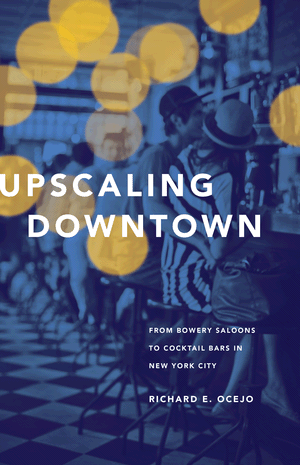
Last year Rich Ocejo published his book Upscaling Downtown, an excellent description of the changing bar scene in and around the Bowery/EV/LES, the nightlife pressure towards commercial gentrification and residential pushback against it. It's an important case history of a neighborhood in transition.
http://press.princeton.edu/titles/10396.html
While it's a great read -- he provides a broad view of the many divisions within the community and it's fun to recognize the many locals he interviewed -- the theoretical background assumptions inherited from the standard academic literature on gentrification occasionally undermine the specificity of the case history. This is not Ocejo's fault; it's the failure of the academic theorists.

It's assumed that because gentrified neighborhoods are preceded by artists and other marginal white misfits, that their presence causes gentrification. But if you look at the facts of history, you find a different and more complex story. When artists and marginals arrived in both the Bowery and the Lower East Side (including what's now called the East Village and Alphabet City), the neighborhoods continued to decline. The artists and misfits did not attract money or commerce. They attracted more misfits and artists.

To blame artists and marginals (Vietnam veterans, the homeless, substance abusers, prostitutes, ex cons, the chronically unemployed, lost youth) for gentrification on the grounds of having preceded gentrification is like blaming the rain on dry streets because dry streets precede rain. The academic theorists have invented a mechanism employing the classic fallacies -- confusing correlation with causation and post hoc ergo propter hoc. In their desperate search for a grandiose theory that will explain all instances, they've drawn hasty, blanket conclusions without looking carefully enough at the details and specificity of the context.

Unfortunately for the big theory, the Bowery attracted misfits for two centuries without seeing any gentrification. For most of those two centuries, it declined right up to 2005 with not a hint of gentrification. What changed the Bowery was city planning, in particular, the Chrystie Avalon complex. Not artists, not misfits, not wayward white youth slumming. City Planning: government.

The theory of gentrification comes to us from classical Marxism, a pre macro-economic theory. It attributes all to market forces and none to government intervention. It's certainly true that the accumulation of capital in excess of any market demand for productivity could be a pressure towards gentrification. But the avenues of speculation depend on what government incentivizes. Buying luxury apartments on Central Park South is the current means. But the gentrification of the LES did not begin with big capital. It started with small time investors. Big capital didn't want to take a chance on a crime-ridden, marginal neighborhood full of weirdos and resistant anarchists.
.....
The assumption has been that whiteness itself attracts money. So Ocejo calls whites who moved to Alphabet City in the mid to late 1970's "early gentrifiers," although for years they watched as their streets continued to decline replacing older residents with shooting galleries (for heroin users), drug dealers replacing families with growing children. More complicating, while these streets declined and buildings were abandoned, burned and the remnants demolished, other parts of the neighborhood were gentrifying. The early marginals and artists did not contribute to it. On the contrary, most of them had to be displaced in order for gentrification to spread. What drew gentrifiers to those parts of the neighborhood were their amenities -- a park view or in the case of Christodora House, spectacular panoramic views. Again, not artists, nor the artistic scene.

If you look through the NYTimes archive, you'll find stories from the Bowery 1880's, the years when it began its steep decline, stories about the death of a resident who lived as a pauper but was escaping from his wealthy family. The millionaire living like a pauper-in-rags is not an urban myth. These people lived on the Bowery and in neighborhoods like the LES. To call them early gentrifiers indicates that the theory has gone astray. The notion is incoherent -- it provides no principled distinction between white people who draw money and white people who repel it -- and it's falsified by history.

Again, contrary to Neil Smith's theory, the neighborhood did not decline in order for developers to buy them cheap, nor is there a universal cyclic law of neighborhood decline followed by redevelopment. The LES declined because it was abandoned by labor when public transit made it possible for labor to leave. It's not a grand conspiracy or a cycle of capital disinvestment. A neighborhood with money need never decline -- investors renovate the housing stock or redevelop it. Contrary to Smith, landlords don't seek disinvestment, although government does -- to create ghettos in a program of segregating races by "providing" affordable housing through the market. Here Smith is particularly incoherent: he sees renovation as a means of gentrification only after the neighborhood reaches rock bottom. He forgets that renovation was always an option.

The underpinnings of gentrification theory are constructed for the convenience of broad theories that ignore the specificity of place and the serendipity of technological, political, cultural and legal transformations. The most effective law of urban development is the law of unintended consequences. A close second is government.

Monday, January 11, 2016

Semiotic neighborhoods vs the authentic and antifragile: prestige and its deceptions and betrayals

(These remarks elaborate an informal presentation I gave as guest speaker at a Columbia University Urban Planning Master's Program class last year. I was asked to discuss Chinatown and the East Village as semiotic neighborhoods. The basic idea is that in ethnic enclaves, the commerce that serves local residents is more resilient than touristy commerce. 

Representations designed to broadcast identity for outsiders betray the people and culture that it purports to represent, so there's a correlation between broadcasting outside and economic fragility, as well as deception and betrayal. Authentic commerce, by contrast, doesn't represent and is antifragile -- it grows stronger in a crisis because the locals have more needs in a crisis, and the local commerce serve them. 

Nevertheless, prestige and respectability are measured in mainstream cultural standards, far from ethnicity and authenticity, and are by nature hypocritical -- invested in presenting and maintaining themselves as prestigious, respectable and mainstream, regardless of the real ethical and moral defects of the apparently respectable -- so authority, including many city planners, administrators, financiers, developers and local community opportunists, scorns and ignores the authentic stability of the enclave's economy, endangering the future of the enclave. Although an ethnic enclave can thrive and grow despite outside catastrophes like terrorist attacks, hurricanes and recessions, it is vulnerable and threatened by internal and external authorities seeking to gentrify it. Already gentrified neighborhoods seek representations of authenticity that betray the authentic roots of the neighborhood. They are stabilized by luxury commerce dependent on upscale trends.)

What is a semiotic neighborhood? Simply put, a neighborhood full of signs. Any commercial street will be lined with signs that draw to its consumers. Delancey Street signs draw to the low-income residents nearby. Times Square draws to an international tourism consumer, advertising the entire city -- that's why the signs are so large, so bright, on-the-pulse and sexy. The signs can be read as an indicator of the character of the consumer.

But semiotics of a neighborhood is not just commercial signage. There are no commercial signs on Park Avenue north of 59th Street, but the stone and stately architecture, the spareness and cleanliness of the streetscape, the absence of commerce, all send a message that this is both a residential neighborhood and a wealthy, exclusive one.

Semiotic neighborhoods can be divided among those that broadcast their signs outside the neighborhood, and those that look inward. Broadcasting neighborhoods use their signs to create an identity for outsiders, an identity they can easily read. It can be a bit of a contradiction: an ethnic neighborhood can broadcast an identity that belongs to the outsiders -- self-stereotyping -- instead of being authentically ethnic. The purpose of the identity after all is not to be authentic, but to draw customers. So notice that it's money that leads to the fakery and the fakery is a betrayal of its own.

Inward-looking neighborhoods have no such need to create such an identity. They are not pretending with a show of what they are. The commerce there simply serves the local community that already understands it for what it is -- theirs. Inward-looking neighborhoods are characterized by authenticity.

In the literature of semiotic neighborhoods, inwardly looking neighborhoods are not even considered as semiotic -- they don't try to speak to the general public or communicate using the broader language of the culture, the recognized stereotypes; the motivation of their signs are restricted to the needs of locals, with no thought of trying to impress anyone with an enhanced identity. Ironically, they have authentic identity -- because they're not trying.

Local-serving commerce has low costs, since the customers don't have to be enticed and brought to the door. The locals are a bit of a captive market. As long as the prices don't drive the locals to seek a better deal, the local commerce can rely on having its customer. When there's a crisis, even a catastrophe like 9-11 or Hurricane Sandy, the local commerce actually thrives. The local residents have more needs in a crisis, not fewer, and the residents are even more captive without transport. They must find their needs served locally.

While the authentic neighborhood tends to keep prices reasonably affordable (the customer is not entirely captive) broadcasting a neighborhood tends to raise prices. The intent of broadcasting is to surpass the profits available locally, otherwise it would stay local and not bother broadcasting at all, since broadcasting incurs advertising and presentation costs. And advertisement and image-creation must be ongoing to keep up with outside trends.

In a crisis, a semiotic neighborhood can be devastated.This happened in parts of Chinatown after 9-11. Mott Street, which had been outward-looking with antique stores and Chinese souvenir shops, lost many stores, and has only recently recovered.

East Broadway, the center of the recent immigration and lined with local-serving stores, has not been devastated in the wake of 9-11 or even the Great Recession. It's been crowded and bustling, the commerce vital and thriving.

To be continued...
See also in this series:
Prestige and distortion in Chinatown
Suits and betrayal in Chinatown
The Mobility Dilemma and the Clearinghouse Effect
Authenticity in the East Village

Friday, January 08, 2016

Should be interesting:

A rare opportunity to learn the labor perspective in Chinatown. And Peter Kwong is an authority on Chinatown. Sunday, Jan. 10, 3pm, 345 Grand Street at Chinese Staff and Workers Association.

Friday, August 23, 2013

Following up on the debate

Last night at the debate, candidate Jennifer Rajkumar cited this article at City and State. Chin responded by dismissing it as "just a blog."

The piece explains that the "affordable commercial space" that First American International Bank promised Chin in exchange for de-landmarking 135 Bowery is a fiction. There's no category of "affordable commercial space" in law or city zoning or land use or regulation or legislation.

But we already knew that. When FAIB and Chin presented to the City Council this promise of affordable commercial space they produced no contract, no written agreement, no letter, no email, no paper trail, no evidence, no document whatsoever. And, btw, the Council Committee, chaired by Brad Lander, didn't even ask about it. In other words, this was a favor to the councilmember that the council members all understood as a favor to the bank -- best not ask questions, just look away and nod assent.

And what contract could there be? How could it be enforced? What measure of affordability? How much under market-rate? How do you negotiate a give-back without getting an enforceable contract? Or even any contract?? The whole transaction was a fabric of malfeasance and cronyism.

Barron's article describes FAIB as a "Chinatown bank." But as I recall, when the bank demolished 135 Bowery, its headquarters were located in Queens, not in Manhattan's Chinatown. At a moment when Chinatown is threatened by outside capital, that's an important detail. The fact that FAIB is moving into Chinatown should not deceive anyone into thinking that they are now integral to the community. Having promoted and won the Chinatown BID and now begun developing in Chinatown, FAIB looks like the spearhead of Chinatown gentrification, an outsider preying upon the built neighborhood and its community.

It always annoys me to hear challenger-candidates mouth the empty promise formulas "If you elect me..." or "You need a councilmember who will...". I mean, after you explain how the incumbent has failed to negotiate effectively, mouthing these formulas are kind of an insult to the audience's intelligence. But in this case, it really is true that Margaret did such a poor job negotiating this deal, that you want to hear someone say, "I know how to negotiate, and I will negotiate for you."

Thursday, August 15, 2013

The rent gap: a logical gap

Neil Smith attempted a predictive theory of gentrification within a Marxist frame with a close examination of the phenomena in the US, particularly in NYC during the period since the word "gentrification" was coined around 1964 by Ruth Glass. Smith observes that when property values decline to its bottom, investors see an opportunity to buy low in the expectation of revalorizing the property to reach its potential. The rent gap -- the gap between the low rent of a devalued property and its potential -- opens an opportunity for capital to fill in.

The notion is at best post hoc predictive, which is to say, not predictive at all. Consider Detroit. Property values have declined, but the properties are not ipso facto an opportunity for capital to invest at the bottom under the assumption that the values can't go anywhere but up. A property's potential is not a determinable quantity.

Property potential depends on many factors: cultural or economic interest in the location; government subsidies or incentives; a housing crunch in upscale neighborhoods driving money to seek options in less upscale locations. Speculation is not one of those. Real estate has speculated on neighborhoods before without raising values. The construction of Harlem around 1900 is the most obvious case in point. Built for the wealthy, it didn't take hold and declined.

Gentrification might not be so much a reflex of capital as of policy, including zoning (creating a housing crunch, e.g.), incentives and subsidies. A too abstract economic view of gentrification will miss the role of government policies that reflect conflicting interests, especially where the owners of capital live.

One might say that as long as population grows, just about every location has a rent gap. But this does not imply that properties must decline before they achieve the gap. Neighborhoods can gentrify even if they have never declined. Glass coined the word to describe the spread of gentry, displacing and transforming working class neighborhoods. Working class neighborhoods are not all the result of decline. Some working class neighborhoods are built for the working class, and appreciate as the neighborhood grows more dense. That was certainly true of the LES in the 19th century.

The urban decline that Smith observes is more an effect of transportation than the age-decline that he attributes it to. The automobile and mass transit allowed the opening up of suburbia and the downward spiral of white flight in the 1950's and 60's.

Though it isn't stated explicitly, Smith's analysis predicts that Park Avenue should turn into the next slum. I think that's possible, but not because the buildings will age-out. Age does not entail decline. There are older buildings in Greenwich Village which attract even wealthier owners. If Park Avenue declines, it'll be because wealthy owners have been attracted to the single-family tenement. Park Avenue can't keep up with the scale of income inequality. The new New York will be full of these repurposed, culturally valued mansions that we are beginning to see in the EV. Three years ago, 47 E. 3rd was an aberration. Today there are four such single-family tenements here. Trends take a while and appear at first as insignificant. Give it time...

Friday, August 02, 2013

Margaret Chin, the developer's candidate

Margaret Chin is taking money from the Real Estate Board of New York's Political Action Committee. You'd want to ask, why would the founder of Asian Americans for Equality welcome large campaign support from real estate?

Affordable housing is built in NYC through incentives given to developers. So if you want to get any affordable housing here, you've got to welcome a market-rate developer, otherwise you get nothing.

Does that explain why Margaret voted for the NYU development (albeit curtailed)? Maybe. Does it explain why she voted for the Chinatown BID against widespread opposition within Chinatown? Maybe. Why she voted to help First American International Bank, the promoter of the BID, demolish and redevelop 135 Bowery?

The BID benefits larger property owners, larger businesses and developers and banks. But the small property owners and the small businesses are the anchor of Chinatown. At what point does a commitment to building new affordable housing sacrifice community entirely?

The city has shoved a wedge between affordable housing and community, turning affordable housing into a tool of gentrification and displacement. Look at Williamsburg. Chinatown next? The BID is a step towards the new Downtown Hotel District (DoHo?) formerly known as Chinatown.

From Crain's http://www.crainsnewyork.com/article/20130729/BLOGS04/130729878 about REBNY's funding of Chin's campaign

From City Council Watch, Seth Barron (writer for City & State) "Margaret Chin Progressively Awful"

Sean Sweeney in The Villager "The billionaires back Margaret Chin for City Council"

Monday, July 29, 2013

WNYC covers rent regulations

Adam Davidson, appearing on WNYC's morning "Brian Lehrer Show" discussion program, gave his strongest argument for rent deregulation without any analysis at all. Instead, he appeals to authority: economists on all sides agree that rent regulations are bad for the housing market and harm the middle class. 

True, economists agree on across-the-board rent regulations, but that's not New York's model. New units in NYC are not required to be regulated, so rent regulations here incentivize new construction. Deregulation would remove that incentive since raising rents and evicting tenants are cheaper and easier than construction. The New York model is actually healthy for the market.

Davidson refers to one economist, Christopher Mayer, but Mayer completely forgets that deregulated tenants don't simply disappear from the rental pool. If they have to vacate, they move from upscale neighborhoods into middle class neighborhoods and create a tighter market, raising rents there. So deregulation will hurt the middle class especially. In aggregate: 
deregulation = same # of units, same # of renters, just more wages going into rent, a windfall for landlords and no incentive to construct or ever ease the market. 

A land tax would help, tagged to upzonings in selected neighborhoods that can withstand increased development. 

Wednesday, July 24, 2013

The Times at it again

Rent regs in the Times again. Amazing to me that they can print baldfaced lies. 

This was empirically studied in Boston:  when rents were deregulated, all rents rose. 

Mayer's key assumption is false. When the deregulated renters vacate, they don't disappear -- they have jobs and family in the city. They move to cheaper neighborhoods where their numbers create a much tighter market in those lower-income neighborhoods, raising rents, displacing more renters who in turn move down the ladder creating a tighter market down the line.

So deregulation would raise rents steeply for the middle class and those below. The highest renters alone might get a break. Deregulation is a win for landlords and maybe the wealthiest renters, a lose for everyone else. 

Building new units will increase supply and ease market rates. Since new units are not required to be regulated in New York, our rent regulations incentivize new unit construction. Deregulation would end that incentive: raising rents and evicting tenants are cheaper than building new housing. Deregulation will likely raise rents steeply across the board while tightening the market even more, driving the middle class out to the further reaches of the metro area. Deregulation is a gift to landlords at the expense of nearly everyone else.

NYC's rent regulations are healthy for its housing market except it's deeply unfair for new arrivals. The state should really get back into housing of all kinds -- upscale to low -- using the upscale housing to finance the rest.

Tuesday, June 25, 2013

Rent regulations

Thinking about the construction boom and the Rent Guidelines Board rent hike, I went back to a piece I did for Met Council refuting the claim that rent regulations artificially raise market rate rents. The key insights were two: 1) in New York, newly constructed apartments are not required to be regulated, so regulation doesn't add to the tight housing market (in fact, rent regs are one of the few incentives to construct in NYC); 2) deregulation doesn't flood the market with new apartments since evicted tenants don't leave the local pool of renters, and wherever they go they tighten the housing market there, displacing lower-income renters. 

Looking back, I'd want to explain explicitly why it is that displacement always shifts downward, and not just a musical chairs of apartments among renters. Deregulation eviction implies that the tenant can no longer meet the high market-rate rent. In a tight housing market, if they go to a lower-income neighborhood, they will find an apartment by displacing someone who was renting at a lower rate. The displaced renter does the same in the next lower-income neighborhood and so on.

[Update: on second thought I think I was right in the original, not as in the paragraph immediately above. Obviously deregulation evictions out of prime locations also allow high renters to move upward -- upward displacement. That displacement doesn't ease market rates: the evicted have created a tighter market down the line. On the other hand, if new upscale renters are entering the market from outside the pool, they would increase downward displacement pressure.]

Some of those deregulation-evicted tenants can pay higher rents than they'd been paying under regulation, just not quite as high as the market rent where they'd been. No one will seek a cheaper apartment -- if there was something cheaper suitable to them they'd have decamped long before deregulation. But some will seek apartments somewhat more expensive than what they'd been paying under regulation. So the only change in the economic equilibrium is the added funds available for rent among the deregulated. 

At the end of the day, deregulation increases the aggregate funds available for rents taken from whatever else the regulated tenants had been spending on in the economy. All of that increase goes to the landlords. Deregulation is just a pointless shift from the non real estate economy to landlords and a downward spiral of displacement, while more upscale renters flow into the city to raise the luxury rates. With more funds flowing into the real estate market, developers construct to meet those upscale renters, who then recreate the commercial economy in their own image, buying upscale items. 

So rent regulation is just a restriction on upscale real estate speculation and upscale commerce. It doesn't raise market rate rents, but actually dampens them. And it's good for non upscale commerce.

So here's the article. The point about the rent pool seems to have grown legs -- I've heard it repeated by lawyers as well New Yorkers on the street. 

Why Rent Regulations Don't Raise Market Rents 


Published: 
June 2011


"If rent decontrol would mean a fairer, less insane market, then it is a just cause," the libertarian-conservative Cato Institute argues.

In every debate over rent regulations, someone—often an angry tenant paying outrageous rent—argues that regulations are responsible for pushing market-rate rents way up. If those regulated rents were brought into the free market, the market would level down, allowing a fair rent for all.

This argument has had wide currency among conservatives in their effort to undermine rent regulation and promote developers and landlords, the market suppliers in the real-estate industry. It appeals directly to people who, bitter over their heavy rent burden, welcome a convenient scapegoat: their own neighbors. And the authority, the landlord, is conveniently exculpated.
This argument is false. It is based on these premises:
1) Rent regulation discourages housing construction, restricting housing availability;
2) landlords make up their losses on regulated rents by gouging market-rate renters; and
3) deregulation would level the playing field, lowering high rents

Its conclusions have been demonstrated to be empirically, factually untrue. It is time to put this claim to rest.

Let's start with the basics. Not only conservative think tanks like the Cato Institute, but the consensus of economists, even the liberal Paul Krugman, accuse rent regulation of discouraging new housing construction. Without new apartment units, the supply can't keep up with demand, and fierce competition for the few remaining units pushes market rates up.

Their observations are true where rents for new construction are regulated. But in New York, it isn't.

New construction is exempt from rent regulation in New York. Building new affordable housing is entirely voluntary in New York, and developers only provide it where the city gives them special incentives, such as allowing construction beyond the zoning restrictions or giving tax breaks. In fact, rent regulation encourages new construction, as the Citizens Budget Commission has pointed out, since new units can garner far higher rents than older regulated units. If landlords can't cash in on regulated units, the only other means to make money is to build new, unregulated units. Rent regulation is an incentive for construction.

The difficulty of building in the city has many causes—the cost of land and construction, restrictive zoning laws, building codes, permits and bids, and, not least, the private and political graft involved. Nevertheless, New York continues to see housing construction. Even during the recession year of 2008, the city issued 33,911 permits for new housing, the greatest number since 1972. In a city of obstacles to construction, rent regulation is one of the few encouragements to build.

The second premise contends that if landlords can't raise regulated rents, they will raise rents on unregulated units to make up for the lost revenue. Unfortunately for the landlords, the free market doesn't work that way.
Market rates depend on renters' willingness to pay, not on owners' costs or losses. Rents can't rise above what renters are willing and able to pay, and the nature of the profit motive ensures that market-rate rents will rise exactly to that level of renter willingness, regardless of what other renters are paying.
In a city where construction lags behind demand, it may be legitimate to ask whether deregulation would free up apartments and ease the market down—the third false premise. Quite aside from the consequences of displacing individuals or even whole communities, the answer is a surprising no.

Rent deregulation, believe it or not, raises market-rate rents. The conservative Manhattan Institute, in its 2003 study of deregulation in Cambridge, Massachusetts, found that, following deregulation, landlords invested in improvements to attract the highest possible market-rate renters. The result of the 1994 deregulation in Massachusetts has been better-quality housing, but higher market rents across the board.

That shouldn't be surprising. A tight housing market implies that many renters can't find apartments in their preferred locations. That's the meaning of a housing crunch. Renters can't find the spaces they want, and the ones they have to live in become overpriced. But when vacancies appear, those renters are willing to pay exorbitant rents for the locations they prefer, and landlords will meet their willingness.

The market value depends on three general factors: demand, supply, and the aggregate available funds for rents. If regulated renters are paying less than their available rent funds (the excess of which presumably goes into the goods and services economy), when they are forced to pay more, it will increase the aggregate funds going to landlords as rents, since most of those renters are tied to the metropolitan area by work, family, or preference. If their rents are deregulated, these people will force rents up wherever they go in the metropolitan area.

That's a recipe for disaster. When renters can't afford their location as a result of deregulation, they move to lower-rent neighborhoods, where they create a tighter rent market, raising the rents there and even gentrifying the area. Some of the longtime renters in those neighborhoods will be priced out and move to even lower-income neighborhoods, tightening those locations in turn.

More affluent longtime renters will see their rent increases as an opportunity to move to a more desirable location. But wherever they go, landlords will raise their rents as high as they are willing to pay. If the market is tight and people are not leaving the metropolitan area, the market rates will remain high.

Market rates only go down if demand goes down—if people leave the city entirely or excess housing is built. But New York's population is increasing, not decreasing, and construction is costly and difficult. Deregulation here will not ease the market any more than it did in the Boston area.

It's not even certain that in a tight market like New York, landlords would invest widely in improvements, as they did in Boston and Cambridge. Unregulated renters have few rights, so if they complain to the city about lack of services or repairs, the landlord can retaliate by refusing to renew their lease when it expires. Regulated renters can compel repairs without that fear. So it is possible that deregulation in a tight market would result in lowered quality of housing and a degrading of services, as well as higher market rents. That's exactly what happened in New York when vacancy decontrol was imposed in 1971.

Regulated rents actually help to depress market rates. Renters who pay exorbitant rents may think it's unfair that regulated tenants pay so much less than they do, but the source of exorbitant rents is not regulation. It is landlords' profit motive and New Yorkers' desire to live here. We are the market that sustains high rents.

So what is the effect of deregulation? It provides a cheaper means of placing money into landlords' hands than construction does. The chief effect of deregulation is an increase in the aggregate funds available for rents. It doesn't ease the market, it won't improve the quality of housing in New York, and it won't create more housing. It will give more money to landlords, it will raise rents all over the city, and it will wreak havoc on communities as markets are tightened even in low-income neighborhoods, causing a spike in gentrification and displacement.

Rent regulation does create an unfairness—the lucky get to spend their money on the local economy, not just on rent, while their market-rate neighbors have to suffer. But forcing everyone to suffer doesn't solve the suffering of the overpriced. It just makes life worse for everyone. Two wrongs don't make a right. Deregulation is a lose-lose. 

Monday, June 24, 2013

Boomtown

Matt Yglesias comments on US cities leading in construction spending. New York is not only way ahead, it's an outrider way ahead (though not quite at a Pareto distribution -- construction is expensive here, so that may be why there's no Pareto), and it's not correlated (pace Yglesias) with population; LA is next most populous, Chicago, then Houston, all on a Pareto distribution, but LA is low on construction; Dallas is constructing more than Houston even though Dallas doesn't have much more than half Houston's population size. In fact Dallas is about one seventh the size of NYC, but it's constructing at the absolute rate of 60% of NYC's.

In any case, NYC is booming. Given the high cost of construction in NYC, this boom means developers see huge money in development. How much of that do you think is affordable housing?

It also means that developers are not worried about diluting the luxury market. Why? Do they expect high-renters/owners to abandon older housing stock to move into new? Or locations further from the center into closer? Either of those would be good news for low-income neighborhoods -- less displacement pressure on them. But if developers simply expect more high-paying population in the city, then no one benefits but the developers.


Friday, June 21, 2013

AALDEF publishes new data on Chinatown land use

From AALDEF (Asian American Legal Defense and Education Fund): 
[scroll down for the pdf of the study]

June 21, 2013 – The Asian American Legal Defense and Education Fund (AALDEF) is releasing land use data on New York City’s Chinatown, as a preview of its forthcoming three-city study of Chinatowns and surrounding areas in Boston, New York, and Philadelphia.

"We have assembled data on the make-up of small businesses and properties in Chinatown that will enable us to document the effects of gentrification on Asian immigrants, who have been fighting for their community for decades,” said Bethany Li, staff attorney at AALDEF.

AALDEF, in collaboration with community partners, academic institutions, and hundreds of volunteers, spent a year recording block by block and lot by lot the existing land uses in Boston, New York, and Philadelphia Chinatowns and surrounding immigrant areas. Today’s initial release of land use data, combined with detailed analysis of Census data from the 1980s, provides a snapshot of the existing uses of New York’s Chinatown and describes its startling transformation in the past three decades.

New York’s Chinatown has served as the gateway for thousands of immigrants from Asia and is home to a thriving network of low-income residents and small businesses. However, property values in Lower Manhattan have increased substantially, and gentrification is threatening the neighborhoods’ historical and cultural significance. According to Census data, the overall population in New York’s Chinatown decreased 7% between 1990 and 2010 (from 125,574 to 116,722 people) due largely to the increase of non-family households and a decrease in family households -- a significant indicator of gentrification. As a result, many Asian immigrants face the prospect of displacement.

For example, AALDEF's study indicates that an overwhelming majority of commercial use in New York’s Chinatown consists of small businesses (94%), approximately 12% of which is classified as “high-end.” However, our survey shows that the most significant cluster of “high-end” businesses is in the area between Houston and Delancey Streets, where students and young professionals have displaced immigrant families in the past decade. "High-end" stores also dot the landscape along Allen and Orchard Streets heading towards more traditional parts of Chinatown.

“Gentrification threatens to transform these previously neglected neighborhoods into tourist centers and destroy the places where Asian immigrants have lived and worked for decades,” said Li. “We hope this data can be used to support organizing and planning efforts that help retain resources for New York’s Chinatown for current and future immigrants.”

This data was collected with the assistance of AALDEF’s community partners including Chinese Progressive Association and Boston Chinatown Neighborhood Center in Boston, Chinese Staff & Workers’ Association in New York, and Asian Americans United in Philadelphia. The University of Pennsylvania’s City and Urban Studies Department provided technical assistance on mapping and data analysis.

Contact: