Showing posts with label urban planning. Show all posts

Friday, February 05, 2016

Collusion between gov't, developers and tenant advocacy non profits

By using zoning to limit developable space, and allowing that space to be bought and sold, gov't created property literally out of thin air -- out of the words of the zoning text. By creating a market the raw resource of which was created by the gov't, gov't could exert influence, manipulate and extort from developers. If a developer wanted more space than was available in the zoning, he had to go beg it of gov't, and gov't could grant the additional space for a favor. This market was the beginning of the end of gov't directly building affordable housing and instead drawing the developer into building it for the public.

Housing projects were widely viewed as a failure. A new generation of planners followed Jane Jacobs' broad criticism of tower-in-the-park construction, which she viewed as anti-urban, generating wastelands of non commercial, semi-abandoned and dangerous, isolated space. The reality was more complex. After all Stuyvesant Town is a housing project but no one complains that it's a failure. If anything, it's become to successful, too attractive as its management tries to replace older tenants with tenants eager to pay much higher rents there. But Stuy Town was middle-income, well maintained, with residents who were also well served by gov't and the economy in many ways. The low-income housing projects relied on inadequate gov't funding streams and the community was consistently underserved whether by the education system for its children or the employment opportunities for its parents, health services, sanitation and the maintenance of the grounds. If it failed, it failed because of the lack of social and financial investment in the human capital of the community. But that failure could easily be dressed up instead as a failure of urban and architectural planning and design.

Zoning incentives replaced housing projects. Developers would be given additional space to develop in return for building a modest percent of affordable housing that would be managed by a non profit tenant advocacy group. This model brought together gov't, developers and affordable housing non profits: gov't offered bulk space incentives to the developers while giving the non profits funding to manage the affordable housing. The developers needed to cooperate with both gov't and the non profits. And critically, the tenant advocacy groups were now compelled to work with and for both gov't and developers. 

In order to obtain affordable housing, the tenant advocacy non profits had to sell upzonings to their community, otherwise the non profit wouldn't get the affordable housing or their funding from the gov't. Since the affordable housing brings with it market-rate development, the result is gentrification, investment, opportunity for more investment and a feeding frenzy of tenant harassment. At the end of the day, affordable housing through zoning nets a loss of affordable housing. And since the affordable housing is given to people who are not currently living in the neighborhood, to call this "community preservation" is Orwellian doublespeak. 

Those in the community who are aware of the consequences of the affordable cooptation of the non profits, are placed in the ugly position of having to protest affordable housing. The gov't has effectively driven a wedge between affordable housing advocates and anti-gentrificationists by this Sophie's choice dichotomy of affordable housing (+market-rate housing) or else no development (+no new affordable housing). 

If you go to a City Planning hearing you can see the wedge in living color. The state-funded affordable housing non profits arrive with their employees and clients -- the tenants they work with in their tenant advocacy -- all in bright orange or yellow T-shirts. They don't testify, since they are brought to the hearing to pad the audience. Their leaders testify in favor of the upzoning on the grounds that it will bring affordable housing to the community. The rest of the audience is comprised by ordinary residents dressed all diversely, unorganized and unfunded. They do testify, one by one. They testify against the upzoning, expressing their concern about gentrification and community displacement. The Planning Commission ignores them because the city wants development -- it's revenue for the city. The people lose, and the sham continues. 

Tuesday, February 02, 2016

Talking this Sunday at OWS Altbank (Alternative Banking) Group on zoning and displacement

I'll be giving a talk on zoning, its consequences and how it plays out in local politics. Here's a brief outline.

The Amenties Dilemma

I'll be starting with what I call the "amenities dilemma": whenever some amenity that improves the quality of life is brought into a low-income neighborhood or ethnic enclave, whether it's better plumbing or a nicer sidewalk, it raises real estate values and attracts investment. It's not just a quantity of money that flows into the neighborhood, but the color of money, which is not green. Money in America is white, and it has an affinity as well as a color: it's drawn to more whiteness. Any improvement in a low-income neighborhood tends to whiten it and drive out the color. It's called gentrification and its consequence, community displacement.

Why should money harass the color out of a neighborhood? Is it greedy maximization of profit?

I dislike the use of "greed" as an economic explanation. It implies that there are some defective people who are to blame for what's wrong in the world. That sort of psychological essentialism -- some people are greedy, others not -- leads to a misunderstanding of how economies and societies work, and leads away from any meaningful solutions to its problems. What we call greed may be less affective, personal or psychological than mere opportunity. If there is no opportunity to make money out of some place, thing or person, people are pretty chill about that person, place or thing. It's when there's some kind of opportunity to gain from a place, person or thing that the feeding frenzy begins.

When the Lower East Side was an abandoned slum, it took my landlord eight months to bother to try to evict me for non payment, because the rent was so low that getting the rent or replacing me with another low renter was hardly worth the trouble. Today if I am five days late with my rent, the landlord files eviction proceedings and assesses a late fine onto my rent. Where there's money to be made, the pressure becomes irresistible and fierce.

The amenities dilemma -- leaving the ghetto in poverty preserves the community but ensures their poverty, while improving the ghetto just shifts the community to a new place of poverty (the dilemma was observed way back by Friedrich Engels in his "The Housing Question")  -- is the big problem for zoning designed to create affordable housing. That's what the talk is mostly about. But first I want to look at how zoning came about, what its goals were and are, and how it works.


The origin of zoning

In 1915, Equitable Life built an office tower designed to be the largest such space in the world. Taking up a huge lot, the building rose straight up 38 stories, casting a shadow a quarter of a mile. This was a time before Wall Street was covered with skyscrapers. The buildings there were much more modest and natural light was still available. Commercial buildings were structured to use natural light. Cast iron, favored for commercial buildings, allowed maximal window coverage with minimal structural support. The Equitable Building's shadow instantly depressed real estate values all around it. Landlords and real estate speculators throughout the city were terrified and infuriated, not just over the building, but the possibility that other corporate giants would build near their lots. The real estate industry demanded that the city respond with a permanent fix so that this never happen again.
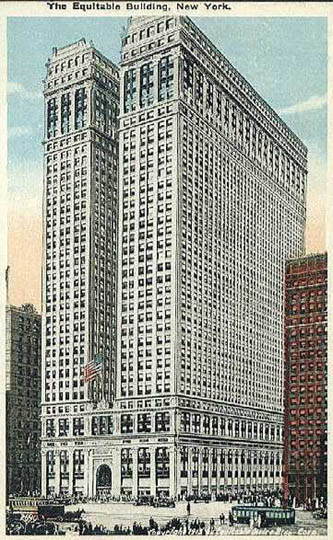
The very next year the city implemented its first zoning law. Note that the city responded immediately. The disastrous 1879 Tenement Housing Act that created dangerous and unsanitary conditions in the ghetto wasn't fixed for twenty-two years. Zoning took a matter of months. The difference? Money and investors vs immigrant labor. Note also that the housing need for the ghetto was dangerous and unsanitary structural designs inducing life-threatening diseases and fire; the needs of the real estate industry were investment.

The zoning had two new requirements. One was a restriction on types of uses so that factories couldn't be built along residences. Factories bring noise and stench and worse, laborers, who are also noisy and smelly that destroy the real estate value of a residential neighborhood. The city came up with the idea of creating residential zones where commerce was allowed but not manufacturing. There'd also be commercial zones where some residences were allowed, and manufacturing zones where manufacturing and some commercial buildings but not residential buildings could be built.

The second idea was a design innovation. Any tall building had to attenuate -- as it grew higher, it had to be more slender. The idea was to prevent the skyscraper from blocking out all the sunlight, while still allowing developers to build big to cash in on rental space. This requirement of attenuation is easily visible in the most familiar and identifiable NYC skyscrapers. The Empire State Building took its design not from any fashion, but from the strictures of the law. In fact, the real estate industry hired an architectural draftsman, Hugh Ferriss, to interpret the legalese to the architects.

These gradual attenuations are called setbacks.

Both of these innovations were specifically designed to protect the interests of real estate industry -- landowners and developers.

Next up, tower-in-the-park zoning, modernism -- design with a social conscience and unintended consequences -- and developmental rights or how gov't creates property and value for the landowner out of thin air.

Monday, January 25, 2016

De Blasio's difference

For the last decade, the progressive left has been begging for a mandatory inclusionary housing program in New York City requiring that all new residential buildings include a quantity of affordable housing. The mayor has proposed exactly such a plan. The community boards and the progressive left have rejected it. Why?

First, compare the mayor's plan with the Bloomberg model of inclusionary zoning. Bloomberg rezoned 120 neighborhoods in the city. Each one contained significant upzonings -- greater allowances for larger buildings, a give-away to developers. In addition to the upzoning give-away, Bloomberg offered developers the option to build even more space if a portion included affordable housing. Usually the bonus -- the added market-rate housing that the developer could build above the affordable component -- wasn't enough for the developer to bother with, so they didn't.

However, affordable housing non profits, which manage the affordable housing component and get their funding for doing it, and whose mission is to create or promote the creation of affordable housing, were the advocates for the inclusionary program. So you'd see the irony of progressive community-based non profits selling development and upzoning to the communities with the promise that the affordable housing would benefit the community. Carefully not mentioned was that the development would raise real estate values, the market rate housing attract more money, and landlords, seeing an opportunity to cash in on the upscaling of the neighborhood, would harass tenants in a thousand ways, and the result would be community displacement and a net loss of affordable housing, particularly steep if the developers didn't even bother with the inclusionary bonus.

Of course, the affordable housing wasn't for the community in the first place. The housing was delegated by raffle, and the housing wasn't often affordable to the locals anyway. So this model of community stabilization or preservation was what I call the Invasion of the Body Snatchers model of community preservation. The community is replaced with other individuals who purport to be just like them with respect to income. But they are not the community. And since the housing isn't affordable to the prior community, it's not even Body Snatchers, it's just wholesale snatching.

Mandatory IZ doesn't solve this conflict between the creation of affordable housing through development and gentrification/displacement. That's one reason why the community boards haven't cottoned to it. But you'd think that the progressive non profits would still be advocating for it. And here's a big difference in the structure of the mayor's proposal. Instead of rezoning neighborhoods one by one, his proposal changes the zoning law itself, so the city would be upzoned automatically without any further process. Community boards would have little say and the non profits would be left out as well.

Under Bloomberg, it was possible for the communities to ask for additional perks in the form of funding for the non profits -- legal services to help evicted tenants, for example. Under de Blasio's proposal, there's no opportunity for the community to leverage such additional funding.

More important, the de Blasio proposal doesn't kick in until there's an upzoning, so in effect, his proposal is just as voluntary as the Bloomberg model. With a little difference: since developers, prior to any upzoning can develop now without including affordable housing, we should expect them to lose interest in upzonings. It has been well observed that mandatory inclusionary housing has this kind of dampening effect on development. We should expect to see the non profits still advocate for upzonings, and less upzoning advocacy from the developers.

The Bloomberg model placed the developer in the drivers' seat, drawing the non profits onto the developers' bus for the sake of the affordable housing and their legal services funding, while they all throw the community under the very bus they're driving. De Blasio's model takes the developer out of the driver's seat, leaving the non profits on a bus going nowhere.

The irony is even more stark -- we should expect to find that the only people advocating for upzoning, gentrification and displacement would be the progressive non profits under the new model.

Tuesday, January 19, 2016

Artists don't cause gentrification

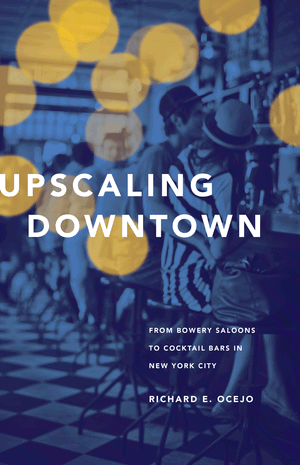
Last year Rich Ocejo published his book Upscaling Downtown, an excellent description of the changing bar scene in and around the Bowery/EV/LES, the nightlife pressure towards commercial gentrification and residential pushback against it. It's an important case history of a neighborhood in transition.
http://press.princeton.edu/titles/10396.html
While it's a great read -- he provides a broad view of the many divisions within the community and it's fun to recognize the many locals he interviewed -- the theoretical background assumptions inherited from the standard academic literature on gentrification occasionally undermine the specificity of the case history. This is not Ocejo's fault; it's the failure of the academic theorists.

It's assumed that because gentrified neighborhoods are preceded by artists and other marginal white misfits, that their presence causes gentrification. But if you look at the facts of history, you find a different and more complex story. When artists and marginals arrived in both the Bowery and the Lower East Side (including what's now called the East Village and Alphabet City), the neighborhoods continued to decline. The artists and misfits did not attract money or commerce. They attracted more misfits and artists.

To blame artists and marginals (Vietnam veterans, the homeless, substance abusers, prostitutes, ex cons, the chronically unemployed, lost youth) for gentrification on the grounds of having preceded gentrification is like blaming the rain on dry streets because dry streets precede rain. The academic theorists have invented a mechanism employing the classic fallacies -- confusing correlation with causation and post hoc ergo propter hoc. In their desperate search for a grandiose theory that will explain all instances, they've drawn hasty, blanket conclusions without looking carefully enough at the details and specificity of the context.

Unfortunately for the big theory, the Bowery attracted misfits for two centuries without seeing any gentrification. For most of those two centuries, it declined right up to 2005 with not a hint of gentrification. What changed the Bowery was city planning, in particular, the Chrystie Avalon complex. Not artists, not misfits, not wayward white youth slumming. City Planning: government.

The theory of gentrification comes to us from classical Marxism, a pre macro-economic theory. It attributes all to market forces and none to government intervention. It's certainly true that the accumulation of capital in excess of any market demand for productivity could be a pressure towards gentrification. But the avenues of speculation depend on what government incentivizes. Buying luxury apartments on Central Park South is the current means. But the gentrification of the LES did not begin with big capital. It started with small time investors. Big capital didn't want to take a chance on a crime-ridden, marginal neighborhood full of weirdos and resistant anarchists.
.....
The assumption has been that whiteness itself attracts money. So Ocejo calls whites who moved to Alphabet City in the mid to late 1970's "early gentrifiers," although for years they watched as their streets continued to decline replacing older residents with shooting galleries (for heroin users), drug dealers replacing families with growing children. More complicating, while these streets declined and buildings were abandoned, burned and the remnants demolished, other parts of the neighborhood were gentrifying. The early marginals and artists did not contribute to it. On the contrary, most of them had to be displaced in order for gentrification to spread. What drew gentrifiers to those parts of the neighborhood were their amenities -- a park view or in the case of Christodora House, spectacular panoramic views. Again, not artists, nor the artistic scene.

If you look through the NYTimes archive, you'll find stories from the Bowery 1880's, the years when it began its steep decline, stories about the death of a resident who lived as a pauper but was escaping from his wealthy family. The millionaire living like a pauper-in-rags is not an urban myth. These people lived on the Bowery and in neighborhoods like the LES. To call them early gentrifiers indicates that the theory has gone astray. The notion is incoherent -- it provides no principled distinction between white people who draw money and white people who repel it -- and it's falsified by history.

Again, contrary to Neil Smith's theory, the neighborhood did not decline in order for developers to buy them cheap, nor is there a universal cyclic law of neighborhood decline followed by redevelopment. The LES declined because it was abandoned by labor when public transit made it possible for labor to leave. It's not a grand conspiracy or a cycle of capital disinvestment. A neighborhood with money need never decline -- investors renovate the housing stock or redevelop it. Contrary to Smith, landlords don't seek disinvestment, although government does -- to create ghettos in a program of segregating races by "providing" affordable housing through the market. Here Smith is particularly incoherent: he sees renovation as a means of gentrification only after the neighborhood reaches rock bottom. He forgets that renovation was always an option.

The underpinnings of gentrification theory are constructed for the convenience of broad theories that ignore the specificity of place and the serendipity of technological, political, cultural and legal transformations. The most effective law of urban development is the law of unintended consequences. A close second is government.

Thursday, January 14, 2016

The MobilityDilemma and the Clearing House Effect

The Asian American Federation, the group that studied Chinatown businesses I mentioned a couple of posts ago, also studied Asian poverty in New York City. Their policy recommendations point up what you might call the mobility dilemma: efforts to increase upward mobility run the risk of displacing their target populations. Here is one of their policy recommendations:

Economic development efforts in enclave economies that encourage a diversified, vibrant business community rather than a hypercompetitive, low-margin, narrow economy would help stabilize the local economy and raise wages and labor standards. 

By "diversified" they mean non local serving businesses: semiotic, outward-looking commerce -- in a word, tourism. To upscale a local-serving produce stand into a high-end restaurant -- necessarily non-local serving since the locals cannot afford it -- will allow, if successful, higher wages for the waiters (if the manager doesn't steal the tips, a wide-spread practice as I've mentioned). But it also crowds out local-serving commerce and attracts more upscale outward-looking commerce. As prices and profits rise, so do real estate values. Soon the neighborhood is in demand from outside and landlord pressure to harass and evict locals increases. Gentrification displaces the local community.

The dilemma is parallel to the urban amenity dilemma: every material improvement in a low-income neighborhood attracts investment that eventually gentrifies and displaces the low-income community. The two horns of the dilemma both seem unacceptable: remain in poverty or be displaced to poverty elsewhere.

The AAF policy recommendation seems to ignore the historical clearing house dynamic of Chinatown. Immigrants arrive there, work hard for several years, spend frugally, save resolutely, then leave for a prettier neighborhood. Upscaling Chinatown may provide higher wages for a few, but it eliminates it as a first destination for new immigrants.

New immigrants most need work they can assume immediately and housing that is extremely cheap so they can both earn and save. AAF concludes that "Making affordable housing more available is critical to alleviating poverty." But current affordable housing programs are all geared towards permanent housing, too expensive for the needs of new immigrants. Only transient housing meets the demand in an immigrant first destination. Permanence is unnecessary and too expensive.

Chinatown today is divided between two communities, one immigrant and transient, another American-born and permanent. Current affordable housing models would change Chinatown into all permanent, but the mobility it provides for the low-income immigrant is not upward, but outward, so the problem is not solved, in Engels' famous words in The Housing Question, "they are merely shifted elsewhere."
See also in this series:
Semiotic neighborhoods vs the authentic and anti-fragile: prestige and its deceptions and betrayals
Prestige and distortion in Chinatown
Suits and betrayal in Chinatown
Authenticity in the East Village

Tuesday, January 12, 2016

Prestige and distortion within Chinatown

The Asian American Federation, a social services and research non profit highly regarded within Chinatown, published a study of Chinatown in 2008 in which they found that East Broadway, the center of recent Fujianese immigration and a low-income area, was one of the most resilient, vibrant and successful parts of Chinatown, while much of the rest of the neighborhood was ailing commercially. Yet the study's recommendations completely disregard its findings of fact. Their recommendations all favor tourism with no recommendations that support the ethnic community.

Most telling are the recommendation that waiters learn more English (useless for local-serving restaurants), and the absence of any recommendation that managers stop stealing waiters' tips, a wide-spread practice among restaurant owners in Chinatown. Stealing tips removes the most easily available incentive reward for waiters to improve services like learning English. Without tips for improved service, AAF's recommendation burdens the waiter entirely. The bias in favor of management is evident: compel the waiter to learn English but still take his tips. There isn't even a recommendation for free or supported English lessons.

The power of prestige and respectability is pervasive. Growth is viewed as outward-looking towards an upscale mainstream culture, not expanding and supporting the base. So, for example, here are their findings of fact:

A number of changes in the mix of residents in Chinatown also has altered the customer base for Chinatown businesses. Over the past 20 years, growth of the Fujianese population in Chinatown, due to new immigration patterns, has generated demand for businesses supporting their food, entertainment and service preferences. Newer Fujianese-owned businesses have sprung up along East Broadway.... A lack of nightlife in Chinatown also makes it difficult for restaurants to attract evening business, and garment-industry job losses and relocations have reduced restaurants’ traditional customer base. However, restaurants catering to Chinatown’s growing Fujianese population report brisk business.... The decline in the garment industry has decreased measurably the daytime population in Chinatown, a key component of the traditional customer base.  As this traditional customer base shrinks, the growth in Chinatown’s Fujianese population and the influx of non-Chinese and some returning Chinese immigrants and retirees have created a demand for products and services catering to these markets. 
 And their conclusions:
A general lack of customer service reduces the appeal of shopping and dining in Chinatown. Limited English capabilities of staff make it challenging for people who do not speak Chinese to patronize Chinatown businesses. Gruff service from a few businesses hurts the image of all Chinatown establishments. Many stores and restaurants operate on a cash basis, which discourages those customers
 The customers mentioned are tourists with credit cards, not local recent immigrants. And "image" is a problem looking to outsiders, not to locals. The sole source for this claim of gruff service and bad image comes from the Zagat Guide -- a restaurant guide published in English for English-speaking customers. There is no Mandarin, Fujianese or  Cantonese Zagat for New York. If you look through all their recommendations, you'll see that they are equally outward, not inward, looking. And this is characteristic of many such studies of Chinatown. Whether they are positioning Chinatown non profits to obtain government funding for development or attracting private sector investment, they ignore the economic base and their recommendations threaten them with unstable, fragile commercial gentrification.

Image and money are tied together. Semiotic neighborhoods pretend with an image for sale, much as a suit allows its wearer to pretend to an image of respectability. The base of the economy is disregarded, dismissed and invisible.

Next: semiotics and deception among the suits in Chinatown, and the struggle up from the bottom.

See also in this series:
Semiotic neighborhoods vs the authentic and anti-fragile: prestige and its deceptions and betrayals
Suits and betrayal in Chinatown
The Mobility Dilemma and the Clearinghouse Effect
Authenticity in the East Village

Monday, January 11, 2016

Semiotic neighborhoods vs the authentic and antifragile: prestige and its deceptions and betrayals

(These remarks elaborate an informal presentation I gave as guest speaker at a Columbia University Urban Planning Master's Program class last year. I was asked to discuss Chinatown and the East Village as semiotic neighborhoods. The basic idea is that in ethnic enclaves, the commerce that serves local residents is more resilient than touristy commerce. 

Representations designed to broadcast identity for outsiders betray the people and culture that it purports to represent, so there's a correlation between broadcasting outside and economic fragility, as well as deception and betrayal. Authentic commerce, by contrast, doesn't represent and is antifragile -- it grows stronger in a crisis because the locals have more needs in a crisis, and the local commerce serve them. 

Nevertheless, prestige and respectability are measured in mainstream cultural standards, far from ethnicity and authenticity, and are by nature hypocritical -- invested in presenting and maintaining themselves as prestigious, respectable and mainstream, regardless of the real ethical and moral defects of the apparently respectable -- so authority, including many city planners, administrators, financiers, developers and local community opportunists, scorns and ignores the authentic stability of the enclave's economy, endangering the future of the enclave. Although an ethnic enclave can thrive and grow despite outside catastrophes like terrorist attacks, hurricanes and recessions, it is vulnerable and threatened by internal and external authorities seeking to gentrify it. Already gentrified neighborhoods seek representations of authenticity that betray the authentic roots of the neighborhood. They are stabilized by luxury commerce dependent on upscale trends.)

What is a semiotic neighborhood? Simply put, a neighborhood full of signs. Any commercial street will be lined with signs that draw to its consumers. Delancey Street signs draw to the low-income residents nearby. Times Square draws to an international tourism consumer, advertising the entire city -- that's why the signs are so large, so bright, on-the-pulse and sexy. The signs can be read as an indicator of the character of the consumer.

But semiotics of a neighborhood is not just commercial signage. There are no commercial signs on Park Avenue north of 59th Street, but the stone and stately architecture, the spareness and cleanliness of the streetscape, the absence of commerce, all send a message that this is both a residential neighborhood and a wealthy, exclusive one.

Semiotic neighborhoods can be divided among those that broadcast their signs outside the neighborhood, and those that look inward. Broadcasting neighborhoods use their signs to create an identity for outsiders, an identity they can easily read. It can be a bit of a contradiction: an ethnic neighborhood can broadcast an identity that belongs to the outsiders -- self-stereotyping -- instead of being authentically ethnic. The purpose of the identity after all is not to be authentic, but to draw customers. So notice that it's money that leads to the fakery and the fakery is a betrayal of its own.

Inward-looking neighborhoods have no such need to create such an identity. They are not pretending with a show of what they are. The commerce there simply serves the local community that already understands it for what it is -- theirs. Inward-looking neighborhoods are characterized by authenticity.

In the literature of semiotic neighborhoods, inwardly looking neighborhoods are not even considered as semiotic -- they don't try to speak to the general public or communicate using the broader language of the culture, the recognized stereotypes; the motivation of their signs are restricted to the needs of locals, with no thought of trying to impress anyone with an enhanced identity. Ironically, they have authentic identity -- because they're not trying.

Local-serving commerce has low costs, since the customers don't have to be enticed and brought to the door. The locals are a bit of a captive market. As long as the prices don't drive the locals to seek a better deal, the local commerce can rely on having its customer. When there's a crisis, even a catastrophe like 9-11 or Hurricane Sandy, the local commerce actually thrives. The local residents have more needs in a crisis, not fewer, and the residents are even more captive without transport. They must find their needs served locally.

While the authentic neighborhood tends to keep prices reasonably affordable (the customer is not entirely captive) broadcasting a neighborhood tends to raise prices. The intent of broadcasting is to surpass the profits available locally, otherwise it would stay local and not bother broadcasting at all, since broadcasting incurs advertising and presentation costs. And advertisement and image-creation must be ongoing to keep up with outside trends.

In a crisis, a semiotic neighborhood can be devastated.This happened in parts of Chinatown after 9-11. Mott Street, which had been outward-looking with antique stores and Chinese souvenir shops, lost many stores, and has only recently recovered.

East Broadway, the center of the recent immigration and lined with local-serving stores, has not been devastated in the wake of 9-11 or even the Great Recession. It's been crowded and bustling, the commerce vital and thriving.

To be continued...
See also in this series:
Prestige and distortion in Chinatown
Suits and betrayal in Chinatown
The Mobility Dilemma and the Clearinghouse Effect
Authenticity in the East Village

Friday, January 08, 2016

Should be interesting:

A rare opportunity to learn the labor perspective in Chinatown. And Peter Kwong is an authority on Chinatown. Sunday, Jan. 10, 3pm, 345 Grand Street at Chinese Staff and Workers Association.

Wednesday, August 21, 2013

Division

There are two sides debating in the Chinatown Working Group. Some want to see more tourists in Chinatown to support business. Developers, financiers, some business owners, the Business Improvement District, for example, sit on this side and arts purveyors as well. On the other side stand the labor and tenant adovocates who want business to serve the local residents. You might ask, why not have both, local services and toursim?
If only the sustainable market forces were balanced. But they’re not. Gentrification is an opportunistic tide that, once it gains an entry, will flood the locality resistlessly. To use urban planning to help the juggernaut of monopolistic market forces is unnecessary. The empowered need no help.
In any economy, there are vulnerable sectors even among the most sustainable. Local services are actually highly sustainable since local residents have consistent, reliable purchasing needs. You see those needs reflected in the streets of Chinatown. As long as the community remains, the local services will be sustainable.
Although they are highly sustainable, local services are also highly vulnerable to attack from giant outside capital which has more resources, government connections and mobility. Ironically, the least vulnerable — giant capital, developers, big businesses, chain stores — are also the least reliable because they are mobile and least tied to the locality. Like a corporation that protects itself in bad times by laying off labor, giant corporations are most capable of protecting themselves at the expense of the locality, whereas small local servers depend on the locals.
Tourism is closely tied to development and big capital — high prices and upscale values that can be marketed to upscale spending. Local services, especially in Chinatown, depend on low prices and high volume. If giant capital gains a foothold, commercial rents will rise, replacing local services, and  gentrification will displace the community, killing the viability of any remaining local services. It’s a snowball effect.
This is not to say there shouldn’t be tourism in Chinatown. There’s always been tourism in Chinatown back all the way to the 19th century. But here’s the paradox of tourism: people come to Chinatown not to see a spectacle staged for them but to experience Chinatown as it is, a lively working community, culturally distinct from the rest of New York because it serves its own. Cater too much to the tourist, and you lose the Chinatown that tourists come for. You’d then have to market Chinatown as a brand, constantly hoping that that brand doesn’t go out of fashion. Chinatown business becomes the slave of an outside community that it has no control over, and it turns a community with businesses in it into a business with no community in it.


In planning, as everywhere, there are empowered sectors that need no help, and disempowered groups that need support. Were it not for the 1% predators, the 99% disempowered would be fully sustainable. That’s why planning should always keep as its goal protecting the disempowered and avoiding giving ground to giant capital.

Thursday, August 15, 2013

The rent gap: a logical gap

Neil Smith attempted a predictive theory of gentrification within a Marxist frame with a close examination of the phenomena in the US, particularly in NYC during the period since the word "gentrification" was coined around 1964 by Ruth Glass. Smith observes that when property values decline to its bottom, investors see an opportunity to buy low in the expectation of revalorizing the property to reach its potential. The rent gap -- the gap between the low rent of a devalued property and its potential -- opens an opportunity for capital to fill in.

The notion is at best post hoc predictive, which is to say, not predictive at all. Consider Detroit. Property values have declined, but the properties are not ipso facto an opportunity for capital to invest at the bottom under the assumption that the values can't go anywhere but up. A property's potential is not a determinable quantity.

Property potential depends on many factors: cultural or economic interest in the location; government subsidies or incentives; a housing crunch in upscale neighborhoods driving money to seek options in less upscale locations. Speculation is not one of those. Real estate has speculated on neighborhoods before without raising values. The construction of Harlem around 1900 is the most obvious case in point. Built for the wealthy, it didn't take hold and declined.

Gentrification might not be so much a reflex of capital as of policy, including zoning (creating a housing crunch, e.g.), incentives and subsidies. A too abstract economic view of gentrification will miss the role of government policies that reflect conflicting interests, especially where the owners of capital live.

One might say that as long as population grows, just about every location has a rent gap. But this does not imply that properties must decline before they achieve the gap. Neighborhoods can gentrify even if they have never declined. Glass coined the word to describe the spread of gentry, displacing and transforming working class neighborhoods. Working class neighborhoods are not all the result of decline. Some working class neighborhoods are built for the working class, and appreciate as the neighborhood grows more dense. That was certainly true of the LES in the 19th century.

The urban decline that Smith observes is more an effect of transportation than the age-decline that he attributes it to. The automobile and mass transit allowed the opening up of suburbia and the downward spiral of white flight in the 1950's and 60's.

Though it isn't stated explicitly, Smith's analysis predicts that Park Avenue should turn into the next slum. I think that's possible, but not because the buildings will age-out. Age does not entail decline. There are older buildings in Greenwich Village which attract even wealthier owners. If Park Avenue declines, it'll be because wealthy owners have been attracted to the single-family tenement. Park Avenue can't keep up with the scale of income inequality. The new New York will be full of these repurposed, culturally valued mansions that we are beginning to see in the EV. Three years ago, 47 E. 3rd was an aberration. Today there are four such single-family tenements here. Trends take a while and appear at first as insignificant. Give it time...

Friday, June 14, 2013

Another CB question for NO711

Here's another question from CB3: on what grounds could the community board deny a chain store?

This is really complex and tough. If it's done quantitatively -- say, no more that one Duane Reade in a half mile radius -- that doesn't prevent a Duane Reade from opening where the locals really don't want it, and may prevent one where the locals do want it. If it's done by local preference, well, the community board is inviting a fight between locals with differing preferences, or making determinations on it's own caprice, which invites law suits from the rejected applicants.

But a special zoning, which is what the CB is considering, seems to me to be worse. If it defines the number of chain stores in particular areas it will freeze those areas based on current circumstances. In five years that plan will be obsolete. Few documents are as depressing as old urban plans. 

Last CB issue: helping the rent-taker

A committee member also said there are too many empty storefronts in the East Village; we can't afford to deny opportunities.

Whether storefronts are empty is a problem for landlords almost exclusively. Are landlords hurting in the East Village? If they lowered the commercial rents, the stores would be filled. That implies the landlords are holding out for high-rent chain stores because they are not hurting. So if they knew chain stores, banks and bars were not available, they'd have to lower their rents, or keep them empty indefinitely. Is there something wrong with empty storefronts? I remember the empty storefronts in the '70's and '80's. I had no problem with it.

That CB3 is worried about filling stores for landlords is troubling to me. Why should the community board serve a group that isn't hurting, is a negligible percent of the community and most of whom don't live here at all. Maybe I didn't understand their comments about emptiness.

Sunday, June 02, 2013

Failed generalizations

Physics doesn't lack for predictive theories of physical nature, but if it were evaluated on its ability to predict the weather, we'd call it a dismal science. Economics doesn't lack for predictive theories either, it's just that we evaluate it on its ability to predict reality. Reality is only partly predictable.

Looking at the history of the LES in the 19th century, you see a consistent pattern of quality of living space declining in inverse relation to density and rent. Demand at the bottom of the social scale was sticky -- choices were limited by the lack of convenient transit and work was concentrated between the downtown docks and downtown industry. Ghetto construction was structurally uniform for each decade. Outside the immigrant quarter, amenities chased big money as you'd expect in an elastic market: a broad gradient from middle-class town houses to immense mansions. 

Both trends are economically predictable, perfect fodder for economic theory. But there's a change in the LES that doesn't fit the pattern. After around 1910, virtually nothing is built, even though the American economy continues to grow. Not surprising, the reasons for the end of development are not economic. One was a technological innovation only marginally unrelated to economic production -- the subway system, which increased mobility and commerce but not so much production. It allowed labor to live far afield. Quotas on immigration in the 1920's turned the ghetto from a high-demand exploitative rent district to a low-demand, low rent district as residents left for better living spaces and no new immigrants replaced them. Less obvious was the third tenement house New Law act, which required so much courtyard space that landlords couldn't develop on single lots anymore, curtailing single-lot development. You can see it for yourself on 1st Avenue -- rows of four- and five-story Antebellum tenements on single lots. 

Disinvestment in the ghetto was not the consequence of a shift from capital. That would be a backward analysis. Disinvestment was the consequence of political policy (labor protectionism, anti-immigrant eugenicism paralleling growing isolationism), a technological advance in mobility, and an entirely unintended consequence of a progressive movement to improve labor housing (again, politics) with the New Law that made it harder to develop downtown. 

The historical lesson I get from it: politics, technology and public policies like zoning and housing laws have had more profound local consequences than constants like capital growth. Culture plays a role as well. Gentrification can no longer be described as a single economic phenomenon if the youth culture of Williamsburg drives upscale families to seek child-friendlier neighborhoods. That has consequences for construction, schools and commercial character. Until an economist comes up with a theory that explains why a fix-wheel bike with no brakes designed for race tracks with no inclines and no stop lights would be the trend among upscale youth in urban centers filled with lights and steeply inclined bridges, economics will be stuck with "60% chance of rain today."

Will the future be like the past? You can count on the constants, so maybe that's where policy should target, always bearing in mind the law of unintended consequences rules. The most depressing documents are the urban planning proposals of the past. In retrospect they look completely wrongheaded, as if their authors didn't have a clue.

That's why local community self-determination has promise. It's not urban planning from above; it's urban needs from below where life actually happens. 

Thursday, May 30, 2013

Bike shares?

While New Yorkers battle over the new-fangled bike shares (new for New York -- they've been implemented in a lot of major cities here and abroad) and their corporate sponsorship, the Canadian economics blog with the sexy name Worthwhile Canadian Initiative (oh, that understated Canuck humor) wrote up a review of bike share claims here.

WCI's Wooley concludes that bike shares don't have much impact on health (bike sharers are mostly youngerish and already physically active), pollution or congestion, and doubts it's good for tourism (tourists are not comfortable biking in unfamiliar traffic and street patterns), but it could ease overloaded public transport since public riders are the most likely bicycle-share candidates and bikes get places faster than public transit.

The conclusion is a bit of understated humor itself. Users support bike sharing because they believe it will curb auto congestion and pollution; the mayor thinks fewer cars are better for tourists. No one is waving bike shares as a solution to public transit congestion, although it is mentioned in the NYC feasibility study.

So all this controversy was just another delay for the 2nd Avenue subway?

Saturday, May 18, 2013

The Death of New York

Here's the picture of the new New York: the new immigrants to New York are the American wealthy and their adult-age children. The new New York has not prepared for the new with large-scale construction, so these new migrants-of-means will gentrify this city unrecognizably throughout all five boroughs.

One of the few incentives to construct remains rent regulation. New construction is not regulated (unless the developer voluntarily accepts a cross-subsidy). When you read the nearly all economists, left, right or upside down and even the redoubtable Krugman, agree that rent regulations are bad for the housing market, what they mean is regulations across the board, including new construction. None of that holds in NYC. It's just the opposite. Rent regulations actually serve new construction. And deregulation wouldn't increase the market pool either. Regulated renters evicted by deregulation don't generally leave the pool -- they work in the city or have family here. They remain in the metro area, and wherever they go they create a tighter market there, displacing renters and upscaling neighborhoods, creating pressure both upwards and downwards. The result of deregulation is a disruptive game of musical chairs in which at best landlords at the top renovate to update deregulated spaces. (This was studied by, of all groups, Giuliani's arch-conservative Manhattan Institute, concluding that deregulation in Boston didn't lower market rate rents but actually increased market rate rents across the board.) The sum effect is a increase in the aggregate funds available for rent, and all of that goes to the landowner -- little more that a shift from the local economy where the regulated renters were spending, to the landlords. 

The moral is: keep rent regulations and construct luxury housing in upscale neighborhoods to keep the upscale out of ethnic neighborhoods, and hope that other American cites can draw the wealthy away from us. 

Saturday, May 11, 2013

The city is your backyard

Bob Holman mentioned yesterday that "NO 7-Eleven" is not a NIMBY issue, unless our backyard is the entire city.

I've been thinking about how NO 7-Eleven is distinct from gentrifying or gentrified neighborhood groups. It's not just that it's a city-wide effort, not just that it's calling for community say in land use for all communities. I think it goes way deeper. Chain stores are an invasion from an inaccessible source. I think that's why I'm puzzled by critics who welcome chains on the ground that it's an expression of the free market. There's nothing "free" about corporate control from afar. 7-Eleven, Walmart, Walgreens, McDonalds -- the whole lot of them -- are the Persians at the Athenian walls, the body snatchers and Big Brother all in one.

We're New Yorkers -- an immigrant, diverse, crazyquilt of communities. We're not the corporate overlords from remote locations and they're not us.

Monday, May 06, 2013

NO711's zoning amendment is better than a special zoning!

The NO711 zoning amendment -- to require all chains including banks go to the local community board for approval before opening -- would not only give the community board a chance to deny a chain where the community doesn't want it, but it also gives the community board leverage to negotiate with a chain store as they do with bars for their liquor approval. Stipluations could include wage scale, aesthetics, range of merchandise -- just about anything could be put on the table. It would give far-reaching power to the CB, a radical idea, but a necessary one if NYC is not to be given over entirely to corporatocracy.

So if McDonald's wanted to open two stores within a couple of blocks in a neighborhood where you have to walk a mile for a supermarket, a dry cleaner, a bike shop or ten miles to a credit union, or where there's a community center that's been waiting for an avaiable space but can't quite meet the chain-store-rent, the community board would be able to consider denying yet another McDonald's. But if Fresh & Co wanted to open on Delancey Street where the community welcomed it, the community board could still negotiate the signage, the hours, maybe even the payscale.

A special zoning that restricts chain stores (like the one CB3 is contemplating) doesn't allow for negotiations. It just says, x many is too many. Not only does that exclude any negotiation, it's also too inflexible. Times change. In ten years, any number chosen today is likely to be either too many or too few. One of the most depressing facts about urban planning documents is how quickly they become out of date, irrelevant or constraining.

But our zoning proposal can never be out of date -- it's maximally flexible. All it really says is, the community board can have a say -- any say, for or against -- if it wants. It wouldn't have to say anything. To paraphrase John Rawls, it's a piece of perfect procedural planning, a thing of urban planning beauty. 

Friday, April 19, 2013

New blog "Chinatown for Chinatown: a discussion board"

I started a blog about Chinatown planning called "Chinatown for Chinatown"
http://chinatownforchinatown.wordpress.com/

I've avoided blogging about Chinatown while I was involved with a Chinatown planning group. It's not the kiss-and-tell aspect -- I believe in transparency. But journalism gives the writer an unfair advantage within the group. It can bias the process or coerce it. But the Chinatown Working Group has mostly concluded its discussions, now waiting for its planning consultant to come up with recommendations to the group. So I can write as an outside observer.

I've asked several local voices and urban planners to post as regular guest bloggers. I'm hoping to see an open, broad discussion that will be of help to the planning consultants as they dig into the issues and challenges that Chinatown faces.