For those looking for the zoning talk @ OWS Altbank today, here are the urls in order
The origins and history of zoning and the Amenities Dilemma
Zoning with a conscience
Contextual zoning and "affordable" housing
Collusion between gov't, developers and non profits: the cooptation of the left
and a post on the current mayor's plan
Showing posts with label Occupy Wall Street. Show all posts
Showing posts with label Occupy Wall Street. Show all posts
Sunday, February 07, 2016


Tuesday, February 02, 2016
Talking this Sunday at OWS Altbank (Alternative Banking) Group on zoning and displacement
I'll be giving a talk on zoning, its consequences and how it plays out in local politics. Here's a brief outline.
I'll be starting with what I call the "amenities dilemma": whenever some amenity that improves the quality of life is brought into a low-income neighborhood or ethnic enclave, whether it's better plumbing or a nicer sidewalk, it raises real estate values and attracts investment. It's not just a quantity of money that flows into the neighborhood, but the color of money, which is not green. Money in America is white, and it has an affinity as well as a color: it's drawn to more whiteness. Any improvement in a low-income neighborhood tends to whiten it and drive out the color. It's called gentrification and its consequence, community displacement.
Why should money harass the color out of a neighborhood? Is it greedy maximization of profit?
I dislike the use of "greed" as an economic explanation. It implies that there are some defective people who are to blame for what's wrong in the world. That sort of psychological essentialism -- some people are greedy, others not -- leads to a misunderstanding of how economies and societies work, and leads away from any meaningful solutions to its problems. What we call greed may be less affective, personal or psychological than mere opportunity. If there is no opportunity to make money out of some place, thing or person, people are pretty chill about that person, place or thing. It's when there's some kind of opportunity to gain from a place, person or thing that the feeding frenzy begins.
When the Lower East Side was an abandoned slum, it took my landlord eight months to bother to try to evict me for non payment, because the rent was so low that getting the rent or replacing me with another low renter was hardly worth the trouble. Today if I am five days late with my rent, the landlord files eviction proceedings and assesses a late fine onto my rent. Where there's money to be made, the pressure becomes irresistible and fierce.
The amenities dilemma -- leaving the ghetto in poverty preserves the community but ensures their poverty, while improving the ghetto just shifts the community to a new place of poverty (the dilemma was observed way back by Friedrich Engels in his "The Housing Question") -- is the big problem for zoning designed to create affordable housing. That's what the talk is mostly about. But first I want to look at how zoning came about, what its goals were and are, and how it works.
In 1915, Equitable Life built an office tower designed to be the largest such space in the world. Taking up a huge lot, the building rose straight up 38 stories, casting a shadow a quarter of a mile. This was a time before Wall Street was covered with skyscrapers. The buildings there were much more modest and natural light was still available. Commercial buildings were structured to use natural light. Cast iron, favored for commercial buildings, allowed maximal window coverage with minimal structural support. The Equitable Building's shadow instantly depressed real estate values all around it. Landlords and real estate speculators throughout the city were terrified and infuriated, not just over the building, but the possibility that other corporate giants would build near their lots. The real estate industry demanded that the city respond with a permanent fix so that this never happen again.
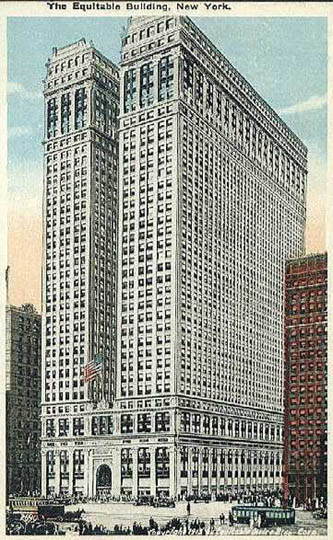 The very next year the city implemented its first zoning law. Note that the city responded immediately. The disastrous 1879 Tenement Housing Act that created dangerous and unsanitary conditions in the ghetto wasn't fixed for twenty-two years. Zoning took a matter of months. The difference? Money and investors vs immigrant labor. Note also that the housing need for the ghetto was dangerous and unsanitary structural designs inducing life-threatening diseases and fire; the needs of the real estate industry were investment.
The zoning had two new requirements. One was a restriction on types of uses so that factories couldn't be built along residences. Factories bring noise and stench and worse, laborers, who are also noisy and smelly that destroy the real estate value of a residential neighborhood. The city came up with the idea of creating residential zones where commerce was allowed but not manufacturing. There'd also be commercial zones where some residences were allowed, and manufacturing zones where manufacturing and some commercial buildings but not residential buildings could be built.
The second idea was a design innovation. Any tall building had to attenuate -- as it grew higher, it had to be more slender. The idea was to prevent the skyscraper from blocking out all the sunlight, while still allowing developers to build big to cash in on rental space. This requirement of attenuation is easily visible in the most familiar and identifiable NYC skyscrapers. The Empire State Building took its design not from any fashion, but from the strictures of the law. In fact, the real estate industry hired an architectural draftsman, Hugh Ferriss, to interpret the legalese to the architects.

These gradual attenuations are called setbacks.
Both of these innovations were specifically designed to protect the interests of real estate industry -- landowners and developers.
Next up, tower-in-the-park zoning, modernism -- design with a social conscience and unintended consequences -- and developmental rights or how gov't creates property and value for the landowner out of thin air.
The Amenties Dilemma
Why should money harass the color out of a neighborhood? Is it greedy maximization of profit?
I dislike the use of "greed" as an economic explanation. It implies that there are some defective people who are to blame for what's wrong in the world. That sort of psychological essentialism -- some people are greedy, others not -- leads to a misunderstanding of how economies and societies work, and leads away from any meaningful solutions to its problems. What we call greed may be less affective, personal or psychological than mere opportunity. If there is no opportunity to make money out of some place, thing or person, people are pretty chill about that person, place or thing. It's when there's some kind of opportunity to gain from a place, person or thing that the feeding frenzy begins.
When the Lower East Side was an abandoned slum, it took my landlord eight months to bother to try to evict me for non payment, because the rent was so low that getting the rent or replacing me with another low renter was hardly worth the trouble. Today if I am five days late with my rent, the landlord files eviction proceedings and assesses a late fine onto my rent. Where there's money to be made, the pressure becomes irresistible and fierce.
The amenities dilemma -- leaving the ghetto in poverty preserves the community but ensures their poverty, while improving the ghetto just shifts the community to a new place of poverty (the dilemma was observed way back by Friedrich Engels in his "The Housing Question") -- is the big problem for zoning designed to create affordable housing. That's what the talk is mostly about. But first I want to look at how zoning came about, what its goals were and are, and how it works.
The origin of zoning
In 1915, Equitable Life built an office tower designed to be the largest such space in the world. Taking up a huge lot, the building rose straight up 38 stories, casting a shadow a quarter of a mile. This was a time before Wall Street was covered with skyscrapers. The buildings there were much more modest and natural light was still available. Commercial buildings were structured to use natural light. Cast iron, favored for commercial buildings, allowed maximal window coverage with minimal structural support. The Equitable Building's shadow instantly depressed real estate values all around it. Landlords and real estate speculators throughout the city were terrified and infuriated, not just over the building, but the possibility that other corporate giants would build near their lots. The real estate industry demanded that the city respond with a permanent fix so that this never happen again.
The zoning had two new requirements. One was a restriction on types of uses so that factories couldn't be built along residences. Factories bring noise and stench and worse, laborers, who are also noisy and smelly that destroy the real estate value of a residential neighborhood. The city came up with the idea of creating residential zones where commerce was allowed but not manufacturing. There'd also be commercial zones where some residences were allowed, and manufacturing zones where manufacturing and some commercial buildings but not residential buildings could be built.
The second idea was a design innovation. Any tall building had to attenuate -- as it grew higher, it had to be more slender. The idea was to prevent the skyscraper from blocking out all the sunlight, while still allowing developers to build big to cash in on rental space. This requirement of attenuation is easily visible in the most familiar and identifiable NYC skyscrapers. The Empire State Building took its design not from any fashion, but from the strictures of the law. In fact, the real estate industry hired an architectural draftsman, Hugh Ferriss, to interpret the legalese to the architects.

These gradual attenuations are called setbacks.
Both of these innovations were specifically designed to protect the interests of real estate industry -- landowners and developers.
Next up, tower-in-the-park zoning, modernism -- design with a social conscience and unintended consequences -- and developmental rights or how gov't creates property and value for the landowner out of thin air.
Thursday, July 11, 2013
The future of government policy-making and the danger of giant global capital mobility
Walmart threatened to leave DC if their mayor signs the council's living wage bill.
Chain store influencing public policy -- when does a chain store become too big to displease? It's the neoliberal dreamstate -- government of, by and for the corporate person. In the piece, Marion Barry called it "a stick-up."
Walmart argues that raising the minimum wage will drive employers away, causing unemployment. But raising wages also boosts demand, creating more employment. Card and Kreuger's classic survey showed that minimum wage raises actually increased employment. Even more interesting, Neumark and Wascher showed disemployment effects only in large fast food stores, with a rise in employment among small restaurants.
You can see what's going on. The large corporations disinvest because they are more mobile. They can leave a state with higher wages for a state with lower wages. Small owners are not as mobile, so they are stuck with the higher wages, but eventually reap the benefits of greater demand!
And you can see where this is going. Walmart has already stated that it will disinvest, regardless of greater demand. After all, Walmart depends on low-wage bargain hunters. If wages rise significantly, the higher demand might not be good for their bottom-end offerings. Walmart has an interest not only in low wages to keep their pricing down, but also to maintain its low-income market demand. They promote themselves as offering low prices, but actually they are in the business of creating low incomes to feed their own market. And its model doesn't move upward as it grows. It grows by spreading the bottom. It's an impoverishment model. Their corporate goal is to vastly increase the bottom.
The DC living wage might have been a test case to see the efffects of demand vs employment cost-cutting, but by stating its intention to leave, Walmart shows up front that it will bias the results. So if employment declines, everyone can blame it on Walmart's political ploy.
Capital mobility is another reason to be wary of the neoliberal giant global corporation. Small businesses have to take the pain. Ironically, they also reap the benefit.
But what's more shocking than the impoverishment model that Walmart is admitting to here, is Walmart's threat to public policy-making. When will corporations become so big that we can't say 'no' to them ever again? Think of the consequences for food (Monsanto), the environment, fracking -- it's not just about wages. It's the entire fabric of life.
Sunday, June 30, 2013
Local credit
At Occupy's Alternative Banking think tank you'll find a mix of economists, ex-Wall Street quants (the redoubtable Cathy O'Neil among them), labor reps and assorted socialists and Marxists, and also young idealists reminiscent of the late '60's. One of these latter presented for us some recent work on alternative money -- not bitcoin stuff, but relational local credit/debit systems. The sharpest head there pointed out that these are already used by airlines as frequent flier miles. The consumer gains credit by buying but can use it only for the local purveyor.
The idea is half-baked. After a couple of minutes I asked: what prevents a large corporation from offering to undercut the local credit with an economy of scale (we'll fly you farther!)? The consensus was, the locals would have to keep faith with the local purveyor. But of course if the local exchange is maintained by faith, there's no need for this alternative credit at all. We talk about capital as if it were a system, and we look at systemic supports in capitalist nations, but really it's just human opportunism wherever there's private property and a market.
The notion of local credit belongs to the youthful idealistic spirit of Occupy. Maybe they can get it to work, but locality seems underlyingly Luddite to me or at best old-style anarchism. The notion of alternative credit, though, that's got appeal. What are the possibilities? It's not so far-fetched. The gold standard was a kind credit limit. Fiat money, by contrast, has turned out to be an unleashed beast, difficult to tame. It could be tamed in flush times, but in bad times, monetary policy, as Keynes said, is like pushing a string. Something to think about.
The idea is half-baked. After a couple of minutes I asked: what prevents a large corporation from offering to undercut the local credit with an economy of scale (we'll fly you farther!)? The consensus was, the locals would have to keep faith with the local purveyor. But of course if the local exchange is maintained by faith, there's no need for this alternative credit at all. We talk about capital as if it were a system, and we look at systemic supports in capitalist nations, but really it's just human opportunism wherever there's private property and a market.
The notion of local credit belongs to the youthful idealistic spirit of Occupy. Maybe they can get it to work, but locality seems underlyingly Luddite to me or at best old-style anarchism. The notion of alternative credit, though, that's got appeal. What are the possibilities? It's not so far-fetched. The gold standard was a kind credit limit. Fiat money, by contrast, has turned out to be an unleashed beast, difficult to tame. It could be tamed in flush times, but in bad times, monetary policy, as Keynes said, is like pushing a string. Something to think about.
Monday, June 24, 2013
Restrict access?
Saw this comment on EV Grieve about a street cart become a new store that everyone likes:
We *can* improve the world if we speak out and take action. Resist corporatocracy, restrict global corprorate capital's access to our our streets. Join NO711! Join Occupy! (Yes, it's still active -- headed to a meeting tonight about coordinating all the local neighborhood Occupations in the city and all the Occupy policy groups.)
This is how it starts. The cart moves inside, the store becomes two, then three, and eventually an evil franchise that must be stamped out -- a symbol of "corporatocracy". Meanwhile, somewhere else, the process begins again, and is cheered.EXACTLY!!! Just think, if we had a zoning law restricting chain stores (usually defined as 12 stores or more), then NYer's could enjoy places like this without watching them turn into huge global corporate human smuggling operations.
We *can* improve the world if we speak out and take action. Resist corporatocracy, restrict global corprorate capital's access to our our streets. Join NO711! Join Occupy! (Yes, it's still active -- headed to a meeting tonight about coordinating all the local neighborhood Occupations in the city and all the Occupy policy groups.)
Monday, June 10, 2013
Hope in organizing?
The panels I attended at the Left Forum on Saturday (mostly analysis) were depressing, Sunday (engaged activism), optimistic.
It's a public forum, so I shouldn't expect any revelations, but still, familiar boilerplate analysis is tired. Even the solutions were depressing since there was no hint of how to get the world to implement them.
Cathy O'Neil, from Occupy's Alt Bank group, provided the only positive suggestion I heard all Saturday: a people's lobby. She thinks office holders are completely in the dark (she seems to ignore their aids some of whom ought to know something) about the complexity of the financial system. All their information comes from corporate lobbyists with a biased slant that serves the immediate corporate interests' grasping. Electeds hear no one from the general public looking out for the overall health of the economy. Office holders, she maintains, need education in the dangers that those narrow corporate interests pose to the overall economy.
There's a big 'if' here: electeds will respond to knowledge if they are not already bought by the corporate interests. If they are bought, then the lobbying is really just providing electeds with their corporate-friendly talking points.
Money is not the only leverage on electeds. Voting is the counterbalance to corporate campaign money, but the voters also need education.
Sunday was more optimistic. Occupy held a round table about current local Occupy efforts including Occupy Astoria/LIC, Occupy Kensington and Occupy Sunset Park. These folks are engaged and getting somewhere. Occupy Kensington is focused on a labor struggle with a specific store, Golden Farm, but they've also become a hub of community discussion. That's also true of the Astoria/Long Island City and Sunset Park groups.
No tired analyses in this room, the discussion was about how to be more effective: how to connect with each other, how useful is the Occupy horizontal organizing, how to sustain momentum, how to get more people off their asses and make a difference, how to take advantage of not-in-my-back-yard & pocketbook issues to expand them into larger social justice activism.
At the last panel the last presenter, Nabil Kamel, gave us the most optimistic history: two instances in which rebuilding from a natural disaster became an opportunity for community groups to improve their circumstances, rather than yet another opportunity for capital to displace the disempowered and rebuild for the revenue-creating rich. Kamel finds that community successes are facilitated by 1) the existence of a prior community organization (e.g., Black Panthers in Oakland, where, decades after their creation, they managed to redirect the rebuilding of a bridge, eventually getting the municipality to train and employ and pay the community to build it themselves), 2) a network of organizations, 3) focus on a single site and 4) 'carving out' of capital interests to gain assistance.
On the downside, any local improvement tends to gentrify the neighborhood. So the Marxist analysis may have the last word if capital turns every reform to its benefit. Chomsky offered a bit of light observing the leftward turn in Latin America. It was fitting that the closing speech was given by the Bolivian Vice President Alvaro Garcia Linera. He made this point that local struggles must be placed in the largest context. Good advice.
It's a public forum, so I shouldn't expect any revelations, but still, familiar boilerplate analysis is tired. Even the solutions were depressing since there was no hint of how to get the world to implement them.
Cathy O'Neil, from Occupy's Alt Bank group, provided the only positive suggestion I heard all Saturday: a people's lobby. She thinks office holders are completely in the dark (she seems to ignore their aids some of whom ought to know something) about the complexity of the financial system. All their information comes from corporate lobbyists with a biased slant that serves the immediate corporate interests' grasping. Electeds hear no one from the general public looking out for the overall health of the economy. Office holders, she maintains, need education in the dangers that those narrow corporate interests pose to the overall economy.
There's a big 'if' here: electeds will respond to knowledge if they are not already bought by the corporate interests. If they are bought, then the lobbying is really just providing electeds with their corporate-friendly talking points.
Money is not the only leverage on electeds. Voting is the counterbalance to corporate campaign money, but the voters also need education.
Sunday was more optimistic. Occupy held a round table about current local Occupy efforts including Occupy Astoria/LIC, Occupy Kensington and Occupy Sunset Park. These folks are engaged and getting somewhere. Occupy Kensington is focused on a labor struggle with a specific store, Golden Farm, but they've also become a hub of community discussion. That's also true of the Astoria/Long Island City and Sunset Park groups.
No tired analyses in this room, the discussion was about how to be more effective: how to connect with each other, how useful is the Occupy horizontal organizing, how to sustain momentum, how to get more people off their asses and make a difference, how to take advantage of not-in-my-back-yard & pocketbook issues to expand them into larger social justice activism.
At the last panel the last presenter, Nabil Kamel, gave us the most optimistic history: two instances in which rebuilding from a natural disaster became an opportunity for community groups to improve their circumstances, rather than yet another opportunity for capital to displace the disempowered and rebuild for the revenue-creating rich. Kamel finds that community successes are facilitated by 1) the existence of a prior community organization (e.g., Black Panthers in Oakland, where, decades after their creation, they managed to redirect the rebuilding of a bridge, eventually getting the municipality to train and employ and pay the community to build it themselves), 2) a network of organizations, 3) focus on a single site and 4) 'carving out' of capital interests to gain assistance.
On the downside, any local improvement tends to gentrify the neighborhood. So the Marxist analysis may have the last word if capital turns every reform to its benefit. Chomsky offered a bit of light observing the leftward turn in Latin America. It was fitting that the closing speech was given by the Bolivian Vice President Alvaro Garcia Linera. He made this point that local struggles must be placed in the largest context. Good advice.
Friday, June 07, 2013
Left Forum
The Left Forum (formerly the Socialist Scholars Conference) opens tonight continuing through the weekend. As usual there will be too many panels to choose from, but at least there'll be something for everyone. Chomsky will speak on Saturday. Occupy will have a presence, including Alt Bank (Occupy's group of economy wonk-activists focused on the financial system), in case anyone's interested in what I've been doing with my Sundays.
Program guide and conference schedule -- at Pace, across from City Hall Park just south of the bridge.
Program guide and conference schedule -- at Pace, across from City Hall Park just south of the bridge.
Sunday, June 02, 2013
From shopping mall to political transformation

In Istanbul the protest started as a defense of a local green space from another shopping mall. It almost sounds like a bourgeois NIMBY story from Greenwich Village protesting NYU. Police repression fanned the flames into a much broader anti-government repression movement. But the central issue is still community self-determination. From RT:
"...respect must come back to the political approach and implementation… That has to do with the way people feel fed up with the interference, micromanagement of their lifestyles." -- Istanbul-based political columnist Yavuz Baydar
Thursday, May 30, 2013
Beware capitalist tools
Robert Reich, Clinton's Labor Secretary, posted Monday on his blog a piece arguing limiting access to giant corporations:
If global corporations obeyed all national laws — the spirit of the laws as well as the letter of them – and didn’t use their inordinate power to dictate the laws in the first place by otherwise threatening to take their jobs and investments elsewhere, there’d be no issue.
It’s the fact of their power to manipulate laws by playing nations off against one another – determining how much they pay in taxes, as well as how much they get in corporate welfare subsidies, how much regulation they’re subject to, and so on – that raises the question of how citizens can countermand this power.
Consumer benefits may sometimes exceed such costs. But, as we’ve painfully learned over the years (the Wall Street meltdown, the BP oil spill in the Gulf, consumer injuries and deaths from unsafe products, worker injuries and deaths from unsafe working conditions, climate change brought on by carbon dioxide emissions, and, yes, manipulation of the tax laws – need I go on?), the social costs may also exceed consumer benefits....
...Comparative advantage is nice in theory, but in a world where powerful global corporations are using every strategy imaginable to maximize their profits and powerful governments are strategically employing market access to develop their economies, it’s just theory.Wouldn't it be great if NO711's zoning proposal were the beginning of a wide-spread resistance against global corporate access at the ground level? Instead of relying on our failed political system to defend us from global capital, start with community self-determination growing from a grassroots movement? Could this be the second wave for Occupy -- occupy our own community?
Subscribe to:
Posts (Atom)

 Posts
Posts


