Here's a very brief snippet from the Occupy AltBank talk on zoning and affordable housing last week posted on facebook by Sumumba Sobukwe, an active member of AltBank and cocreator of Occu-Evolve.
Here again is the presentation in the form of blogposts:
The origins and history of zoning and the Amenities Dilemma
Zoning with a conscience
Contextual zoning and "affordable" housing
Collusion between gov't, developers and non profits: the cooptation of the left
the current mayor's plan
Showing posts with label city planning. Show all posts
Showing posts with label city planning. Show all posts
Sunday, February 14, 2016


Sunday, February 07, 2016
Zoning talk @ OWS Alternative Banking Group
For those looking for the zoning talk @ OWS Altbank today, here are the urls in order
The origins and history of zoning and the Amenities Dilemma
Zoning with a conscience
Contextual zoning and "affordable" housing
Collusion between gov't, developers and non profits: the cooptation of the left
and a post on the current mayor's plan
The origins and history of zoning and the Amenities Dilemma
Zoning with a conscience
Contextual zoning and "affordable" housing
Collusion between gov't, developers and non profits: the cooptation of the left
and a post on the current mayor's plan
Friday, February 05, 2016
Collusion between gov't, developers and tenant advocacy non profits
By using zoning to limit developable space, and allowing that space to be bought and sold, gov't created property literally out of thin air -- out of the words of the zoning text. By creating a market the raw resource of which was created by the gov't, gov't could exert influence, manipulate and extort from developers. If a developer wanted more space than was available in the zoning, he had to go beg it of gov't, and gov't could grant the additional space for a favor. This market was the beginning of the end of gov't directly building affordable housing and instead drawing the developer into building it for the public.
Housing projects were widely viewed as a failure. A new generation of planners followed Jane Jacobs' broad criticism of tower-in-the-park construction, which she viewed as anti-urban, generating wastelands of non commercial, semi-abandoned and dangerous, isolated space. The reality was more complex. After all Stuyvesant Town is a housing project but no one complains that it's a failure. If anything, it's become to successful, too attractive as its management tries to replace older tenants with tenants eager to pay much higher rents there. But Stuy Town was middle-income, well maintained, with residents who were also well served by gov't and the economy in many ways. The low-income housing projects relied on inadequate gov't funding streams and the community was consistently underserved whether by the education system for its children or the employment opportunities for its parents, health services, sanitation and the maintenance of the grounds. If it failed, it failed because of the lack of social and financial investment in the human capital of the community. But that failure could easily be dressed up instead as a failure of urban and architectural planning and design.
Zoning incentives replaced housing projects. Developers would be given additional space to develop in return for building a modest percent of affordable housing that would be managed by a non profit tenant advocacy group. This model brought together gov't, developers and affordable housing non profits: gov't offered bulk space incentives to the developers while giving the non profits funding to manage the affordable housing. The developers needed to cooperate with both gov't and the non profits. And critically, the tenant advocacy groups were now compelled to work with and for both gov't and developers.
In order to obtain affordable housing, the tenant advocacy non profits had to sell upzonings to their community, otherwise the non profit wouldn't get the affordable housing or their funding from the gov't. Since the affordable housing brings with it market-rate development, the result is gentrification, investment, opportunity for more investment and a feeding frenzy of tenant harassment. At the end of the day, affordable housing through zoning nets a loss of affordable housing. And since the affordable housing is given to people who are not currently living in the neighborhood, to call this "community preservation" is Orwellian doublespeak.
Those in the community who are aware of the consequences of the affordable cooptation of the non profits, are placed in the ugly position of having to protest affordable housing. The gov't has effectively driven a wedge between affordable housing advocates and anti-gentrificationists by this Sophie's choice dichotomy of affordable housing (+market-rate housing) or else no development (+no new affordable housing).
If you go to a City Planning hearing you can see the wedge in living color. The state-funded affordable housing non profits arrive with their employees and clients -- the tenants they work with in their tenant advocacy -- all in bright orange or yellow T-shirts. They don't testify, since they are brought to the hearing to pad the audience. Their leaders testify in favor of the upzoning on the grounds that it will bring affordable housing to the community. The rest of the audience is comprised by ordinary residents dressed all diversely, unorganized and unfunded. They do testify, one by one. They testify against the upzoning, expressing their concern about gentrification and community displacement. The Planning Commission ignores them because the city wants development -- it's revenue for the city. The people lose, and the sham continues.
Thursday, February 04, 2016
Contextual zoning and inclusionary housing
As we saw last time, by limiting the developmental rights -- the allowable floor area -- in every zone, zoning created a market of space. By the same token, it made it possible for the gov't to create property out of air, out of words in the zoning text. Upzone a neighborhood -- allow more floor area per lot -- the owner now not only can build more actual rental space but, if he doesn't have the financial resources to construct, can sell the unbuilt floor area to another developer who does. This gives the gov't powerful leverage on developers.
We also saw that while the small landowners benefit form the sale of developmental rights ("air rights"), their property becomes developmentally inert and in the long run, less profitable, and because the nearby skyscraper has raised the local real estate taxes, the property may become a source of discontent. In addition, the Modernist model of surrounding tall, dense buildings with park space instead of integrating residences with commercial storefronts aligned on the streetscape turned out to be a disaster in the so-called "projects." Modernist ideals were replaced with a belief in value of the urban integrated streetscape -- storefronts on the street-level which would bring lively commerce and businesses that would clean and protect the street. This led to a reaction against the tower-in-the-park zoning which created disjointed, discontinuous streetscapes.
The response was the current model of zoning called "contextual." The city added another innovation, this in the measure of space: the height cap. Zoning would now provide a floor space allowance, but also a height cap, so a developer could no longer buy unused developmental rights ("air rights") to build out-of-scale skyscrapers in low- or mid-rise zones.
Meanwhile, the gov't got out of the business of constructing low-income housing (projects) using instead its leverage through zoning to get developers to build affordable housing. The Bloomberg model worked so:
1. Designate a height cap in a zone that is higher than is needed for the designated floor area.
2. Offer the developer additional floor area if the developer built some affordable housing there.
So it's an incentive deal made to the developer. If he builds affordable housing in addition to the market rate units he wants, the city will allow him more space to build additional market rate units. The market rate bonus wasn't much, but it was more than nothing. Typically, the ratio was something like 4 units affordable, 1 unit market rate. The developer might be allowed, in other words, to build another 25% more space, but the total building would have to be 20% affordable, so the market rate bonus was just 5%.
Not many developers bothered with the bonus. De Blasio claimed that they didn't want the bonus because in order to squeeze in the affordable units within the height cap, the entire building had to have low ceilings. So the Department of City Planning came up with a fix: raise all the contextual heights so that developers didn't have to sacrifice ceiling height for the affordability bonus. The developer could build high ceilings for the luxury clients and still have room for affordable housing plus the market rate bonus incentive. The developer could eat his cake and the city could have it too.
De Blasio also proposed that wherever there's an upzoning, affordable housing would have to be included -- if the developer gets an increase in floor area, the developer must build 20% of the building as affordable housing. Since this mandatory inclusionary housing doesn't apply unless there's an upzoning, de Blasio's proposal is similar to the Bloomberg model. But under the Bloomberg model developers might advocate to get an upzoning and not bother with the bonus affordability incentive. Under the de Blasio model, the developers might think twice about advocating for an upzoning since the affordability would be forced on them.
Next up, the role of affordable housing non profits and the community boards.
Wednesday, February 03, 2016
Zoning with a conscience (the talk'll be up at Columbia University in the Foreign Affairs building, 420 W. 118th Street, room 409, 2pm Sunday)
In 1961, the city updated its zoning. This time, the city's planners responded to the Modernist movement which had been around since 1910 or so, but gov't isn't exactly avant garde, so it takes time for gov't to catch on.
The principles of Modernism reflect deep social awareness, with its origins in socialism at a time when socialism was not only respectable, but viewed as the best means, perhaps the only means, towards social justice. Rather than merely serving the investors' financial interests, Modernist architects intended to design an ideal world for all. They developed manifestos and principles of design, competed intellectually for innovations that would improve humanity, not just the developer or his rich clients. Stylistically, they rejected the ostentatious flaunting of wealth that characterized the design fashions of their predecessors. Ornamentation signaled useless vanity. Modernism replaced the show of wealth with purely functional form -- no eyebrows over the windows, no more columns and terra cotta. Steel girders and glass walls -- the structural elements -- were left bare in rectangular shapes of structural support: the Seagrams Building is its most insistent and elegant expression.

The principles of Modernism reflect deep social awareness, with its origins in socialism at a time when socialism was not only respectable, but viewed as the best means, perhaps the only means, towards social justice. Rather than merely serving the investors' financial interests, Modernist architects intended to design an ideal world for all. They developed manifestos and principles of design, competed intellectually for innovations that would improve humanity, not just the developer or his rich clients. Stylistically, they rejected the ostentatious flaunting of wealth that characterized the design fashions of their predecessors. Ornamentation signaled useless vanity. Modernism replaced the show of wealth with purely functional form -- no eyebrows over the windows, no more columns and terra cotta. Steel girders and glass walls -- the structural elements -- were left bare in rectangular shapes of structural support: the Seagrams Building is its most insistent and elegant expression.

You'll notice that unlike the Equitable Building that covered the lot completely, and unlike the Empire State Building that attenuates towards its spire, this building rises straight up but doesn't cover the lot. Instead of setbacks to bring light to the street, the new zoning required that as the building grows taller, its footprint must attenuate, not its tower. The result is an empty space surrounding the building, which then can be used by the public as a park or plaza. The method of bringing light to the street is shifted from the top of the building to the bottom where the public can benefit both from the light and from the space.
The new zoning also introduced a method of restricting the bulk or size of a building. Previously, buildings could be built to whatever height, allowing overwhelming and oppressive density. City Planning Commission came up with a measure of density that still allowed for flexibility of height. The measure of size is the floor area. By zoning for floor space rather than for height, developers were allowed to choose the height of the ceiling freely.
 |
| The New Museum has the same floor area and zoning as its nextdoor neighbor but because its ceiling heights are 20'+ it dwarfs the buildings on the street. |
But their innovation served much more than that. It was now possible to limit the bulk of all the existing or potential buildings in a specific zone. And it allowed landowners to sell their bulk allowance to other landowners who might want to build more than the zoning had given them. The new zoning created a market of space.
It also had a preservationist consequence for owners who sold their bulk allowance in excess of their existing building. Once an owner has sold his excess bulk allowance -- his developmental rights, sometimes called "air rights" -- the owner can't develop anything larger than the building he already has, so there's no reason for him ever to redevelop his building. The result is a kind of preservationist balance: for every tall skyscraper built by buying developmental rights of small buildings nearby, those smaller buildings are preserved. The new ensures the old.
It also ensures that the old, small owner loses the value of his property, can't sell it easily, since who wants a building that can't be redeveloped for increased rents, while the skyscraper next door increases the real estate values of the neighborhood and therefore the real estate taxes. The small owner may have gotten a one-time windfall from selling the air rights, but in the long run, he's losing.
Next up, the current model and how it plays into affordable housing.
Monday, January 25, 2016
De Blasio's difference
For the last decade, the progressive left has been begging for a mandatory inclusionary housing program in New York City requiring that all new residential buildings include a quantity of affordable housing. The mayor has proposed exactly such a plan. The community boards and the progressive left have rejected it. Why?
First, compare the mayor's plan with the Bloomberg model of inclusionary zoning. Bloomberg rezoned 120 neighborhoods in the city. Each one contained significant upzonings -- greater allowances for larger buildings, a give-away to developers. In addition to the upzoning give-away, Bloomberg offered developers the option to build even more space if a portion included affordable housing. Usually the bonus -- the added market-rate housing that the developer could build above the affordable component -- wasn't enough for the developer to bother with, so they didn't.
However, affordable housing non profits, which manage the affordable housing component and get their funding for doing it, and whose mission is to create or promote the creation of affordable housing, were the advocates for the inclusionary program. So you'd see the irony of progressive community-based non profits selling development and upzoning to the communities with the promise that the affordable housing would benefit the community. Carefully not mentioned was that the development would raise real estate values, the market rate housing attract more money, and landlords, seeing an opportunity to cash in on the upscaling of the neighborhood, would harass tenants in a thousand ways, and the result would be community displacement and a net loss of affordable housing, particularly steep if the developers didn't even bother with the inclusionary bonus.
Of course, the affordable housing wasn't for the community in the first place. The housing was delegated by raffle, and the housing wasn't often affordable to the locals anyway. So this model of community stabilization or preservation was what I call the Invasion of the Body Snatchers model of community preservation. The community is replaced with other individuals who purport to be just like them with respect to income. But they are not the community. And since the housing isn't affordable to the prior community, it's not even Body Snatchers, it's just wholesale snatching.
Mandatory IZ doesn't solve this conflict between the creation of affordable housing through development and gentrification/displacement. That's one reason why the community boards haven't cottoned to it. But you'd think that the progressive non profits would still be advocating for it. And here's a big difference in the structure of the mayor's proposal. Instead of rezoning neighborhoods one by one, his proposal changes the zoning law itself, so the city would be upzoned automatically without any further process. Community boards would have little say and the non profits would be left out as well.
Under Bloomberg, it was possible for the communities to ask for additional perks in the form of funding for the non profits -- legal services to help evicted tenants, for example. Under de Blasio's proposal, there's no opportunity for the community to leverage such additional funding.
More important, the de Blasio proposal doesn't kick in until there's an upzoning, so in effect, his proposal is just as voluntary as the Bloomberg model. With a little difference: since developers, prior to any upzoning can develop now without including affordable housing, we should expect them to lose interest in upzonings. It has been well observed that mandatory inclusionary housing has this kind of dampening effect on development. We should expect to see the non profits still advocate for upzonings, and less upzoning advocacy from the developers.
The Bloomberg model placed the developer in the drivers' seat, drawing the non profits onto the developers' bus for the sake of the affordable housing and their legal services funding, while they all throw the community under the very bus they're driving. De Blasio's model takes the developer out of the driver's seat, leaving the non profits on a bus going nowhere.
The irony is even more stark -- we should expect to find that the only people advocating for upzoning, gentrification and displacement would be the progressive non profits under the new model.
Thursday, January 21, 2016
Cooptation of the Left and the permanent shadow government at the local level
Underneath the community boards' rejection of de Blasio's zoning proposals lies a practical and familiar issue: money. Bloomberg's 120 rezonings each went through the arduous public process in which community boards -- and crucially its members -- played an important role. De Blasio's proposals bypass the community level by writing the upzoning directly into the zoning law (called "the zoning text"). The Blaz's proposals eliminate any local leverage for funds that local community non profits might obtain.
Affordable housing built by developers to meet zoning requirements must be managed by a non profit community-based organization (CBO). It's part of their mission and they get funding for it. As a result, CBO's are often the most vigorous proponents of development at the local level. Without the market rate development, no affordable housing -- the market-rate housing "subsidises" the "affordable" housing (a deceptive expression -- the housing is often beyond the means of local residents). That's the Inclusionary Zoning/Inclusionary Housing model -- 80% market rate, 20% "affordable." The non profit becomes complicit with gentrification and displacement.
Displacement is difficult to quantify. Unless a tenant died, the reason for vacating an apartment is anyone's guess, since it's not recorded. Affordable housing is eminently quantifiable, which is one reason why politicians romance it and parade it. Same with CBO's. If the market-rate housing raises real estate values and landlords evict tenants wholesale, as long as the affordable units are built and occupied, no one will be the wiser even though the net affordable housing in the neighborhood has declined.
 CBO's have a long life in the neighborhood. Their members often sit on the community board. There they often create a consensus of what is "right" for the neighborhood, which too often means colluding with developers to obtain the "affordable" housing the CBO's will manage.
The political opportunists that cohabit the community boards recognize the going game, and, being political opportunists, play their game. The community board, and underneath the CBO's, are the permanent gov't at the local level. Given that the CBO's are receiving funds to implement the policies that the community boards vote on, the CBO's can also be described as the shadow gov't at the local level.
 I'm preparing a talk for Occupy Wall Street Altbank Group about zoning and how gov't coopts the Left through community-based non profits. I want to present this in the context of the amenity dilemma: every material improvement made in a low-income neighborhood attracts wealth and its whiteness, raises real estate values, increases pressure from landlords to evict and yields displacement. Maybe the only solution to the amenity dilemma -- remain in poverty or be displaced to poverty elsewhere; all things accrue to the top -- is protection. So the talk will include a defense of rent regulations, the defense I've made here and elsewhere many times.
Affordable housing built by developers to meet zoning requirements must be managed by a non profit community-based organization (CBO). It's part of their mission and they get funding for it. As a result, CBO's are often the most vigorous proponents of development at the local level. Without the market rate development, no affordable housing -- the market-rate housing "subsidises" the "affordable" housing (a deceptive expression -- the housing is often beyond the means of local residents). That's the Inclusionary Zoning/Inclusionary Housing model -- 80% market rate, 20% "affordable." The non profit becomes complicit with gentrification and displacement.
Displacement is difficult to quantify. Unless a tenant died, the reason for vacating an apartment is anyone's guess, since it's not recorded. Affordable housing is eminently quantifiable, which is one reason why politicians romance it and parade it. Same with CBO's. If the market-rate housing raises real estate values and landlords evict tenants wholesale, as long as the affordable units are built and occupied, no one will be the wiser even though the net affordable housing in the neighborhood has declined.

The political opportunists that cohabit the community boards recognize the going game, and, being political opportunists, play their game. The community board, and underneath the CBO's, are the permanent gov't at the local level. Given that the CBO's are receiving funds to implement the policies that the community boards vote on, the CBO's can also be described as the shadow gov't at the local level.
 I'm preparing a talk for Occupy Wall Street Altbank Group about zoning and how gov't coopts the Left through community-based non profits. I want to present this in the context of the amenity dilemma: every material improvement made in a low-income neighborhood attracts wealth and its whiteness, raises real estate values, increases pressure from landlords to evict and yields displacement. Maybe the only solution to the amenity dilemma -- remain in poverty or be displaced to poverty elsewhere; all things accrue to the top -- is protection. So the talk will include a defense of rent regulations, the defense I've made here and elsewhere many times.
Wednesday, January 20, 2016
Money laundering and affordable housing

Constructing a lot of new housing can keep rents low by adding supply. Because it's expensive to build, developers prefer constructing luxury housing to get the quickest and highest rate of return. If the wealthy move out of older housing stock or locations further from the city center into these new luxury units, they free up housing for the less wealthy, who decamp from their older and further locations in turn freeing up housing for the even less wealthy and so on down the line. This is the one good reason for de Blasio's Zoning for Quality and Affordability (ZQA) -- allow new units to have higher ceilings to attract the wealthy out of less appealing older models.
But if the luxury housing is being bought by foreign speculators or money launderers who have no intention of living in the apartments, new construction does no good for the housing market. It turns the city's real estate into a non housing market crowding out the housing market. It's a disaster for the resident citizen, especially the low-income and immigrants.
(You might think, well if we eliminated rent regulations, the market would be flooded with vacant apartments, but this is both empirically and theoretically wrong. Most people who would be pushed out of deregulated apartments don't -- and often can't -- leave the local rental pool. They just move to a lower income neighborhood where they create a tighter market and push out lower income tenants who in turn move to lower income neighborhoods evicting people there, again, all the way down the line until at the bottom immigrants huddle up in substandard housing crowded together in dangerous conditions. At the top, landlords renovate the vacated luxury units and hike the rents there. Iow, deregulation doesn't free up the market, it's just a game of musical chairs, destabilizing everyone and raising rents everywhere. This happened in Boston when rents were deregulated, so we know that it's not just a theoretical speculation-- it's reality.)
The alternative to constructing luxury apartments to ease the housing market is constructing affordable housing. But if the monied are still coming to the city and searching for apartments, the pressure on gentrification in outer boroughs will be greater than the creation of affordable housing can accommodate.
It's easy to show that the current model of affordable housing creation is necessarily inadequate. De Blasio's Mandatory Inclusionary Zoning, for example, would require one affordable apartment for every four luxury unit. But as we know from Occupy and presidential campaigns and memes everywhere, the ratio of the wealthy to the struggling is not four rich folks to each struggler, but more like 1:99, and that's actually generous. 1:999 would be closer to reality. So the current model is beyond inadequate -- it's preposterously inadequate.
So again, the affordable housing model can only work if the luxury housing doesn't become a place for billionaires to park their money. It's got to be housing, not speculation, otherwise the entire geography of the city will be distorted into empty speculation at its center without even a tax base.
Tuesday, January 19, 2016
Artists don't cause gentrification
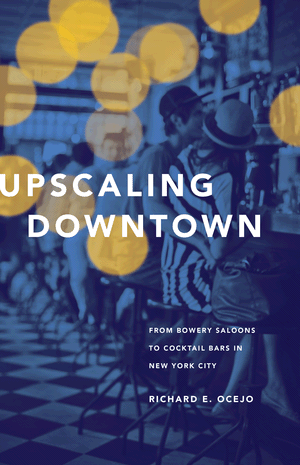
Last year Rich Ocejo published his book Upscaling Downtown, an excellent description of the changing bar scene in and around the Bowery/EV/LES, the nightlife pressure towards commercial gentrification and residential pushback against it. It's an important case history of a neighborhood in transition.
http://press.princeton.edu/titles/10396.html
 While it's a great read -- he provides a broad view of the many divisions within the community and it's fun to recognize the many locals he interviewed -- the theoretical background assumptions inherited from the standard academic literature on gentrification occasionally undermine the specificity of the case history. This is not Ocejo's fault; it's the failure of the academic theorists.
It's assumed that because gentrified neighborhoods are preceded by artists and other marginal white misfits, that their presence causes gentrification. But if you look at the facts of history, you find a different and more complex story. When artists and marginals arrived in both the Bowery and the Lower East Side (including what's now called the East Village and Alphabet City), the neighborhoods continued to decline. The artists and misfits did not attract money or commerce. They attracted more misfits and artists.
To blame artists and marginals (Vietnam veterans, the homeless, substance abusers, prostitutes, ex cons, the chronically unemployed, lost youth) for gentrification on the grounds of having preceded gentrification is like blaming the rain on dry streets because dry streets precede rain. The academic theorists have invented a mechanism employing the classic fallacies -- confusing correlation with causation and post hoc ergo propter hoc. In their desperate search for a grandiose theory that will explain all instances, they've drawn hasty, blanket conclusions without looking carefully enough at the details and specificity of the context.
Unfortunately for the big theory, the Bowery attracted misfits for two centuries without seeing any gentrification. For most of those two centuries, it declined right up to 2005 with not a hint of gentrification. What changed the Bowery was city planning, in particular, the Chrystie Avalon complex. Not artists, not misfits, not wayward white youth slumming. City Planning: government.
The theory of gentrification comes to us from classical Marxism, a pre macro-economic theory. It attributes all to market forces and none to government intervention. It's certainly true that the accumulation of capital in excess of any market demand for productivity could be a pressure towards gentrification. But the avenues of speculation depend on what government incentivizes. Buying luxury apartments on Central Park South is the current means. But the gentrification of the LES did not begin with big capital. It started with small time investors. Big capital didn't want to take a chance on a crime-ridden, marginal neighborhood full of weirdos and resistant anarchists.
.....
The assumption has been that whiteness itself attracts money. So Ocejo calls whites who moved to Alphabet City in the mid to late 1970's "early gentrifiers," although for years they watched as their streets continued to decline replacing older residents with shooting galleries (for heroin users), drug dealers replacing families with growing children. More complicating, while these streets declined and buildings were abandoned, burned and the remnants demolished, other parts of the neighborhood were gentrifying. The early marginals and artists did not contribute to it. On the contrary, most of them had to be displaced in order for gentrification to spread. What drew gentrifiers to those parts of the neighborhood were their amenities -- a park view or in the case of Christodora House, spectacular panoramic views. Again, not artists, nor the artistic scene.
If you look through the NYTimes archive, you'll find stories from the Bowery 1880's, the years when it began its steep decline, stories about the death of a resident who lived as a pauper but was escaping from his wealthy family. The millionaire living like a pauper-in-rags is not an urban myth. These people lived on the Bowery and in neighborhoods like the LES. To call them early gentrifiers indicates that the theory has gone astray. The notion is incoherent -- it provides no principled distinction between white people who draw money and white people who repel it -- and it's falsified by history.
Again, contrary to Neil Smith's theory, the neighborhood did not decline in order for developers to buy them cheap, nor is there a universal cyclic law of neighborhood decline followed by redevelopment. The LES declined because it was abandoned by labor when public transit made it possible for labor to leave. It's not a grand conspiracy or a cycle of capital disinvestment. A neighborhood with money need never decline -- investors renovate the housing stock or redevelop it. Contrary to Smith, landlords don't seek disinvestment, although government does -- to create ghettos in a program of segregating races by "providing" affordable housing through the market. Here Smith is particularly incoherent: he sees renovation as a means of gentrification only after the neighborhood reaches rock bottom. He forgets that renovation was always an option.
The underpinnings of gentrification theory are constructed for the convenience of broad theories that ignore the specificity of place and the serendipity of technological, political, cultural and legal transformations. The most effective law of urban development is the law of unintended consequences. A close second is government.
http://press.princeton.edu/titles/10396.html
It's assumed that because gentrified neighborhoods are preceded by artists and other marginal white misfits, that their presence causes gentrification. But if you look at the facts of history, you find a different and more complex story. When artists and marginals arrived in both the Bowery and the Lower East Side (including what's now called the East Village and Alphabet City), the neighborhoods continued to decline. The artists and misfits did not attract money or commerce. They attracted more misfits and artists.
To blame artists and marginals (Vietnam veterans, the homeless, substance abusers, prostitutes, ex cons, the chronically unemployed, lost youth) for gentrification on the grounds of having preceded gentrification is like blaming the rain on dry streets because dry streets precede rain. The academic theorists have invented a mechanism employing the classic fallacies -- confusing correlation with causation and post hoc ergo propter hoc. In their desperate search for a grandiose theory that will explain all instances, they've drawn hasty, blanket conclusions without looking carefully enough at the details and specificity of the context.
Unfortunately for the big theory, the Bowery attracted misfits for two centuries without seeing any gentrification. For most of those two centuries, it declined right up to 2005 with not a hint of gentrification. What changed the Bowery was city planning, in particular, the Chrystie Avalon complex. Not artists, not misfits, not wayward white youth slumming. City Planning: government.
The theory of gentrification comes to us from classical Marxism, a pre macro-economic theory. It attributes all to market forces and none to government intervention. It's certainly true that the accumulation of capital in excess of any market demand for productivity could be a pressure towards gentrification. But the avenues of speculation depend on what government incentivizes. Buying luxury apartments on Central Park South is the current means. But the gentrification of the LES did not begin with big capital. It started with small time investors. Big capital didn't want to take a chance on a crime-ridden, marginal neighborhood full of weirdos and resistant anarchists.
.....
The assumption has been that whiteness itself attracts money. So Ocejo calls whites who moved to Alphabet City in the mid to late 1970's "early gentrifiers," although for years they watched as their streets continued to decline replacing older residents with shooting galleries (for heroin users), drug dealers replacing families with growing children. More complicating, while these streets declined and buildings were abandoned, burned and the remnants demolished, other parts of the neighborhood were gentrifying. The early marginals and artists did not contribute to it. On the contrary, most of them had to be displaced in order for gentrification to spread. What drew gentrifiers to those parts of the neighborhood were their amenities -- a park view or in the case of Christodora House, spectacular panoramic views. Again, not artists, nor the artistic scene.
If you look through the NYTimes archive, you'll find stories from the Bowery 1880's, the years when it began its steep decline, stories about the death of a resident who lived as a pauper but was escaping from his wealthy family. The millionaire living like a pauper-in-rags is not an urban myth. These people lived on the Bowery and in neighborhoods like the LES. To call them early gentrifiers indicates that the theory has gone astray. The notion is incoherent -- it provides no principled distinction between white people who draw money and white people who repel it -- and it's falsified by history.
Again, contrary to Neil Smith's theory, the neighborhood did not decline in order for developers to buy them cheap, nor is there a universal cyclic law of neighborhood decline followed by redevelopment. The LES declined because it was abandoned by labor when public transit made it possible for labor to leave. It's not a grand conspiracy or a cycle of capital disinvestment. A neighborhood with money need never decline -- investors renovate the housing stock or redevelop it. Contrary to Smith, landlords don't seek disinvestment, although government does -- to create ghettos in a program of segregating races by "providing" affordable housing through the market. Here Smith is particularly incoherent: he sees renovation as a means of gentrification only after the neighborhood reaches rock bottom. He forgets that renovation was always an option.
The underpinnings of gentrification theory are constructed for the convenience of broad theories that ignore the specificity of place and the serendipity of technological, political, cultural and legal transformations. The most effective law of urban development is the law of unintended consequences. A close second is government.
Thursday, January 14, 2016
The MobilityDilemma and the Clearing House Effect

Economic development efforts in enclave economies that encourage a diversified, vibrant business community rather than a hypercompetitive, low-margin, narrow economy would help stabilize the local economy and raise wages and labor standards.
By "diversified" they mean non local serving businesses: semiotic, outward-looking commerce -- in a word, tourism. To upscale a local-serving produce stand into a high-end restaurant -- necessarily non-local serving since the locals cannot afford it -- will allow, if successful, higher wages for the waiters (if the manager doesn't steal the tips, a wide-spread practice as I've mentioned). But it also crowds out local-serving commerce and attracts more upscale outward-looking commerce. As prices and profits rise, so do real estate values. Soon the neighborhood is in demand from outside and landlord pressure to harass and evict locals increases. Gentrification displaces the local community.
The dilemma is parallel to the urban amenity dilemma: every material improvement in a low-income neighborhood attracts investment that eventually gentrifies and displaces the low-income community. The two horns of the dilemma both seem unacceptable: remain in poverty or be displaced to poverty elsewhere.
The AAF policy recommendation seems to ignore the historical clearing house dynamic of Chinatown. Immigrants arrive there, work hard for several years, spend frugally, save resolutely, then leave for a prettier neighborhood. Upscaling Chinatown may provide higher wages for a few, but it eliminates it as a first destination for new immigrants.
New immigrants most need work they can assume immediately and housing that is extremely cheap so they can both earn and save. AAF concludes that "Making affordable housing more available is critical to alleviating poverty." But current affordable housing programs are all geared towards permanent housing, too expensive for the needs of new immigrants. Only transient housing meets the demand in an immigrant first destination. Permanence is unnecessary and too expensive.
Chinatown today is divided between two communities, one immigrant and transient, another American-born and permanent. Current affordable housing models would change Chinatown into all permanent, but the mobility it provides for the low-income immigrant is not upward, but outward, so the problem is not solved, in Engels' famous words in The Housing Question, "they are merely shifted elsewhere."
See also in this series:
Semiotic neighborhoods vs the authentic and anti-fragile: prestige and its deceptions and betrayals
Prestige and distortion in Chinatown
Suits and betrayal in Chinatown
Authenticity in the East Village
Thursday, January 07, 2016
The consequences of unaccountability
The Parks Department closed the basketball court all summer to resurface it even though there were no complaints about the old court and there was no community need for a resurfaced court. The Community Board did not request a resurfacing. Calling it a "repair," the Department proceeded without consultation, consent, or process.
The Department also renovated the nearest basketball court on Avenue D at the same time, closing out basketball to the community youth for nearly the entire summer.
The placement of ping pong tables in the park was also done without process beyond finding a space. The installation of a police surveillance station: also without process or consultation. Both of these targeted the homeless in Tompkins Square Park who've been part of the park community for decades.
The police station was installed after an article appeared in which a new young white person complained about the homeless in the park. The article appeared in the New York Observer, owned by Donald Trump's son-in-law Jared Kushner, who owns at least 36 buildings in the neighborhood. The homeless are clearly an obstacle to financial appreciation of his holdings and his vision for the neighborhood, one that is cleansed of anything but wealth and whiteness.
The park is the center of the Alphabet City neighborhood and community. It is being transformed without any accountability. I often hear the simplistic analysis that gentrification is the inevitable the result of global capital accumulation seeking a place to develop new markets. But gentrification doesn't happen without government complicity. Parks, development, real estate taxes, zoning restrictions, housing availability and regulation, services -- all these are within government purview. Gentrification is as much a policy choice as a pressure from capital.
The government in a democracy purports to be us. But when a government agency -- whether it's Parks and Recreation or the NYPD -- or the mayor himself changes the landscape without process, that's where gentrification gets in the door.
Wednesday, August 21, 2013
Division
[Cross-posted at http://chinatownforchinatown.wordpress.com/]
There are two sides debating in the Chinatown Working Group. Some want to see more tourists in Chinatown to support business. Developers, financiers, some business owners, the Business Improvement District, for example, sit on this side and arts purveyors as well. On the other side stand the labor and tenant adovocates who want business to serve the local residents. You might ask, why not have both, local services and toursim?
If only the sustainable market forces were balanced. But they’re not. Gentrification is an opportunistic tide that, once it gains an entry, will flood the locality resistlessly. To use urban planning to help the juggernaut of monopolistic market forces is unnecessary. The empowered need no help.
In any economy, there are vulnerable sectors even among the most sustainable. Local services are actually highly sustainable since local residents have consistent, reliable purchasing needs. You see those needs reflected in the streets of Chinatown. As long as the community remains, the local services will be sustainable.
Although they are highly sustainable, local services are also highly vulnerable to attack from giant outside capital which has more resources, government connections and mobility. Ironically, the least vulnerable — giant capital, developers, big businesses, chain stores — are also the least reliable because they are mobile and least tied to the locality. Like a corporation that protects itself in bad times by laying off labor, giant corporations are most capable of protecting themselves at the expense of the locality, whereas small local servers depend on the locals.
Tourism is closely tied to development and big capital — high prices and upscale values that can be marketed to upscale spending. Local services, especially in Chinatown, depend on low prices and high volume. If giant capital gains a foothold, commercial rents will rise, replacing local services, and gentrification will displace the community, killing the viability of any remaining local services. It’s a snowball effect.
This is not to say there shouldn’t be tourism in Chinatown. There’s always been tourism in Chinatown back all the way to the 19th century. But here’s the paradox of tourism: people come to Chinatown not to see a spectacle staged for them but to experience Chinatown as it is, a lively working community, culturally distinct from the rest of New York because it serves its own. Cater too much to the tourist, and you lose the Chinatown that tourists come for. You’d then have to market Chinatown as a brand, constantly hoping that that brand doesn’t go out of fashion. Chinatown business becomes the slave of an outside community that it has no control over, and it turns a community with businesses in it into a business with no community in it.
In planning, as everywhere, there are empowered sectors that need no help, and disempowered groups that need support. Were it not for the 1% predators, the 99% disempowered would be fully sustainable. That’s why planning should always keep as its goal protecting the disempowered and avoiding giving ground to giant capital.
Thursday, August 15, 2013
The rent gap: a logical gap
Neil Smith attempted a predictive theory of gentrification within a Marxist frame with a close examination of the phenomena in the US, particularly in NYC during the period since the word "gentrification" was coined around 1964 by Ruth Glass. Smith observes that when property values decline to its bottom, investors see an opportunity to buy low in the expectation of revalorizing the property to reach its potential. The rent gap -- the gap between the low rent of a devalued property and its potential -- opens an opportunity for capital to fill in.
The notion is at best post hoc predictive, which is to say, not predictive at all. Consider Detroit. Property values have declined, but the properties are not ipso facto an opportunity for capital to invest at the bottom under the assumption that the values can't go anywhere but up. A property's potential is not a determinable quantity.
Property potential depends on many factors: cultural or economic interest in the location; government subsidies or incentives; a housing crunch in upscale neighborhoods driving money to seek options in less upscale locations. Speculation is not one of those. Real estate has speculated on neighborhoods before without raising values. The construction of Harlem around 1900 is the most obvious case in point. Built for the wealthy, it didn't take hold and declined.
Gentrification might not be so much a reflex of capital as of policy, including zoning (creating a housing crunch, e.g.), incentives and subsidies. A too abstract economic view of gentrification will miss the role of government policies that reflect conflicting interests, especially where the owners of capital live.
One might say that as long as population grows, just about every location has a rent gap. But this does not imply that properties must decline before they achieve the gap. Neighborhoods can gentrify even if they have never declined. Glass coined the word to describe the spread of gentry, displacing and transforming working class neighborhoods. Working class neighborhoods are not all the result of decline. Some working class neighborhoods are built for the working class, and appreciate as the neighborhood grows more dense. That was certainly true of the LES in the 19th century.
The urban decline that Smith observes is more an effect of transportation than the age-decline that he attributes it to. The automobile and mass transit allowed the opening up of suburbia and the downward spiral of white flight in the 1950's and 60's.
Though it isn't stated explicitly, Smith's analysis predicts that Park Avenue should turn into the next slum. I think that's possible, but not because the buildings will age-out. Age does not entail decline. There are older buildings in Greenwich Village which attract even wealthier owners. If Park Avenue declines, it'll be because wealthy owners have been attracted to the single-family tenement. Park Avenue can't keep up with the scale of income inequality. The new New York will be full of these repurposed, culturally valued mansions that we are beginning to see in the EV. Three years ago, 47 E. 3rd was an aberration. Today there are four such single-family tenements here. Trends take a while and appear at first as insignificant. Give it time...
Monday, July 29, 2013
WNYC covers rent regulations
Adam Davidson, appearing on WNYC's morning "Brian Lehrer Show" discussion program, gave his strongest argument for rent deregulation without any analysis at all. Instead, he appeals to authority: economists on all sides agree that rent regulations are bad for the housing market and harm the middle class.
True, economists agree on across-the-board rent regulations, but that's not New York's model. New units in NYC are not required to be regulated, so rent regulations here incentivize new construction. Deregulation would remove that incentive since raising rents and evicting tenants are cheaper and easier than construction. The New York model is actually healthy for the market.
Davidson refers to one economist, Christopher Mayer, but Mayer completely forgets that deregulated tenants don't simply disappear from the rental pool. If they have to vacate, they move from upscale neighborhoods into middle class neighborhoods and create a tighter market, raising rents there. So deregulation will hurt the middle class especially. In aggregate:
deregulation = same # of units, same # of renters, just more wages going into rent, a windfall for landlords and no incentive to construct or ever ease the market.
A land tax would help, tagged to upzonings in selected neighborhoods that can withstand increased development.
Monday, June 24, 2013
Restricting global corporate access from the local level
Following up on the last post, I'm posting a cool piece Robert Reich wrote on his blog:
Comparative advantage is nice in theory, but in a world where powerful global corporations are using every strategy imaginable to maximize their profits and powerful governments are strategically employing market access to develop their economies, it’s just theory.
Economics writers like those affiliated with Forbes Magazine surely are sophisticated enough to know this as well. So why are they so eager to trot out such economic nonsense?
Perhaps because so much profit is at stake that those who pay their salaries – and who have also put many academic economists on retainers – prefer that they mislead the public with simplistic economic theory that appears to justify these profits rather than to tell the truth.and
Many of the world’s most successful economies – among them, China and Singapore – owe their successes in part to their conditioning market access on certain kinds of jobs and investments, including research and development. That’s the way they have come to use global corporations, rather than be used by them.In other words: resist corporate control by restricting corporate access. That's the NO711 program in a nutshell. He's thinking of restrictions from above. We're thinking of it from the local level.
Thursday, June 20, 2013
Sustainability
Even if restaurants do provide many more jobs than a 7-Eleven, are restaurants as sustainable as 7-Elevens? That's exactly the question that leads right to the heart, goal and purpose of NO711.
Because they can get higher rents from chain stores, banks and bars, landlords raise their commercial rents on small businesses as soon as their leases come due and drive out those small local-serving businesses in order to open up space for higher-renting bars, banks and chains.
As the highest rent-payer, chains take the highest-density foot traffic locations, clustering to increase that foot traffic. Increasingly, chains are invading less dense neighborhoods. As long as there's no regulatory restriction on chain stores, there's no reason to believe this trend will not continue. Landords in less dense neighborhoods speculate on that trend by raising rents even leaving stores vacant until a chain takes it, as the Pratt Center has observed.
Small storefronts increased rents by as much as 600% in 2006 to make way for bars and chain stores in the EV. Commercial rent increases and upscaling are not static levels. They respond to speculations on itself -- a recursive function that spirals upwards to the highest bidder creating a context in which only the highest bidder can survive. CBGB's was lost to Varvatos, a chain store. Veselka, an independent restaurant, opened on the Bowery after Varvatos opened and has already failed. This is no coincidence.
(As it happens, the restaurant I mentioned a couple of posts back has been around for decades. It has a full liquor license as most successful restaurants have. It is also nowhere near any chain stores.)
Friday, June 14, 2013
The importance of ignoring the community
A third question CB3 raised about NO711's zoning ammendment proposal:
Are other community boards willing to take on the burden of reviewing all chain stores?
At first this doesn't seem to tell against the NO711 proposed zoning amendment. Other community boards wouldn't have to consider any chain stores if they didn't want to, so the zoning proposal doesn't constrain or burden them.
But members of the community might demand a hearing over a chain store, and such a zoning amendment would make it difficult for the community board to ignore them. It's not a pretty reason to oppose the zoning amendment (to preserve the CB's right to ignore the community??), but it's a possible one.
Monday, June 10, 2013
Despair and cynicism on the left
At the Forum, I was particularly discouraged by Doug Henwood's cynicism. He applauded Bloomberg for being competent. "He got 311 to run on time" was his opening laugh line. When I asked him about Bloomberg's rezonings, he complained about more high-rises, as if this were the extent of the negative consequences. No mention of displacement of low-income communities and further erosion of manufacturing.
I get the impression that within the Left there is a strain of defeatism. Despairing of any wholesale revolution, Henwood seems to have made his peace with Neoliberalism. If it's managed well, then let's make the best of it! He worried that some incompetent Democrat mayor would mess up what Bloomberg has created.
So is Leftism now compatible with kleptocratic Republicanism?
Tuesday, June 04, 2013
Face the new EV
EV Grieve has been following the piecemeal clearance of all the commerce on 14th Street for some yet unknown development. Locals expect a huge high rise like the ones we saw south of Houston (The Ludlow, Blue, THOR, SVA), so I thought I'd show what is allowed there --
except maybe all glass and steel and ground floor storefronts. You can imagine which stores.
The strip from Avenue A to 1st Avenue is zoned for mixed use commercial and residential space with an 80 ft height cap and a maximum floor area ratio of 4, about the size of an Old Law 6-story tenement. It's similar to the EV/LES 2008 rezoning but without any affordable housing provision (beyond the 421a tax incentive which keeps it affordable only for about 25 years).
Will the developer get a variance to build higher? The Board of Standards and Appeals doesn't give out variances like candy -- the developer has to show some rationale. Otherwise the city wouldn't have spent millions on rezoning 120 neighbrohoods under Bloomberg.
 |
| Photo: DCP |
The strip from Avenue A to 1st Avenue is zoned for mixed use commercial and residential space with an 80 ft height cap and a maximum floor area ratio of 4, about the size of an Old Law 6-story tenement. It's similar to the EV/LES 2008 rezoning but without any affordable housing provision (beyond the 421a tax incentive which keeps it affordable only for about 25 years).
Will the developer get a variance to build higher? The Board of Standards and Appeals doesn't give out variances like candy -- the developer has to show some rationale. Otherwise the city wouldn't have spent millions on rezoning 120 neighbrohoods under Bloomberg.
Sunday, June 02, 2013
Right to the City
The group that started it all in Turkey was Istanbul Right to the City. The U.S. has a Right to the City too. The slogan has been around for a while. David Harvey wrote about it in a broad economic context here in the New Left Review. It raises a question: right to the city for whom? Of course, it's for residents, not for capital which preys on them. But which residents? Labor? The dispossessed? The disempowered? Artists? Professionals? Students? Gentrifiers?
The protest in Istanbul began with a confluence of middle-class interests including park conservancy and community groups: Taksim Gezi Park Protection and Beautification Association along withTaksim Solidarity and RttC, according to Jadaliyya. So do the middle-class have a right to the city? Is resistance in itself a progressive act against the powers that be, be they corporate or government or the collusion between them?
No. Community self-determination can be racist or reactionary. And it can be both regardless of class and income. I know upscale NoHo residents who support a new measure that will harass street vendors with hefty fines. (When I asked why, the answer was, there are too many. Sort of begs the question.) I attended a CB2 meeting at which Greenwich Village gentry angrily protested a small school's proposal to use a street for a playground during the day. Too much noise. I attended a meeting of low-income, subsidized residents who did not want a low-income assisted living facility next to their property. Beyond NIMBY, they asked that the facility be built in someone else's backyard a couple of blocks north -- it goes without saying that they didn't consult those residents. It made no difference to them that this assisted living facility was needed in the wider community, that two large senior facilities had just been closed not far away, and that this facility was dedicated to the disempowered and the dispossessed. Residents can be harsh and selfish. "Right to the City" is a romantic slogan. In reality, it can mean anything to anyone.
The credit goes to Istanbul RttC for seeing the park issue as more than a NIMBY issue, connecting it to a broader empowerment issue. That's what I see in NO711 -- the city-wide zoning amendment allowing community resistance to giant corporate control from afar, restricting access to capital, the Right to the City as Harvey means it, not just another reactionary NIMBY fight.
Subscribe to:
Posts (Atom)

 Posts


