Showing posts with label abandonment. Show all posts

Tuesday, January 19, 2016

Artists don't cause gentrification

Last year Rich Ocejo published his book Upscaling Downtown, an excellent description of the changing bar scene in and around the Bowery/EV/LES, the nightlife pressure towards commercial gentrification and residential pushback against it. It's an important case history of a neighborhood in transition.
http://press.princeton.edu/titles/10396.html
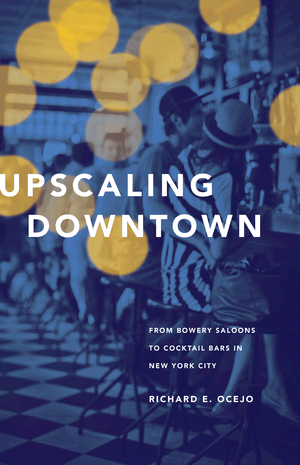
While it's a great read -- he provides a broad view of the many divisions within the community and it's fun to recognize the many locals he interviewed -- the theoretical background assumptions inherited from the standard academic literature on gentrification occasionally undermine the specificity of the case history. This is not Ocejo's fault; it's the failure of the academic theorists.

It's assumed that because gentrified neighborhoods are preceded by artists and other marginal white misfits, that their presence causes gentrification. But if you look at the facts of history, you find a different and more complex story. When artists and marginals arrived in both the Bowery and the Lower East Side (including what's now called the East Village and Alphabet City), the neighborhoods continued to decline. The artists and misfits did not attract money or commerce. They attracted more misfits and artists.

To blame artists and marginals (Vietnam veterans, the homeless, substance abusers, prostitutes, ex cons, the chronically unemployed, lost youth) for gentrification on the grounds of having preceded gentrification is like blaming the rain on dry streets because dry streets precede rain. The academic theorists have invented a mechanism employing the classic fallacies -- confusing correlation with causation and post hoc ergo propter hoc. In their desperate search for a grandiose theory that will explain all instances, they've drawn hasty, blanket conclusions without looking carefully enough at the details and specificity of the context.

Unfortunately for the big theory, the Bowery attracted misfits for two centuries without seeing any gentrification. For most of those two centuries, it declined right up to 2005 with not a hint of gentrification. What changed the Bowery was city planning, in particular, the Chrystie Avalon complex. Not artists, not misfits, not wayward white youth slumming. City Planning: government.

The theory of gentrification comes to us from classical Marxism, a pre macro-economic theory. It attributes all to market forces and none to government intervention. It's certainly true that the accumulation of capital in excess of any market demand for productivity could be a pressure towards gentrification. But the avenues of speculation depend on what government incentivizes. Buying luxury apartments on Central Park South is the current means. But the gentrification of the LES did not begin with big capital. It started with small time investors. Big capital didn't want to take a chance on a crime-ridden, marginal neighborhood full of weirdos and resistant anarchists.
.....
The assumption has been that whiteness itself attracts money. So Ocejo calls whites who moved to Alphabet City in the mid to late 1970's "early gentrifiers," although for years they watched as their streets continued to decline replacing older residents with shooting galleries (for heroin users), drug dealers replacing families with growing children. More complicating, while these streets declined and buildings were abandoned, burned and the remnants demolished, other parts of the neighborhood were gentrifying. The early marginals and artists did not contribute to it. On the contrary, most of them had to be displaced in order for gentrification to spread. What drew gentrifiers to those parts of the neighborhood were their amenities -- a park view or in the case of Christodora House, spectacular panoramic views. Again, not artists, nor the artistic scene.

If you look through the NYTimes archive, you'll find stories from the Bowery 1880's, the years when it began its steep decline, stories about the death of a resident who lived as a pauper but was escaping from his wealthy family. The millionaire living like a pauper-in-rags is not an urban myth. These people lived on the Bowery and in neighborhoods like the LES. To call them early gentrifiers indicates that the theory has gone astray. The notion is incoherent -- it provides no principled distinction between white people who draw money and white people who repel it -- and it's falsified by history.

Again, contrary to Neil Smith's theory, the neighborhood did not decline in order for developers to buy them cheap, nor is there a universal cyclic law of neighborhood decline followed by redevelopment. The LES declined because it was abandoned by labor when public transit made it possible for labor to leave. It's not a grand conspiracy or a cycle of capital disinvestment. A neighborhood with money need never decline -- investors renovate the housing stock or redevelop it. Contrary to Smith, landlords don't seek disinvestment, although government does -- to create ghettos in a program of segregating races by "providing" affordable housing through the market. Here Smith is particularly incoherent: he sees renovation as a means of gentrification only after the neighborhood reaches rock bottom. He forgets that renovation was always an option.

The underpinnings of gentrification theory are constructed for the convenience of broad theories that ignore the specificity of place and the serendipity of technological, political, cultural and legal transformations. The most effective law of urban development is the law of unintended consequences. A close second is government.

Sunday, June 30, 2013

NeverNeverLand

Some years ago (14? 15?) I was walking back home through TSP from a civil disobedience arrest -- earlier in the day I'd intervened with a cop giving a bike ticket to an elderly Latino who'd innocently biked through the intersection of 11th and B on a Saturday morning with no traffic anywhere in sight (except the cop car). The cop was already incensed, since he'd been barking orders over his car megaphone trying to get the old man to get off his bike, this cop too dim (nothing against the force -- some are smart, others not) too dim to grasp that the old man obviously didn't know a word of English and had no clue he'd done anything wrong and the cop too lazy to get out of his car and use gestures to explain himself. I knew the old man -- he bagged groceries for the local supermarket. A $100 fine would be more than he could afford, probably ten times more than the price of his funky third-hand bike. After I tried, nicely, to persuade the cop to let the old guy go, the cop brushed me off insultingly when he'd done with the ticket. I yelled back at him, "Get out of my community," for which he arrested me. I'd already been arrested for civil disobedience a couple times before (was this civil disobedience or just self-expression?) so I didn't think much of it, but my roommate, a gentle soul not from New York, who saw it from down the block, was terrified. If you break the law and are arrested for it, at least you know what the charge will be and something of what to expect from the police. But if you're arrested for nothing illegal but for angering the arresting officer -- well my roommate was convinced he'd never see me alive again.)

So I was coming back from this arrest -- as it turned out, the two hours I spent in the holding cell was passed with talking to the cop, intermittently explaining why ticketing old immigrants just to raise city revenue or personal quotas is really shameful. By the time the two hours were done, he was embrrassed enough that he wrote up the charges intentionally so that the judge would throw them out instantly -- disorderly conduct for talking back to an officer. Several weeks later in court, the senescent nonagenarian judge did dismiss it along with a doddering admonition to me that I should be more respectful, young man.

Well, coming back home I ran into Hippie. "Hippie" is not actually his name, of course. From Puerto Rico, here he was called "Hippie" for his long, flowing, reddish pony tail. I asked Hippie what he was doing back in the neighborhood. Since he'd been released from prison -- some stupid drug charge I suppose, I say stupid because Hippie was one of the most honest, decent, charming, pleasant men I've known -- he'd been diagnosed with Hep C, so the Dept of Social Services had arranged a free apartment for him in Brooklyn, yet here he was homeless and couch-surfing in Loisaida. "Hippie, you have an apartment, you're seriously sick and then some, why are you hanging here homeless?"

"I always come back to this neighborhood. I come back here for one reason and I can tell you why. Because it's mixed. I don't want to live in a ghetto. I always liked that this place is mixed. It was mixed back then. It still is."

That was about 14, 15 years ago. I don't see Hippie anymore. So many of the best are gone.

I grew up in a white 'ghetto.' Sometimes I ride my bike past it, but I never stop. It wasn't much interesting back then, and it's just as uninteresting today. For a while I lived up in Inwood -- huge, bright apartment, immense rooms; the hallway between the livingroom and the den so wide I had a piano in it -- a view of the Cloisters from my bedroom window, and cheap rent too. I was never happy there.

It's only been in Loisaida that I've found that urban mix, even when it was most abandoned -- because it was abandoned, abandoned by ownership, abandoned by commerce, abandonned by law and all authority. Landlord? Invisible. Work? No one worked except the dealers. The only people who cared about what you did were the people you lived with on the block. It was scarier than it was dangerous, but it was too scary for slummers. The place drew only outcasts, loners, misfits and marginals. And artists -- blacksmiths, poets, muralists, brilliant muralists, their work all gone.

Some places are more interesting than others, some more extreme, some more free; few are all those together. Never say NeverNeverLand never existed if you never lived there once.

David Graeber's recent book on debt ends with a defense of the chronic unemployed. He hints that maybe the economically unproductive are actually busy with useful services to their local communities.

Previously
the feeling for place -- the sacred and the profane; 

sacrificing for progress

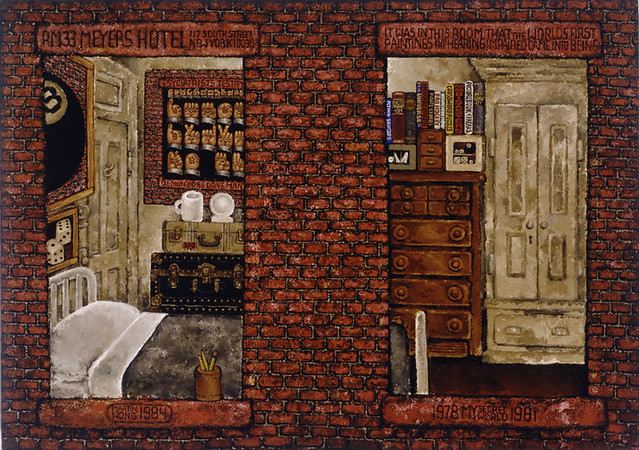
The work of Martin Wong, the only way to understand what we saw. Photography captures nothing -- nothing -- of a space so emotionally rich.