Here's the complete series on Gentrification in Chinatown:
Prestige and its deceptions and betrayals
Prestige and distortion in Chinatown
Suits and betrayal in Chinatown
The Mobility Dilemma and the Clearinghouse Effect
Authenticity in the East Village
and a broad consideration of the government role in gentrification and the flaw in academic theory.
Showing posts with label Neil Smith. Show all posts
Showing posts with label Neil Smith. Show all posts
Friday, February 19, 2016


Tuesday, January 19, 2016
Artists don't cause gentrification
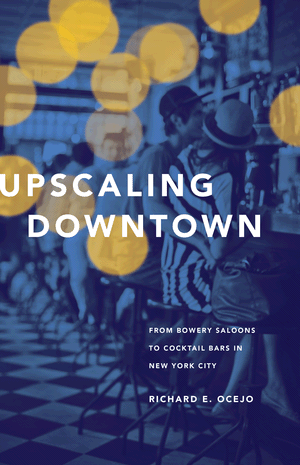
Last year Rich Ocejo published his book Upscaling Downtown, an excellent description of the changing bar scene in and around the Bowery/EV/LES, the nightlife pressure towards commercial gentrification and residential pushback against it. It's an important case history of a neighborhood in transition.
http://press.princeton.edu/titles/10396.html
 While it's a great read -- he provides a broad view of the many divisions within the community and it's fun to recognize the many locals he interviewed -- the theoretical background assumptions inherited from the standard academic literature on gentrification occasionally undermine the specificity of the case history. This is not Ocejo's fault; it's the failure of the academic theorists.
It's assumed that because gentrified neighborhoods are preceded by artists and other marginal white misfits, that their presence causes gentrification. But if you look at the facts of history, you find a different and more complex story. When artists and marginals arrived in both the Bowery and the Lower East Side (including what's now called the East Village and Alphabet City), the neighborhoods continued to decline. The artists and misfits did not attract money or commerce. They attracted more misfits and artists.
To blame artists and marginals (Vietnam veterans, the homeless, substance abusers, prostitutes, ex cons, the chronically unemployed, lost youth) for gentrification on the grounds of having preceded gentrification is like blaming the rain on dry streets because dry streets precede rain. The academic theorists have invented a mechanism employing the classic fallacies -- confusing correlation with causation and post hoc ergo propter hoc. In their desperate search for a grandiose theory that will explain all instances, they've drawn hasty, blanket conclusions without looking carefully enough at the details and specificity of the context.
Unfortunately for the big theory, the Bowery attracted misfits for two centuries without seeing any gentrification. For most of those two centuries, it declined right up to 2005 with not a hint of gentrification. What changed the Bowery was city planning, in particular, the Chrystie Avalon complex. Not artists, not misfits, not wayward white youth slumming. City Planning: government.
The theory of gentrification comes to us from classical Marxism, a pre macro-economic theory. It attributes all to market forces and none to government intervention. It's certainly true that the accumulation of capital in excess of any market demand for productivity could be a pressure towards gentrification. But the avenues of speculation depend on what government incentivizes. Buying luxury apartments on Central Park South is the current means. But the gentrification of the LES did not begin with big capital. It started with small time investors. Big capital didn't want to take a chance on a crime-ridden, marginal neighborhood full of weirdos and resistant anarchists.
.....
The assumption has been that whiteness itself attracts money. So Ocejo calls whites who moved to Alphabet City in the mid to late 1970's "early gentrifiers," although for years they watched as their streets continued to decline replacing older residents with shooting galleries (for heroin users), drug dealers replacing families with growing children. More complicating, while these streets declined and buildings were abandoned, burned and the remnants demolished, other parts of the neighborhood were gentrifying. The early marginals and artists did not contribute to it. On the contrary, most of them had to be displaced in order for gentrification to spread. What drew gentrifiers to those parts of the neighborhood were their amenities -- a park view or in the case of Christodora House, spectacular panoramic views. Again, not artists, nor the artistic scene.
If you look through the NYTimes archive, you'll find stories from the Bowery 1880's, the years when it began its steep decline, stories about the death of a resident who lived as a pauper but was escaping from his wealthy family. The millionaire living like a pauper-in-rags is not an urban myth. These people lived on the Bowery and in neighborhoods like the LES. To call them early gentrifiers indicates that the theory has gone astray. The notion is incoherent -- it provides no principled distinction between white people who draw money and white people who repel it -- and it's falsified by history.
Again, contrary to Neil Smith's theory, the neighborhood did not decline in order for developers to buy them cheap, nor is there a universal cyclic law of neighborhood decline followed by redevelopment. The LES declined because it was abandoned by labor when public transit made it possible for labor to leave. It's not a grand conspiracy or a cycle of capital disinvestment. A neighborhood with money need never decline -- investors renovate the housing stock or redevelop it. Contrary to Smith, landlords don't seek disinvestment, although government does -- to create ghettos in a program of segregating races by "providing" affordable housing through the market. Here Smith is particularly incoherent: he sees renovation as a means of gentrification only after the neighborhood reaches rock bottom. He forgets that renovation was always an option.
The underpinnings of gentrification theory are constructed for the convenience of broad theories that ignore the specificity of place and the serendipity of technological, political, cultural and legal transformations. The most effective law of urban development is the law of unintended consequences. A close second is government.
http://press.princeton.edu/titles/10396.html
It's assumed that because gentrified neighborhoods are preceded by artists and other marginal white misfits, that their presence causes gentrification. But if you look at the facts of history, you find a different and more complex story. When artists and marginals arrived in both the Bowery and the Lower East Side (including what's now called the East Village and Alphabet City), the neighborhoods continued to decline. The artists and misfits did not attract money or commerce. They attracted more misfits and artists.
To blame artists and marginals (Vietnam veterans, the homeless, substance abusers, prostitutes, ex cons, the chronically unemployed, lost youth) for gentrification on the grounds of having preceded gentrification is like blaming the rain on dry streets because dry streets precede rain. The academic theorists have invented a mechanism employing the classic fallacies -- confusing correlation with causation and post hoc ergo propter hoc. In their desperate search for a grandiose theory that will explain all instances, they've drawn hasty, blanket conclusions without looking carefully enough at the details and specificity of the context.
Unfortunately for the big theory, the Bowery attracted misfits for two centuries without seeing any gentrification. For most of those two centuries, it declined right up to 2005 with not a hint of gentrification. What changed the Bowery was city planning, in particular, the Chrystie Avalon complex. Not artists, not misfits, not wayward white youth slumming. City Planning: government.
The theory of gentrification comes to us from classical Marxism, a pre macro-economic theory. It attributes all to market forces and none to government intervention. It's certainly true that the accumulation of capital in excess of any market demand for productivity could be a pressure towards gentrification. But the avenues of speculation depend on what government incentivizes. Buying luxury apartments on Central Park South is the current means. But the gentrification of the LES did not begin with big capital. It started with small time investors. Big capital didn't want to take a chance on a crime-ridden, marginal neighborhood full of weirdos and resistant anarchists.
.....
The assumption has been that whiteness itself attracts money. So Ocejo calls whites who moved to Alphabet City in the mid to late 1970's "early gentrifiers," although for years they watched as their streets continued to decline replacing older residents with shooting galleries (for heroin users), drug dealers replacing families with growing children. More complicating, while these streets declined and buildings were abandoned, burned and the remnants demolished, other parts of the neighborhood were gentrifying. The early marginals and artists did not contribute to it. On the contrary, most of them had to be displaced in order for gentrification to spread. What drew gentrifiers to those parts of the neighborhood were their amenities -- a park view or in the case of Christodora House, spectacular panoramic views. Again, not artists, nor the artistic scene.
If you look through the NYTimes archive, you'll find stories from the Bowery 1880's, the years when it began its steep decline, stories about the death of a resident who lived as a pauper but was escaping from his wealthy family. The millionaire living like a pauper-in-rags is not an urban myth. These people lived on the Bowery and in neighborhoods like the LES. To call them early gentrifiers indicates that the theory has gone astray. The notion is incoherent -- it provides no principled distinction between white people who draw money and white people who repel it -- and it's falsified by history.
Again, contrary to Neil Smith's theory, the neighborhood did not decline in order for developers to buy them cheap, nor is there a universal cyclic law of neighborhood decline followed by redevelopment. The LES declined because it was abandoned by labor when public transit made it possible for labor to leave. It's not a grand conspiracy or a cycle of capital disinvestment. A neighborhood with money need never decline -- investors renovate the housing stock or redevelop it. Contrary to Smith, landlords don't seek disinvestment, although government does -- to create ghettos in a program of segregating races by "providing" affordable housing through the market. Here Smith is particularly incoherent: he sees renovation as a means of gentrification only after the neighborhood reaches rock bottom. He forgets that renovation was always an option.
The underpinnings of gentrification theory are constructed for the convenience of broad theories that ignore the specificity of place and the serendipity of technological, political, cultural and legal transformations. The most effective law of urban development is the law of unintended consequences. A close second is government.
Thursday, August 15, 2013
The rent gap: a logical gap
Neil Smith attempted a predictive theory of gentrification within a Marxist frame with a close examination of the phenomena in the US, particularly in NYC during the period since the word "gentrification" was coined around 1964 by Ruth Glass. Smith observes that when property values decline to its bottom, investors see an opportunity to buy low in the expectation of revalorizing the property to reach its potential. The rent gap -- the gap between the low rent of a devalued property and its potential -- opens an opportunity for capital to fill in.
The notion is at best post hoc predictive, which is to say, not predictive at all. Consider Detroit. Property values have declined, but the properties are not ipso facto an opportunity for capital to invest at the bottom under the assumption that the values can't go anywhere but up. A property's potential is not a determinable quantity.
Property potential depends on many factors: cultural or economic interest in the location; government subsidies or incentives; a housing crunch in upscale neighborhoods driving money to seek options in less upscale locations. Speculation is not one of those. Real estate has speculated on neighborhoods before without raising values. The construction of Harlem around 1900 is the most obvious case in point. Built for the wealthy, it didn't take hold and declined.
Gentrification might not be so much a reflex of capital as of policy, including zoning (creating a housing crunch, e.g.), incentives and subsidies. A too abstract economic view of gentrification will miss the role of government policies that reflect conflicting interests, especially where the owners of capital live.
One might say that as long as population grows, just about every location has a rent gap. But this does not imply that properties must decline before they achieve the gap. Neighborhoods can gentrify even if they have never declined. Glass coined the word to describe the spread of gentry, displacing and transforming working class neighborhoods. Working class neighborhoods are not all the result of decline. Some working class neighborhoods are built for the working class, and appreciate as the neighborhood grows more dense. That was certainly true of the LES in the 19th century.
The urban decline that Smith observes is more an effect of transportation than the age-decline that he attributes it to. The automobile and mass transit allowed the opening up of suburbia and the downward spiral of white flight in the 1950's and 60's.
Though it isn't stated explicitly, Smith's analysis predicts that Park Avenue should turn into the next slum. I think that's possible, but not because the buildings will age-out. Age does not entail decline. There are older buildings in Greenwich Village which attract even wealthier owners. If Park Avenue declines, it'll be because wealthy owners have been attracted to the single-family tenement. Park Avenue can't keep up with the scale of income inequality. The new New York will be full of these repurposed, culturally valued mansions that we are beginning to see in the EV. Three years ago, 47 E. 3rd was an aberration. Today there are four such single-family tenements here. Trends take a while and appear at first as insignificant. Give it time...
The notion is at best post hoc predictive, which is to say, not predictive at all. Consider Detroit. Property values have declined, but the properties are not ipso facto an opportunity for capital to invest at the bottom under the assumption that the values can't go anywhere but up. A property's potential is not a determinable quantity.
Property potential depends on many factors: cultural or economic interest in the location; government subsidies or incentives; a housing crunch in upscale neighborhoods driving money to seek options in less upscale locations. Speculation is not one of those. Real estate has speculated on neighborhoods before without raising values. The construction of Harlem around 1900 is the most obvious case in point. Built for the wealthy, it didn't take hold and declined.
Gentrification might not be so much a reflex of capital as of policy, including zoning (creating a housing crunch, e.g.), incentives and subsidies. A too abstract economic view of gentrification will miss the role of government policies that reflect conflicting interests, especially where the owners of capital live.
One might say that as long as population grows, just about every location has a rent gap. But this does not imply that properties must decline before they achieve the gap. Neighborhoods can gentrify even if they have never declined. Glass coined the word to describe the spread of gentry, displacing and transforming working class neighborhoods. Working class neighborhoods are not all the result of decline. Some working class neighborhoods are built for the working class, and appreciate as the neighborhood grows more dense. That was certainly true of the LES in the 19th century.
The urban decline that Smith observes is more an effect of transportation than the age-decline that he attributes it to. The automobile and mass transit allowed the opening up of suburbia and the downward spiral of white flight in the 1950's and 60's.
Though it isn't stated explicitly, Smith's analysis predicts that Park Avenue should turn into the next slum. I think that's possible, but not because the buildings will age-out. Age does not entail decline. There are older buildings in Greenwich Village which attract even wealthier owners. If Park Avenue declines, it'll be because wealthy owners have been attracted to the single-family tenement. Park Avenue can't keep up with the scale of income inequality. The new New York will be full of these repurposed, culturally valued mansions that we are beginning to see in the EV. Three years ago, 47 E. 3rd was an aberration. Today there are four such single-family tenements here. Trends take a while and appear at first as insignificant. Give it time...
Subscribe to:
Posts (Atom)

 Posts
Posts


