Showing posts with label zoning. Show all posts

Sunday, February 14, 2016

Affordable housing and non profits (video snip)

Here's a very brief snippet from the Occupy AltBank talk on zoning and affordable housing last week posted on facebook by Sumumba Sobukwe, an active member of AltBank and cocreator of Occu-Evolve.

Here again is the presentation in the form of blogposts:

The origins and history of zoning and the Amenities Dilemma

Zoning with a conscience

Contextual zoning and "affordable" housing

Collusion between gov't, developers and non profits: the cooptation of the left

the current mayor's plan

Thursday, February 04, 2016

Contextual zoning and inclusionary housing

As we saw last time, by limiting the developmental rights -- the allowable floor area -- in every zone, zoning created a market of space. By the same token, it made it possible for the gov't to create property out of air, out of words in the zoning text. Upzone a neighborhood -- allow more floor area per lot -- the owner now not only can build more actual rental space but, if he doesn't have the financial resources to construct, can sell the unbuilt floor area to another developer who does. This gives the gov't powerful leverage on developers.

We also saw that while the small landowners benefit form the sale of developmental rights ("air rights"), their property becomes developmentally inert and in the long run, less profitable, and because the nearby skyscraper has raised the local real estate taxes, the property may become a source of discontent. In addition, the Modernist model of surrounding tall, dense buildings with park space instead of integrating residences with commercial storefronts aligned on the streetscape turned out to be a disaster in the so-called "projects." Modernist ideals were replaced with a belief in value of the urban integrated streetscape -- storefronts on the street-level which would bring lively commerce and businesses that would clean and protect the street. This led to a reaction against the tower-in-the-park zoning which created disjointed, discontinuous streetscapes.

The response was the current model of zoning called "contextual." The city added another innovation, this in the measure of space: the height cap. Zoning would now provide a floor space allowance, but also a height cap, so a developer could no longer buy unused developmental rights ("air rights") to build out-of-scale skyscrapers in low- or mid-rise zones.

Meanwhile, the gov't got out of the business of constructing low-income housing (projects) using instead its leverage through zoning to get developers to build affordable housing. The Bloomberg model worked so:

1. Designate a height cap in a zone that is higher than is needed for the designated floor area.
2. Offer the developer additional floor area if the developer built some affordable housing there.

So it's an incentive deal made to the developer. If he builds affordable housing in addition to the market rate units he wants, the city will allow him more space to build additional market rate units. The market rate bonus wasn't much, but it was more than nothing. Typically, the ratio was something like 4 units affordable, 1 unit market rate. The developer might be allowed, in other words, to build another  25% more space, but the total building would have to be 20% affordable, so the market rate bonus was just 5%.

Not many developers bothered with the bonus. De Blasio claimed that they didn't want the bonus because in order to squeeze in the affordable units within the height cap, the entire building had to have low ceilings. So the Department of City Planning came up with a fix: raise all the contextual heights so that developers didn't have to sacrifice ceiling height for the affordability bonus. The developer could build high ceilings for the luxury clients and still have room for affordable housing plus the market rate bonus incentive. The developer could eat his cake and the city could have it too.

De Blasio also proposed that wherever there's an upzoning, affordable housing would have to be included -- if the developer gets an increase in floor area, the developer must build 20% of the building as affordable housing. Since this mandatory inclusionary housing doesn't apply unless there's an upzoning, de Blasio's proposal is similar to the Bloomberg model. But under the Bloomberg model developers might advocate to get an upzoning and not bother with the bonus affordability incentive. Under the de Blasio model, the developers might think twice about advocating for an upzoning since the affordability would be forced on them.

Next up, the role of affordable housing non profits and the community boards.

Wednesday, February 03, 2016

Zoning with a conscience (the talk'll be up at Columbia University in the Foreign Affairs building, 420 W. 118th Street, room 409, 2pm Sunday)

In 1961, the city updated its zoning. This time, the city's planners responded to the Modernist movement which had been around since 1910 or so, but gov't isn't exactly avant garde, so it takes time for gov't to catch on.

The principles of Modernism reflect deep social awareness, with its origins in socialism at a time when socialism was not only respectable, but viewed as the best means, perhaps the only means, towards social justice. Rather than merely serving the investors' financial interests, Modernist architects intended to design an ideal world for all. They developed manifestos and principles of design, competed intellectually for innovations that would improve humanity, not just the developer or his rich clients. Stylistically, they rejected the ostentatious flaunting of wealth that characterized the design fashions of their predecessors. Ornamentation signaled useless vanity. Modernism replaced the show of wealth with purely functional form -- no eyebrows over the windows, no more columns and terra cotta. Steel girders and glass walls -- the structural elements -- were left bare in rectangular shapes of structural support: the Seagrams Building is its most insistent and elegant expression.

You'll notice that unlike the Equitable Building that covered the lot completely, and unlike the Empire State Building that attenuates towards its spire, this building rises straight up but doesn't cover the lot. Instead of setbacks to bring light to the street, the new zoning required that as the building grows taller, its footprint must attenuate, not its tower. The result is an empty space surrounding the building, which then can be used by the public as a park or plaza. The method of bringing light to the street is shifted from the top of the building to the bottom where the public can benefit both from the light and from the space. 

The new zoning also introduced a method of restricting the bulk or size of a building. Previously, buildings could be built to whatever height, allowing overwhelming and oppressive density. City Planning Commission came up with a measure of density that still allowed for flexibility of height. The measure of size is the floor area. By zoning for floor space rather than for height, developers were allowed to choose the height of the ceiling freely. 
The New Museum has the same floor area and zoning as its nextdoor neighbor
but because its ceiling heights are 20'+ it dwarfs the buildings on the street.
But their innovation served much more than that. It was now possible to limit the bulk of all the existing or potential buildings in a specific zone. And it allowed landowners to sell their bulk allowance to other landowners who might want to build more than the zoning had given them. The new zoning created a market of space. 

It also had a preservationist consequence for owners who sold their bulk allowance in excess of their existing building. Once an owner has sold his excess bulk allowance -- his developmental rights, sometimes called "air rights" -- the owner can't develop anything larger than the building he already has, so there's no reason for him ever to redevelop his building. The result is a kind of preservationist balance: for every tall skyscraper built by buying developmental rights of small buildings nearby, those smaller buildings are preserved. The new ensures the old. 

It also ensures that the old, small owner loses the value of his property, can't sell it easily, since who wants a building that can't be redeveloped for increased rents, while the skyscraper next door increases the real estate values of the neighborhood and therefore the real estate taxes. The small owner may have gotten a one-time windfall from selling the air rights, but in the long run, he's losing. 

Next up, the current model and how it plays into affordable housing. 

Tuesday, February 02, 2016

Talking this Sunday at OWS Altbank (Alternative Banking) Group on zoning and displacement

I'll be giving a talk on zoning, its consequences and how it plays out in local politics. Here's a brief outline.

The Amenties Dilemma

I'll be starting with what I call the "amenities dilemma": whenever some amenity that improves the quality of life is brought into a low-income neighborhood or ethnic enclave, whether it's better plumbing or a nicer sidewalk, it raises real estate values and attracts investment. It's not just a quantity of money that flows into the neighborhood, but the color of money, which is not green. Money in America is white, and it has an affinity as well as a color: it's drawn to more whiteness. Any improvement in a low-income neighborhood tends to whiten it and drive out the color. It's called gentrification and its consequence, community displacement.

Why should money harass the color out of a neighborhood? Is it greedy maximization of profit?

I dislike the use of "greed" as an economic explanation. It implies that there are some defective people who are to blame for what's wrong in the world. That sort of psychological essentialism -- some people are greedy, others not -- leads to a misunderstanding of how economies and societies work, and leads away from any meaningful solutions to its problems. What we call greed may be less affective, personal or psychological than mere opportunity. If there is no opportunity to make money out of some place, thing or person, people are pretty chill about that person, place or thing. It's when there's some kind of opportunity to gain from a place, person or thing that the feeding frenzy begins.

When the Lower East Side was an abandoned slum, it took my landlord eight months to bother to try to evict me for non payment, because the rent was so low that getting the rent or replacing me with another low renter was hardly worth the trouble. Today if I am five days late with my rent, the landlord files eviction proceedings and assesses a late fine onto my rent. Where there's money to be made, the pressure becomes irresistible and fierce.

The amenities dilemma -- leaving the ghetto in poverty preserves the community but ensures their poverty, while improving the ghetto just shifts the community to a new place of poverty (the dilemma was observed way back by Friedrich Engels in his "The Housing Question")  -- is the big problem for zoning designed to create affordable housing. That's what the talk is mostly about. But first I want to look at how zoning came about, what its goals were and are, and how it works.


The origin of zoning

In 1915, Equitable Life built an office tower designed to be the largest such space in the world. Taking up a huge lot, the building rose straight up 38 stories, casting a shadow a quarter of a mile. This was a time before Wall Street was covered with skyscrapers. The buildings there were much more modest and natural light was still available. Commercial buildings were structured to use natural light. Cast iron, favored for commercial buildings, allowed maximal window coverage with minimal structural support. The Equitable Building's shadow instantly depressed real estate values all around it. Landlords and real estate speculators throughout the city were terrified and infuriated, not just over the building, but the possibility that other corporate giants would build near their lots. The real estate industry demanded that the city respond with a permanent fix so that this never happen again.
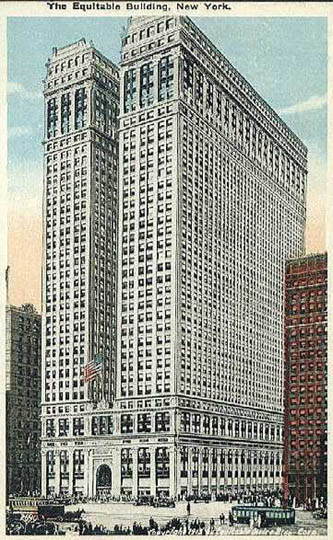
The very next year the city implemented its first zoning law. Note that the city responded immediately. The disastrous 1879 Tenement Housing Act that created dangerous and unsanitary conditions in the ghetto wasn't fixed for twenty-two years. Zoning took a matter of months. The difference? Money and investors vs immigrant labor. Note also that the housing need for the ghetto was dangerous and unsanitary structural designs inducing life-threatening diseases and fire; the needs of the real estate industry were investment.

The zoning had two new requirements. One was a restriction on types of uses so that factories couldn't be built along residences. Factories bring noise and stench and worse, laborers, who are also noisy and smelly that destroy the real estate value of a residential neighborhood. The city came up with the idea of creating residential zones where commerce was allowed but not manufacturing. There'd also be commercial zones where some residences were allowed, and manufacturing zones where manufacturing and some commercial buildings but not residential buildings could be built.

The second idea was a design innovation. Any tall building had to attenuate -- as it grew higher, it had to be more slender. The idea was to prevent the skyscraper from blocking out all the sunlight, while still allowing developers to build big to cash in on rental space. This requirement of attenuation is easily visible in the most familiar and identifiable NYC skyscrapers. The Empire State Building took its design not from any fashion, but from the strictures of the law. In fact, the real estate industry hired an architectural draftsman, Hugh Ferriss, to interpret the legalese to the architects.

These gradual attenuations are called setbacks.

Both of these innovations were specifically designed to protect the interests of real estate industry -- landowners and developers.

Next up, tower-in-the-park zoning, modernism -- design with a social conscience and unintended consequences -- and developmental rights or how gov't creates property and value for the landowner out of thin air.

Monday, January 25, 2016

De Blasio's difference

For the last decade, the progressive left has been begging for a mandatory inclusionary housing program in New York City requiring that all new residential buildings include a quantity of affordable housing. The mayor has proposed exactly such a plan. The community boards and the progressive left have rejected it. Why?

First, compare the mayor's plan with the Bloomberg model of inclusionary zoning. Bloomberg rezoned 120 neighborhoods in the city. Each one contained significant upzonings -- greater allowances for larger buildings, a give-away to developers. In addition to the upzoning give-away, Bloomberg offered developers the option to build even more space if a portion included affordable housing. Usually the bonus -- the added market-rate housing that the developer could build above the affordable component -- wasn't enough for the developer to bother with, so they didn't.

However, affordable housing non profits, which manage the affordable housing component and get their funding for doing it, and whose mission is to create or promote the creation of affordable housing, were the advocates for the inclusionary program. So you'd see the irony of progressive community-based non profits selling development and upzoning to the communities with the promise that the affordable housing would benefit the community. Carefully not mentioned was that the development would raise real estate values, the market rate housing attract more money, and landlords, seeing an opportunity to cash in on the upscaling of the neighborhood, would harass tenants in a thousand ways, and the result would be community displacement and a net loss of affordable housing, particularly steep if the developers didn't even bother with the inclusionary bonus.

Of course, the affordable housing wasn't for the community in the first place. The housing was delegated by raffle, and the housing wasn't often affordable to the locals anyway. So this model of community stabilization or preservation was what I call the Invasion of the Body Snatchers model of community preservation. The community is replaced with other individuals who purport to be just like them with respect to income. But they are not the community. And since the housing isn't affordable to the prior community, it's not even Body Snatchers, it's just wholesale snatching.

Mandatory IZ doesn't solve this conflict between the creation of affordable housing through development and gentrification/displacement. That's one reason why the community boards haven't cottoned to it. But you'd think that the progressive non profits would still be advocating for it. And here's a big difference in the structure of the mayor's proposal. Instead of rezoning neighborhoods one by one, his proposal changes the zoning law itself, so the city would be upzoned automatically without any further process. Community boards would have little say and the non profits would be left out as well.

Under Bloomberg, it was possible for the communities to ask for additional perks in the form of funding for the non profits -- legal services to help evicted tenants, for example. Under de Blasio's proposal, there's no opportunity for the community to leverage such additional funding.

More important, the de Blasio proposal doesn't kick in until there's an upzoning, so in effect, his proposal is just as voluntary as the Bloomberg model. With a little difference: since developers, prior to any upzoning can develop now without including affordable housing, we should expect them to lose interest in upzonings. It has been well observed that mandatory inclusionary housing has this kind of dampening effect on development. We should expect to see the non profits still advocate for upzonings, and less upzoning advocacy from the developers.

The Bloomberg model placed the developer in the drivers' seat, drawing the non profits onto the developers' bus for the sake of the affordable housing and their legal services funding, while they all throw the community under the very bus they're driving. De Blasio's model takes the developer out of the driver's seat, leaving the non profits on a bus going nowhere.

The irony is even more stark -- we should expect to find that the only people advocating for upzoning, gentrification and displacement would be the progressive non profits under the new model.

Wednesday, January 20, 2016

Money laundering and affordable housing

The Treasury's decision to investigate money laundering through NYC real estate might actually save New York from wholesale gentrification.

Constructing a lot of new housing can keep rents low by adding supply. Because it's expensive to build, developers prefer constructing luxury housing to get the quickest and highest rate of return. If the wealthy move out of older housing stock or locations further from the city center into these new luxury units, they free up housing for the less wealthy, who decamp from their older and further locations in turn freeing up housing for the even less wealthy and so on down the line. This is the one good reason for de Blasio's Zoning for Quality and Affordability (ZQA) -- allow new units to have higher ceilings to attract the wealthy out of less appealing older models.

But if the luxury housing is being bought by foreign speculators or money launderers who have no intention of living in the apartments, new construction does no good for the housing market. It turns the city's real estate into a non housing market crowding out the housing market. It's a disaster for the resident citizen, especially the low-income and immigrants.

(You might think, well if we eliminated rent regulations, the market would be flooded with vacant apartments, but this is both empirically and theoretically wrong. Most people who would be pushed out of deregulated apartments don't -- and often can't -- leave the local rental pool. They just move to a lower income neighborhood where they create a tighter market and push out lower income tenants who in turn move to lower income neighborhoods evicting people there, again, all the way down the line until at the bottom immigrants huddle up in substandard housing crowded together in dangerous conditions. At the top, landlords renovate the vacated luxury units and hike the rents there. Iow, deregulation doesn't free up the market, it's just a game of musical chairs, destabilizing everyone and raising rents everywhere. This happened in Boston when rents were deregulated, so we know that it's not just a theoretical speculation-- it's reality.)

The alternative to constructing luxury apartments to ease the housing market is constructing affordable housing. But if the monied are still coming to the city and searching for apartments, the pressure on gentrification in outer boroughs will be greater than the creation of affordable housing can accommodate.

It's easy to show that the current model of affordable housing creation is necessarily inadequate. De Blasio's Mandatory Inclusionary Zoning, for example, would require one affordable apartment for every four luxury unit. But as we know from Occupy and presidential campaigns and memes everywhere, the ratio of the wealthy to the struggling is not four rich folks to each struggler, but more like 1:99, and that's actually generous. 1:999 would be closer to reality. So the current model is beyond inadequate -- it's preposterously inadequate.

So again, the affordable housing model can only work if the luxury housing doesn't become a place for billionaires to park their money. It's got to be housing, not speculation, otherwise the entire geography of the city will be distorted into empty speculation at its center without even a tax base.

Thursday, August 15, 2013

The rent gap: a logical gap

Neil Smith attempted a predictive theory of gentrification within a Marxist frame with a close examination of the phenomena in the US, particularly in NYC during the period since the word "gentrification" was coined around 1964 by Ruth Glass. Smith observes that when property values decline to its bottom, investors see an opportunity to buy low in the expectation of revalorizing the property to reach its potential. The rent gap -- the gap between the low rent of a devalued property and its potential -- opens an opportunity for capital to fill in.

The notion is at best post hoc predictive, which is to say, not predictive at all. Consider Detroit. Property values have declined, but the properties are not ipso facto an opportunity for capital to invest at the bottom under the assumption that the values can't go anywhere but up. A property's potential is not a determinable quantity.

Property potential depends on many factors: cultural or economic interest in the location; government subsidies or incentives; a housing crunch in upscale neighborhoods driving money to seek options in less upscale locations. Speculation is not one of those. Real estate has speculated on neighborhoods before without raising values. The construction of Harlem around 1900 is the most obvious case in point. Built for the wealthy, it didn't take hold and declined.

Gentrification might not be so much a reflex of capital as of policy, including zoning (creating a housing crunch, e.g.), incentives and subsidies. A too abstract economic view of gentrification will miss the role of government policies that reflect conflicting interests, especially where the owners of capital live.

One might say that as long as population grows, just about every location has a rent gap. But this does not imply that properties must decline before they achieve the gap. Neighborhoods can gentrify even if they have never declined. Glass coined the word to describe the spread of gentry, displacing and transforming working class neighborhoods. Working class neighborhoods are not all the result of decline. Some working class neighborhoods are built for the working class, and appreciate as the neighborhood grows more dense. That was certainly true of the LES in the 19th century.

The urban decline that Smith observes is more an effect of transportation than the age-decline that he attributes it to. The automobile and mass transit allowed the opening up of suburbia and the downward spiral of white flight in the 1950's and 60's.

Though it isn't stated explicitly, Smith's analysis predicts that Park Avenue should turn into the next slum. I think that's possible, but not because the buildings will age-out. Age does not entail decline. There are older buildings in Greenwich Village which attract even wealthier owners. If Park Avenue declines, it'll be because wealthy owners have been attracted to the single-family tenement. Park Avenue can't keep up with the scale of income inequality. The new New York will be full of these repurposed, culturally valued mansions that we are beginning to see in the EV. Three years ago, 47 E. 3rd was an aberration. Today there are four such single-family tenements here. Trends take a while and appear at first as insignificant. Give it time...

Monday, July 29, 2013

WNYC covers rent regulations

Adam Davidson, appearing on WNYC's morning "Brian Lehrer Show" discussion program, gave his strongest argument for rent deregulation without any analysis at all. Instead, he appeals to authority: economists on all sides agree that rent regulations are bad for the housing market and harm the middle class. 

True, economists agree on across-the-board rent regulations, but that's not New York's model. New units in NYC are not required to be regulated, so rent regulations here incentivize new construction. Deregulation would remove that incentive since raising rents and evicting tenants are cheaper and easier than construction. The New York model is actually healthy for the market.

Davidson refers to one economist, Christopher Mayer, but Mayer completely forgets that deregulated tenants don't simply disappear from the rental pool. If they have to vacate, they move from upscale neighborhoods into middle class neighborhoods and create a tighter market, raising rents there. So deregulation will hurt the middle class especially. In aggregate: 
deregulation = same # of units, same # of renters, just more wages going into rent, a windfall for landlords and no incentive to construct or ever ease the market. 

A land tax would help, tagged to upzonings in selected neighborhoods that can withstand increased development. 

Friday, June 21, 2013

AALDEF publishes new data on Chinatown land use

From AALDEF (Asian American Legal Defense and Education Fund): 
[scroll down for the pdf of the study]

June 21, 2013 – The Asian American Legal Defense and Education Fund (AALDEF) is releasing land use data on New York City’s Chinatown, as a preview of its forthcoming three-city study of Chinatowns and surrounding areas in Boston, New York, and Philadelphia.

"We have assembled data on the make-up of small businesses and properties in Chinatown that will enable us to document the effects of gentrification on Asian immigrants, who have been fighting for their community for decades,” said Bethany Li, staff attorney at AALDEF.

AALDEF, in collaboration with community partners, academic institutions, and hundreds of volunteers, spent a year recording block by block and lot by lot the existing land uses in Boston, New York, and Philadelphia Chinatowns and surrounding immigrant areas. Today’s initial release of land use data, combined with detailed analysis of Census data from the 1980s, provides a snapshot of the existing uses of New York’s Chinatown and describes its startling transformation in the past three decades.

New York’s Chinatown has served as the gateway for thousands of immigrants from Asia and is home to a thriving network of low-income residents and small businesses. However, property values in Lower Manhattan have increased substantially, and gentrification is threatening the neighborhoods’ historical and cultural significance. According to Census data, the overall population in New York’s Chinatown decreased 7% between 1990 and 2010 (from 125,574 to 116,722 people) due largely to the increase of non-family households and a decrease in family households -- a significant indicator of gentrification. As a result, many Asian immigrants face the prospect of displacement.

For example, AALDEF's study indicates that an overwhelming majority of commercial use in New York’s Chinatown consists of small businesses (94%), approximately 12% of which is classified as “high-end.” However, our survey shows that the most significant cluster of “high-end” businesses is in the area between Houston and Delancey Streets, where students and young professionals have displaced immigrant families in the past decade. "High-end" stores also dot the landscape along Allen and Orchard Streets heading towards more traditional parts of Chinatown.

“Gentrification threatens to transform these previously neglected neighborhoods into tourist centers and destroy the places where Asian immigrants have lived and worked for decades,” said Li. “We hope this data can be used to support organizing and planning efforts that help retain resources for New York’s Chinatown for current and future immigrants.”

This data was collected with the assistance of AALDEF’s community partners including Chinese Progressive Association and Boston Chinatown Neighborhood Center in Boston, Chinese Staff & Workers’ Association in New York, and Asian Americans United in Philadelphia. The University of Pennsylvania’s City and Urban Studies Department provided technical assistance on mapping and data analysis.

Contact:

Friday, June 14, 2013

Another CB question for NO711

Here's another question from CB3: on what grounds could the community board deny a chain store?

This is really complex and tough. If it's done quantitatively -- say, no more that one Duane Reade in a half mile radius -- that doesn't prevent a Duane Reade from opening where the locals really don't want it, and may prevent one where the locals do want it. If it's done by local preference, well, the community board is inviting a fight between locals with differing preferences, or making determinations on it's own caprice, which invites law suits from the rejected applicants.

But a special zoning, which is what the CB is considering, seems to me to be worse. If it defines the number of chain stores in particular areas it will freeze those areas based on current circumstances. In five years that plan will be obsolete. Few documents are as depressing as old urban plans. 

Sunday, June 02, 2013

Failed generalizations

Physics doesn't lack for predictive theories of physical nature, but if it were evaluated on its ability to predict the weather, we'd call it a dismal science. Economics doesn't lack for predictive theories either, it's just that we evaluate it on its ability to predict reality. Reality is only partly predictable.

Looking at the history of the LES in the 19th century, you see a consistent pattern of quality of living space declining in inverse relation to density and rent. Demand at the bottom of the social scale was sticky -- choices were limited by the lack of convenient transit and work was concentrated between the downtown docks and downtown industry. Ghetto construction was structurally uniform for each decade. Outside the immigrant quarter, amenities chased big money as you'd expect in an elastic market: a broad gradient from middle-class town houses to immense mansions. 

Both trends are economically predictable, perfect fodder for economic theory. But there's a change in the LES that doesn't fit the pattern. After around 1910, virtually nothing is built, even though the American economy continues to grow. Not surprising, the reasons for the end of development are not economic. One was a technological innovation only marginally unrelated to economic production -- the subway system, which increased mobility and commerce but not so much production. It allowed labor to live far afield. Quotas on immigration in the 1920's turned the ghetto from a high-demand exploitative rent district to a low-demand, low rent district as residents left for better living spaces and no new immigrants replaced them. Less obvious was the third tenement house New Law act, which required so much courtyard space that landlords couldn't develop on single lots anymore, curtailing single-lot development. You can see it for yourself on 1st Avenue -- rows of four- and five-story Antebellum tenements on single lots. 

Disinvestment in the ghetto was not the consequence of a shift from capital. That would be a backward analysis. Disinvestment was the consequence of political policy (labor protectionism, anti-immigrant eugenicism paralleling growing isolationism), a technological advance in mobility, and an entirely unintended consequence of a progressive movement to improve labor housing (again, politics) with the New Law that made it harder to develop downtown. 

The historical lesson I get from it: politics, technology and public policies like zoning and housing laws have had more profound local consequences than constants like capital growth. Culture plays a role as well. Gentrification can no longer be described as a single economic phenomenon if the youth culture of Williamsburg drives upscale families to seek child-friendlier neighborhoods. That has consequences for construction, schools and commercial character. Until an economist comes up with a theory that explains why a fix-wheel bike with no brakes designed for race tracks with no inclines and no stop lights would be the trend among upscale youth in urban centers filled with lights and steeply inclined bridges, economics will be stuck with "60% chance of rain today."

Will the future be like the past? You can count on the constants, so maybe that's where policy should target, always bearing in mind the law of unintended consequences rules. The most depressing documents are the urban planning proposals of the past. In retrospect they look completely wrongheaded, as if their authors didn't have a clue.

That's why local community self-determination has promise. It's not urban planning from above; it's urban needs from below where life actually happens. 

Thursday, May 30, 2013

Beware capitalist tools

Robert Reich, Clinton's Labor Secretary, posted Monday on his blog a piece arguing limiting access to giant corporations:
If global corporations obeyed all national laws — the spirit of the laws as well as the letter of them – and didn’t use their inordinate power to dictate the laws in the first place by otherwise threatening to take their jobs and investments elsewhere, there’d be no issue.
It’s the fact of their power to manipulate laws by playing nations off against one another – determining how much they pay in taxes, as well as how much they get in corporate welfare subsidies, how much regulation they’re subject to, and so on – that raises the question of how citizens can countermand this power.
Consumer benefits may sometimes exceed such costs. But, as we’ve painfully learned over the years (the Wall Street meltdown, the BP oil spill in the Gulf, consumer injuries and deaths from unsafe products, worker injuries and deaths from unsafe working conditions, climate change brought on by carbon dioxide emissions, and, yes, manipulation of the tax laws – need I go on?), the social costs may also exceed consumer benefits....
...Comparative advantage is nice in theory, but in a world where powerful global corporations are using every strategy imaginable to maximize their profits and powerful governments are strategically employing market access to develop their economies, it’s just theory. 
 Wouldn't it be great if NO711's zoning proposal were the beginning of a wide-spread resistance against global corporate access at the ground level? Instead of relying on our failed political system to defend us from global capital, start with community self-determination growing from a grassroots movement? Could this be the second wave for Occupy -- occupy our own community?

Wednesday, May 22, 2013

Shaoul, the BSA, DoB and WTF

Went to the Board of Standards and Appeals to see their response to Shaoul's request for a variance to keep the 6th floor expansion that the BSA had ruled illegally built some years ago. Shaoul's attorney made the good point that the Department of Buildings had issued a permit for the expansion, and the BSA didn't rule it illegal until after the expansion had been completed.

The BSA chair wasn't having any of it. She pointed out that the even though the building didn't have a Certificate of Occupancy, the owner had been renting the apartments illegally for years.

In reply, the attorney blamed that on the DoB for not enforcing the law. I was truly impressed with audacity of this legal argument. I really like it. If you place several hundred landlords, say, into a ship and sink it and drown them, it's the fault of the Coast Guard for not stopping you. I'm all for it.

But seriously, this attorney nailed the truth about NYC real estate: the DoB encourages illegal activity at every turn, either by issuing illegal permits (commonly permitting bulkheads that are actually intended for residential use, to skirt the zoning limits on residential space), or by failing to enforce blatantly illegal expansions, demolitions, hazardous endangerments to tenants -- literally whatever and whateverything landlords can think up.

Btw addendum: the BSA didn't rule on Shaoul's request at this hearing. They scheduled another hearing in late June and another in July to finish up. It was pretty clear that the BSA intends to deny him -- a whole bunch of elected officials signed on to a letter asking for a denial. But even if they deny, without enforcement, he'll just continue to flout the law.

Saturday, May 18, 2013

Reviewing the 2008 rezoning

Irrational opposition to NO711 takes me back to the EV/LES rezoning. The supporters of the rezoning were as outraged at me back then as I am towards the one person who maintains polemical objections to NO711 -- not because of his polemic, which is at least interesting, sound or not, but because he lied, then supressed the truth and followed with a string of manipulations and distortions. So I wonder if, in pushing my opposition to the rezoning, I was similarly manipulative. What I said about the rezoning back then was: 

1. The rezoning is an overall upzoning. The EIS bore me out -- 53% more development under the rezoning than under the previous zoning. (Harvey Epstein fortunately managed to mitigate the upzoning plan with an IZ application over the avenues.) 

2. The upzoning of sidestreets will turn townhouses overnight into candidates for demolition and luxury redevelopment. That was an accurate prediction.

3. Developers would often choose not to take the Inclusionary Housing bonus. Also an accurate prediction, although the jury remains out with the largest developments upcoming on Mary Help of Christians and the former theater/deli on A between 6th & 7th. 

4. The height caps were too high, which allows for air rights sales, undermining the inclusionary bonus incentive. We're seeing this at play on Norfolk Street, and there will be more. 

5. The LES downzoning would drive hotel development onto the Bowery and into Chinatown. Hotel development has gone crazy on the Bowery and in Chinatown since the rezoning, although it had already begun before 2008. Hotel development would probably have continued regardless of the rezoning, so it's hard to tell how much the rezoning increased it. 

6. If the EV rezoning is implemented, there would be little political will within CB3 to protect Chinatown and the Bowery. I think I was wrong about this. CB3 eventually came around to support the Bower Alliance of Neighbors zoning plan (although CB3 still features on its website its old Bowery study that BAN rejected), and CB3 has shown support for the Chinatown Working Group's zoning efforts despite its amibitious scope. It's taken time, but it's happening. 

7. CB3 did not push hard enough to protect the Bowery. Here I was completely wrong. The city was and is intransigent on the Bowery. When CB3 members told me this, I simply didn't believe them. I wrongly assumed that they were sacrificing the Bowery for the sake of the rest of the EV. Whether they could have tried harder is irrelevant: they saw (and I did not understand at the time) that the city wouldn't budge, so pushing would get nothing but push back and trouble. So, considering the possibilities, I now think that CB3 cannot be faulted at all for the Bowery and its lack of protection, and I was wrong to fault them then. 

(In my defense, the Task Force leadership undermined its credibility by insisting that everyone had to accept the plan immediately and without change otherwise DCP would walk away from the plan. I responded, btw, that DCP had no intention of walking out. I was right about that as well: CB3 never fully approved the plan, insisting on Harvey's and Paul's 11-points of contention to the end, and yet DCP never walked. It was DCP's plan as much as the Task Force's and DCP wanted it at least as much as the Task Force leadership wanted it.) 

8. Under the previous zoning, most development in the EV was contextual; out-of-scale development was mostly south of Houston. That was true. After NY Law School and TNC, there was a lot of redevelopment in the EV, but only two rose above seven stories, one on 12th & C and one on 13th & B, both about 9 stories, one story taller than would be allowed under the rezoning. Just about everything else capped at 6 stories. 

So was I full of manipulations, distortions and absurd arguments? I'd genuinely like the rezoning supporters to explain. I'm sure I see all this still from my own perspective, so I have to rely on them for a more complete assessment.

Demand for luxury apartments is higher than ever

Luxury apartments are rising higher now to meet increased demand. But "demand" is a gloss for at least three independent economic functions: 1) the quantity of those seeking an apartment relative to the availability of supply, 2) their willingness to part with their disposable income for living space (the "opportunity cost" of space), 3) the sheer quantity of their disposable income. There's a fourth function: a decline in use value that increases the exchange demand -- the willingness of apartment seekers to double up and share a space. Even if that doesn't directly raise prices of luxury apartments, it raises them indirectly. Raising prices down the ladder raises up top as the options narrow. 

The 19th century argument that the cost of living space would always rise as capital expands was definitively disproved in the 1960's and '70's when large swaths of Manhattan saw rental declines, in some places precipitous declines to zero and even below (landlord abandonment or arson, the city giving properties away to residents). This wasn't a shift of capital as with Detroit -- Detroit's experience gave support for Engels' warning that the immobility and economic inflexibility of home ownership for labor would be a curse as capital shifted locations, although in Engels' case he thought it wasn't so much capital shifting as that labor needed mobility to shift so it could sustain a strike by seeking work elsewhere. 

In New York it was a cultural shift to the suburbs partly encouraged by government both by construction of suburbs and of infrastructure to take residents to and from the suburbs. That's why Robert Moses is so much blamed for the bankrupting of NYC. Capital did not shift to the suburbs, leading urban dwellers out of the city; capital was still in the urban center when Moses allowed the tax base to shift to the suburbs, and capital followed. It can't be blamed on the loss of manufacturing base: New York is growing in population and in wealth and tax base, but not in manufacturing. The move to the suburbs was a government-facilitated cultural shift that eventually spiraled the city downward as the eroded tax base undermined services, and middle class flight undermined public education. Explicit race-based programs like red lining and slum clearance closed the coffin. 

The new demand for upscale housing shows distinct reflexes of its distinct functions. The quantity of apartment seekers will gentrify outer boroughs as long as central upscale development lags demand. The price of space will rise as long as the willingness and wealth is there. The draw in New York seems to be its density, safety and convenience. It's a party for the rich. 

So why do all these rich folks come here and why are they willing to pay ever more? Is it the nightlife here? Or that NYC is the chain store capital of the US? Maybe it's just NYU. 

Friday, April 12, 2013

Sunday in the Park with NO 7-ELEVEN


We're going to chalk up the park at the Tompkins Square Park nonbandshell at 2pm and then take our chalk and our Community Wheel of Fortune to the corner of Avenue A and 11th Street, the site of the threatened 7-Eleven, and chalk up the street and talk to the passers-by who don't yet know what's coming to their neighborhood. Join us for some good old anti-corporate-anti-suburbanization-and-anti-Pringle-ization-of-our-souls-and-our-streets fun! 

Here's a video journalism piece CUNY TV did on us (NO 7-Eleven starts @ 12:45) --

http://219tvmagazine.journalism.cuny.edu/2013/04/10/march2013/


(Wissecracks about my apartment will be punished.)

Friday, May 22, 2009

End of public review?

The NYC.Gov questionnaire on Environmental Review ("environment" here includes all impacts of a development on communities and includes public review) invites developers to provide reasons for dismantling ("streamlining") the review process. Once again, I urge you to go to the NYC.Gov Environmental Review questionnaire and explain why public review is important and should be strengthened.

Here's what I posted on the questionnaire (for an explanation of Environmental Review see the post below)

In answer to the question, "What contributes to the length and cost of the environmental review?":
What contributes to the length and cost of the environmental review is the government's essential responsibility to protect the public good, the indispensable need for public oversight, the public's need for protection from harmful development, and the responsibility of government to ensure that the public is not only protected, but informed and empowered against private interests that are not concerned at all with the public good or with sound urban planning.

In answer to the question, "How can City agencies communicate more effectively with the public concerning public hearings and meetings?" (the only well-meaning question there):

Community Boards and the city administration should provide the means for local organizing, with neighborhood websites and street-by-street blogs devoted to community issues where local residents and business owners can read press releases and post on issues of concern.
Community Boards should be required to publicize hearings at least one month in advance.
Developers should be required to post their building plans on the construction site as soon as they apply for plan approval.

And in answer to the question, "We want to know where you see opportunities for improvement. Which aspects of the process are successful and could be used as models to improve more problematic areas? Why?":

1) Including alternatives in the review enhances the value of the process and takes best advantage of resources. More alternatives should be included to afford the process greater flexibility and allow better planning directions and ideas a chance to be considered.
2) The independent research firm that conducts the reviews should be assessed and vetted by independent public interest urban planning groups including The Municipal Arts Society and the Historic Districts Council.
Currently, zoning EIS's have the uniform look of a rubber stamp for DCP. a) The independence of the public review must be ensured. It should not respond to developers' needs, but to the public's needs. b) The objectivity of the process must be protected. The Environmental Review must not become a rubber stamp for development.
3) The comprehensiveness, detail and thoroughness of the Review must be ensured and expanded. All aspects of impact on the community and surrounding communities must be carefully and objectively assessed by an independent party.
4) Public hearings and public outreach must be expanded.
5) Means of informing and educating the public must be enhanced.

The end of public review?

The mayor is planning to undermine government regulation and the public voice yet again.

The public's most powerful protection against destructive development is called the "Environmental Review" process. It's not about ecology. It's intended to be a public assessment of the impact of a proposed development on the entire community -- on population density, traffic, housing, services... And it includes crucial public hearings.

Developers hate this process. It's an obstacle in their way. They prefer to avoid public review or eliminate it entirely. And now the mayor wants to help them. Take a look.
http://www.nyc.gov/html/misc/html/2009/environmental_questionnaire.html

The mayor's Economic Development Corporation is seeking to "streamline" the process to "reduce the costs and delays" specifically for "property owners." The questionnaire is designed as a first step towards making it easier for developers to bypass Environmental Review.

Note the wording of the first topic: Topic 1 - Obstacles and Roadblocks
"We are interested in understanding the obstacles and roadblocks that may be experienced by applicants for projects subject to environmental review...."

I urge you to go to the questionnaire and explain why public review is important and should be strengthened. Let the EDC know that
1) The independence of the public review must be ensured. It should not respond to developers' needs, but to the public's needs.
2) The objectivity of the process must be protected. The Environmental Review must not become a rubber stamp for development.
3) The comprehensiveness, detail and thoroughness of the Review must be ensured and expanded. All aspects of impact on the community and surrounding communities must be carefully and objectively assessed by an independent party.
4) Public hearings and public outreach must be expanded.
5) Means of informing the public must be enhanced.

Remember that this is the same mayor who came up with a plan to restrict legal challenges to illegal developments. Without public review, residents and small businesses have no protection against development, against demolition, bulldozing, eviction, gentrification. It's giving the entire city over to developers whose interest is not the public good. It undermines government regulation and public oversight of destructive private interests. It's taking the city away from the public and handing it over to the few who just want to make a killing off your city and your lives.

Sunday, March 01, 2009

Chinatown working teams

I've been to three meetings of Chinatown Working Group 'teams' (euphemism for "committee," word that stifles all hope). Pleurisy, the devil's own invention, prevented me from attending a fourth team.

The cultural preservation team and the affordability team devoted their time to discussion, raising important issues and observing the challenges to resolving them. Wisely, no decisions were made. Instead, the teams took their first meeting as an opportunity to gain a sense of the group and a sense of direction.

The zoning team, by contrast, immediately drew up and voted on a list of desiderata without first gaining any sense of group direction. The result was a laundry list of items some of which seem to me to conflict, if not contradict one another.

I noticed that Chinatown residents participated fully at the cultural and especially at the affordability team, where the discussion seemed to me deepest. Chinatown residents participated least in the disappointing zoning team discussion. Perhaps there's a lesson to be learned there.

Full disclosure: I don't live in Chinatown (though I work there) and I did participate in the discussions.

The argument for bringing in outside meddlers seems to rest on the diversity and lack of consensus within Chinatown. Several members of the cultural team cited plans for a Chinatown arch that have gone nowhere although the City Council long ago designated funds for it, the moral being, you can't even get consensus in Chinatown on a free arch.

Hell, I don't know whether this whole enterpise will succeed, but I wouldn't be discouraged by an unbuilt arch! It may seem a paltry and easy task, but building an arch is actually just the kind of project that courts controversy: it's public, symbolic, supplies no need directly yet can favor one area over another and alters the experience of the common space for everyone in a seemingly gratuitous, authoritarian, paternalistic way. Of course it hasn't been built!

Not all projects court controversy. Creating and supporting a space for a cultural center, for example, supplies a need directly and daily, doesn't have to be seen by any but those who use and love it and doesn't force anyone to accept its symbolism, if it has any symbolism; it provides without taking. Where's the controversy?

Ah, Chinatown leaders sound like East Village activists: "it can't be done here, we're too factious." Well, if pessimistic complaints must precede accomplishment, so be it. I have confidence in this process...if only we outsiders can listen more and talk less.