Showing posts with label regulation. Show all posts

Friday, February 05, 2016

Collusion between gov't, developers and tenant advocacy non profits

By using zoning to limit developable space, and allowing that space to be bought and sold, gov't created property literally out of thin air -- out of the words of the zoning text. By creating a market the raw resource of which was created by the gov't, gov't could exert influence, manipulate and extort from developers. If a developer wanted more space than was available in the zoning, he had to go beg it of gov't, and gov't could grant the additional space for a favor. This market was the beginning of the end of gov't directly building affordable housing and instead drawing the developer into building it for the public.

Housing projects were widely viewed as a failure. A new generation of planners followed Jane Jacobs' broad criticism of tower-in-the-park construction, which she viewed as anti-urban, generating wastelands of non commercial, semi-abandoned and dangerous, isolated space. The reality was more complex. After all Stuyvesant Town is a housing project but no one complains that it's a failure. If anything, it's become to successful, too attractive as its management tries to replace older tenants with tenants eager to pay much higher rents there. But Stuy Town was middle-income, well maintained, with residents who were also well served by gov't and the economy in many ways. The low-income housing projects relied on inadequate gov't funding streams and the community was consistently underserved whether by the education system for its children or the employment opportunities for its parents, health services, sanitation and the maintenance of the grounds. If it failed, it failed because of the lack of social and financial investment in the human capital of the community. But that failure could easily be dressed up instead as a failure of urban and architectural planning and design.

Zoning incentives replaced housing projects. Developers would be given additional space to develop in return for building a modest percent of affordable housing that would be managed by a non profit tenant advocacy group. This model brought together gov't, developers and affordable housing non profits: gov't offered bulk space incentives to the developers while giving the non profits funding to manage the affordable housing. The developers needed to cooperate with both gov't and the non profits. And critically, the tenant advocacy groups were now compelled to work with and for both gov't and developers. 

In order to obtain affordable housing, the tenant advocacy non profits had to sell upzonings to their community, otherwise the non profit wouldn't get the affordable housing or their funding from the gov't. Since the affordable housing brings with it market-rate development, the result is gentrification, investment, opportunity for more investment and a feeding frenzy of tenant harassment. At the end of the day, affordable housing through zoning nets a loss of affordable housing. And since the affordable housing is given to people who are not currently living in the neighborhood, to call this "community preservation" is Orwellian doublespeak. 

Those in the community who are aware of the consequences of the affordable cooptation of the non profits, are placed in the ugly position of having to protest affordable housing. The gov't has effectively driven a wedge between affordable housing advocates and anti-gentrificationists by this Sophie's choice dichotomy of affordable housing (+market-rate housing) or else no development (+no new affordable housing). 

If you go to a City Planning hearing you can see the wedge in living color. The state-funded affordable housing non profits arrive with their employees and clients -- the tenants they work with in their tenant advocacy -- all in bright orange or yellow T-shirts. They don't testify, since they are brought to the hearing to pad the audience. Their leaders testify in favor of the upzoning on the grounds that it will bring affordable housing to the community. The rest of the audience is comprised by ordinary residents dressed all diversely, unorganized and unfunded. They do testify, one by one. They testify against the upzoning, expressing their concern about gentrification and community displacement. The Planning Commission ignores them because the city wants development -- it's revenue for the city. The people lose, and the sham continues. 

Monday, February 01, 2016

What's a tenement?

Good question! When I presented this talk at the Kahila Kedosha Janina, someone in the audience asked what I meant by tenement because this slide

looked to him like a picture of a luxurious residence, not his notion of a tenement. Appearances can deceive, and, we'll see, in more ways than one.

So what does the word tenement mean? What does the word denote -- what is a tenement?

Back in the day before the apartment building, New Yorkers lived in houses. Except for the new immigrants. They lived in abandoned breweries, abandoned churches, make-shift shacks and hovels. Wherever they lived in crowded quarters, the structure was referred to as a tenement, to distinguish it from a house or single-family home. The essential notion was a multiple dwelling. When the apartment building was created for the immigrants, they were then called tenement houses. These houses, bereft of any plumbing and soon without light or access to fresh air, eventually became the target of legal reform. The law then had to define its term: "the residence of three families or more living independently of each other and doing their cooking upon the premises..." (Tenement House Act 1867).

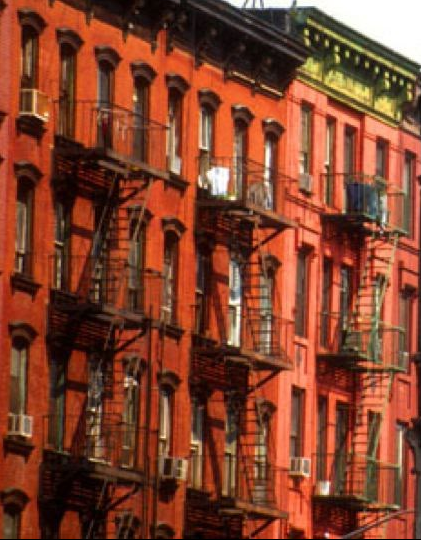
Popular culture mid century identified the tenement as the drab apartments of the poor, uniformly five stories tall, after 1867 with a fire-escape. When multiple dwellings caught on with the middle classes, the meaning of tenement could no longer be applied to them, since the connotation of poverty had been attached to the word as part of its denotation. So they built apartment buildings instead. Same structure, different dwellers, different class.
[For any semanticists reading, it's a case of de re association determining de dicto over time. First the de dicto meaning determines a class of objects that happened to be associated at one point with poverty. The denotation and its metonymic association then determines backward a new de dicto meaning, changing it into multiple dwelling in poverty. It's a language shift driven by the objects in the world, rather than by the word relations.]
Tenement housing reforms led to a truly progressive law just at the end of the Gilded Age in 1901, a moment in city history known as the City Beautiful Movement. The tenements built under this law were required to be larger than the old tenements, and were built in the contemporary international style (aka Parisian Academie des Beaux Arts style). They look like palatial mansions, but they were built for immigrant labor in the immigrant ghetto to collect immigrant labor rents and following the law defining them as tenements.

At this point in the history of the word, the meaning in English and the meaning in legalese depart ways. The audience member objected to me calling this building a tenement because tenement today denotes drab five or six story walk-up on a single lot with a fire escape originally built for the working class. The deception is multiple: the structure may look palatial but it was built for the working class, and even though it seems more spacious than an old tenement, it was defined by law as a tenement and not built as a middle-class apartment building. Once again: the exterior belongs to fashion; class is not a distinction in architectural style. The interior was determined by housing reform as a result of elite Republican efforts to recapture the voting base -- catering to the working class. Progress in the Progressive Age arose from working class solidarity, something we've lost in the city today.

So there are five meanings of tenement in New York history:

a building with many destitute immigrants living together before the apartment building was developed
1855
the typical structure built for immigrants in the immigrant ghetto
ca. 1870
the legal definition of multiple dwelling
Really big-ass tenement

the buildings built under the New Law Tenement House Act

the current American English meaning (derived from the second one above) but now inhabited by hipsters, yuppies, young families and old residents:

Thursday, August 01, 2013

Bloomberg smoking gun, media fails to report on it

Remember how we were all told that the Bloomberg sugar "portion cap" exempted the Big Gulp because the Health Department had no jurisdiction over FSE's (gorcieries, bodegas, 7-Elevens, convenience stores)? All lies. 

The Appellate Division's decision against Bloomberg's sugar "portion cap" addresses a complex web of intriguiging policy issues indicative of the Bloomberg administration. If a legilsative body, the City Council in this case, fails in its mandate to write effective laws, can a mayoral administration usurp its function for the welfare of the public? Under what conditions?

It turns out that the cap was much more than an administrative remedy for an ineffective legislature. The big news in the decision -- which has not been adequately reported in the media -- lies in the cap's favoritism. The mayor and the Board of Health claims that they have no jurisdiction over FSE's (groceries, 7-Eleven's, bodegas). But the decision explains that this is simply not true:

With regard to the exemption of certain FSE’s (i.e., grocerymarkets, 7-11s, bodegas, etc.), the DOHMH does not deny that the exemption has no relationship to health-related concerns. Still, the agency argues that it was not based on impermissible reasons, but on the agency’s allegedly reasonable view that such FSEs cannot be regulated by the Agency under the MOU signed with the state’s Department of Agriculture. However, the Board’s claim that the MOU tied its hands is belied by the fact that the agency [the Board of Health] has previously used its regulatory authority to promulgate city-wide health rules that regulate all FSEs (see e.g. 24 RCNY HealthCode 181.07) [city-wide regulation of common eating and drinking utensils]; 24 RCNY Health Code 71.05) [city-wide prohibition on the sale of “any food . . . which is adulterated or misbranded”]). Moreover, the MOU envisions “cooperative efforts between the two agencies [to] assure comprehensive food protection” and to avoid gaps in food surveillance.” Yet, the agency offers no evidence of any prior attempt to coordinate witht he Department of Agriculture on the Portion Cap Rule. The failure to obtain such expansion resulted in a ban that includes exceptions which necessarily favor some businesses and products at the expenses of others. Accordingly, the selective restrictions enacted by the Board of Health reveal that the health of the residents of New YorkCity was not its sole concern. If it were, the “Soda Ban” would apply to all public and private enterprises in New York City. By enacting a compromise measure — one that tempered its strong health concerns with its unstated but real worries about commercial well-being, as well as political considerations — the Board necessarily took into account its own non-health policy considerations. Judged by its deeds rather than by its explanations, the Board of Health's jurisdictional rationale evaporates.
Judge Renwick writing for a unanimous decision of all four Appellate judges, my emphases
What's important here is not just that the mayor could have extended the cap to delis, bodegas, groceries and 7-Elevens. It's that the mayor and the Board of Health lied about it to the public. 

The mayor purposely exempted FSE's exactly at the moment when 7-Eleven began its entry into New York. No wonder he lied.  

There's further evidence of malfeasance. The court found that the Department of Health didn't bother to include research in its cap policy, instead accepting a policy draft from the mayor's office itself without any research background. The research is easily available and pursuasive, but the Board didn't bother with it. The policy was a ukase from on high, handed from one office and accepted by another without demur or even window dressing. It shows excesive administrative control and a lack of agency independence, responsibility and accountability. Agencies are supposed to have and use specific expertise, not just hand over orders from above. Otherwise the agency has no justification for its existence or its expenses. 

Legislative bodies respond to constituencies as well as research, so popularity might be an obstacle to writing sound law. That's a justification for an administration, or certainly for a regulatory agency, to step in, where its expertise is wiser than popular opinion. But to step in without providing the evidence of the greater wisdom is hubris. You'd think Bloomberg would have been more careful. 

The answer to the questions at the top -- when can an administration overreach for the benefit of the public? -- has its answer. Checks and balances of government serve a purpose. Overreaching allows abuse of authority and cronyism. 

The court found that the Health Department overreached as a regulative agency on other grounds as well. One ground seems ambiguous: They found that sugar is not inherently dangerous, but only in large quantities, so regulating it depends on behavior, not flat out substance banning. That seems to argue on both sides: how else can the regulatory agency control the substance without overreaching into behavioral social policies that belong to the legislature? If the legislature is ineffectual, why not overreach? Is the slippery slope there too steep?

This seems to me to trade on a false dichotomy. Behavior is not the only means of controlling sugar. The soft drink industry can be burdened with the regulation, not the consumer. Problem is, the city has no jurisdiction over corn syrup production or use. 

In all organizations ruled by law, there are sectors that are protected from change, others that are easily pushed. By definition, those are the disempowered. Here it is the low-income consumer. Monsanto and Pepsi et al. should be burdened, not the consumer. In our society labor and consumers are mere pawns. Corporations and their products control our politics, our imagery, our information, our visibility. The bigger they are, the more control.

Monday, July 29, 2013

WNYC covers rent regulations

Adam Davidson, appearing on WNYC's morning "Brian Lehrer Show" discussion program, gave his strongest argument for rent deregulation without any analysis at all. Instead, he appeals to authority: economists on all sides agree that rent regulations are bad for the housing market and harm the middle class. 

True, economists agree on across-the-board rent regulations, but that's not New York's model. New units in NYC are not required to be regulated, so rent regulations here incentivize new construction. Deregulation would remove that incentive since raising rents and evicting tenants are cheaper and easier than construction. The New York model is actually healthy for the market.

Davidson refers to one economist, Christopher Mayer, but Mayer completely forgets that deregulated tenants don't simply disappear from the rental pool. If they have to vacate, they move from upscale neighborhoods into middle class neighborhoods and create a tighter market, raising rents there. So deregulation will hurt the middle class especially. In aggregate: 
deregulation = same # of units, same # of renters, just more wages going into rent, a windfall for landlords and no incentive to construct or ever ease the market. 

A land tax would help, tagged to upzonings in selected neighborhoods that can withstand increased development. 

Tuesday, June 25, 2013

Rent regulations

Thinking about the construction boom and the Rent Guidelines Board rent hike, I went back to a piece I did for Met Council refuting the claim that rent regulations artificially raise market rate rents. The key insights were two: 1) in New York, newly constructed apartments are not required to be regulated, so regulation doesn't add to the tight housing market (in fact, rent regs are one of the few incentives to construct in NYC); 2) deregulation doesn't flood the market with new apartments since evicted tenants don't leave the local pool of renters, and wherever they go they tighten the housing market there, displacing lower-income renters. 

Looking back, I'd want to explain explicitly why it is that displacement always shifts downward, and not just a musical chairs of apartments among renters. Deregulation eviction implies that the tenant can no longer meet the high market-rate rent. In a tight housing market, if they go to a lower-income neighborhood, they will find an apartment by displacing someone who was renting at a lower rate. The displaced renter does the same in the next lower-income neighborhood and so on.

[Update: on second thought I think I was right in the original, not as in the paragraph immediately above. Obviously deregulation evictions out of prime locations also allow high renters to move upward -- upward displacement. That displacement doesn't ease market rates: the evicted have created a tighter market down the line. On the other hand, if new upscale renters are entering the market from outside the pool, they would increase downward displacement pressure.]

Some of those deregulation-evicted tenants can pay higher rents than they'd been paying under regulation, just not quite as high as the market rent where they'd been. No one will seek a cheaper apartment -- if there was something cheaper suitable to them they'd have decamped long before deregulation. But some will seek apartments somewhat more expensive than what they'd been paying under regulation. So the only change in the economic equilibrium is the added funds available for rent among the deregulated. 

At the end of the day, deregulation increases the aggregate funds available for rents taken from whatever else the regulated tenants had been spending on in the economy. All of that increase goes to the landlords. Deregulation is just a pointless shift from the non real estate economy to landlords and a downward spiral of displacement, while more upscale renters flow into the city to raise the luxury rates. With more funds flowing into the real estate market, developers construct to meet those upscale renters, who then recreate the commercial economy in their own image, buying upscale items. 

So rent regulation is just a restriction on upscale real estate speculation and upscale commerce. It doesn't raise market rate rents, but actually dampens them. And it's good for non upscale commerce.

So here's the article. The point about the rent pool seems to have grown legs -- I've heard it repeated by lawyers as well New Yorkers on the street. 

Why Rent Regulations Don't Raise Market Rents 


Published: 
June 2011


"If rent decontrol would mean a fairer, less insane market, then it is a just cause," the libertarian-conservative Cato Institute argues.

In every debate over rent regulations, someone—often an angry tenant paying outrageous rent—argues that regulations are responsible for pushing market-rate rents way up. If those regulated rents were brought into the free market, the market would level down, allowing a fair rent for all.

This argument has had wide currency among conservatives in their effort to undermine rent regulation and promote developers and landlords, the market suppliers in the real-estate industry. It appeals directly to people who, bitter over their heavy rent burden, welcome a convenient scapegoat: their own neighbors. And the authority, the landlord, is conveniently exculpated.
This argument is false. It is based on these premises:
1) Rent regulation discourages housing construction, restricting housing availability;
2) landlords make up their losses on regulated rents by gouging market-rate renters; and
3) deregulation would level the playing field, lowering high rents

Its conclusions have been demonstrated to be empirically, factually untrue. It is time to put this claim to rest.

Let's start with the basics. Not only conservative think tanks like the Cato Institute, but the consensus of economists, even the liberal Paul Krugman, accuse rent regulation of discouraging new housing construction. Without new apartment units, the supply can't keep up with demand, and fierce competition for the few remaining units pushes market rates up.

Their observations are true where rents for new construction are regulated. But in New York, it isn't.

New construction is exempt from rent regulation in New York. Building new affordable housing is entirely voluntary in New York, and developers only provide it where the city gives them special incentives, such as allowing construction beyond the zoning restrictions or giving tax breaks. In fact, rent regulation encourages new construction, as the Citizens Budget Commission has pointed out, since new units can garner far higher rents than older regulated units. If landlords can't cash in on regulated units, the only other means to make money is to build new, unregulated units. Rent regulation is an incentive for construction.

The difficulty of building in the city has many causes—the cost of land and construction, restrictive zoning laws, building codes, permits and bids, and, not least, the private and political graft involved. Nevertheless, New York continues to see housing construction. Even during the recession year of 2008, the city issued 33,911 permits for new housing, the greatest number since 1972. In a city of obstacles to construction, rent regulation is one of the few encouragements to build.

The second premise contends that if landlords can't raise regulated rents, they will raise rents on unregulated units to make up for the lost revenue. Unfortunately for the landlords, the free market doesn't work that way.
Market rates depend on renters' willingness to pay, not on owners' costs or losses. Rents can't rise above what renters are willing and able to pay, and the nature of the profit motive ensures that market-rate rents will rise exactly to that level of renter willingness, regardless of what other renters are paying.
In a city where construction lags behind demand, it may be legitimate to ask whether deregulation would free up apartments and ease the market down—the third false premise. Quite aside from the consequences of displacing individuals or even whole communities, the answer is a surprising no.

Rent deregulation, believe it or not, raises market-rate rents. The conservative Manhattan Institute, in its 2003 study of deregulation in Cambridge, Massachusetts, found that, following deregulation, landlords invested in improvements to attract the highest possible market-rate renters. The result of the 1994 deregulation in Massachusetts has been better-quality housing, but higher market rents across the board.

That shouldn't be surprising. A tight housing market implies that many renters can't find apartments in their preferred locations. That's the meaning of a housing crunch. Renters can't find the spaces they want, and the ones they have to live in become overpriced. But when vacancies appear, those renters are willing to pay exorbitant rents for the locations they prefer, and landlords will meet their willingness.

The market value depends on three general factors: demand, supply, and the aggregate available funds for rents. If regulated renters are paying less than their available rent funds (the excess of which presumably goes into the goods and services economy), when they are forced to pay more, it will increase the aggregate funds going to landlords as rents, since most of those renters are tied to the metropolitan area by work, family, or preference. If their rents are deregulated, these people will force rents up wherever they go in the metropolitan area.

That's a recipe for disaster. When renters can't afford their location as a result of deregulation, they move to lower-rent neighborhoods, where they create a tighter rent market, raising the rents there and even gentrifying the area. Some of the longtime renters in those neighborhoods will be priced out and move to even lower-income neighborhoods, tightening those locations in turn.

More affluent longtime renters will see their rent increases as an opportunity to move to a more desirable location. But wherever they go, landlords will raise their rents as high as they are willing to pay. If the market is tight and people are not leaving the metropolitan area, the market rates will remain high.

Market rates only go down if demand goes down—if people leave the city entirely or excess housing is built. But New York's population is increasing, not decreasing, and construction is costly and difficult. Deregulation here will not ease the market any more than it did in the Boston area.

It's not even certain that in a tight market like New York, landlords would invest widely in improvements, as they did in Boston and Cambridge. Unregulated renters have few rights, so if they complain to the city about lack of services or repairs, the landlord can retaliate by refusing to renew their lease when it expires. Regulated renters can compel repairs without that fear. So it is possible that deregulation in a tight market would result in lowered quality of housing and a degrading of services, as well as higher market rents. That's exactly what happened in New York when vacancy decontrol was imposed in 1971.

Regulated rents actually help to depress market rates. Renters who pay exorbitant rents may think it's unfair that regulated tenants pay so much less than they do, but the source of exorbitant rents is not regulation. It is landlords' profit motive and New Yorkers' desire to live here. We are the market that sustains high rents.

So what is the effect of deregulation? It provides a cheaper means of placing money into landlords' hands than construction does. The chief effect of deregulation is an increase in the aggregate funds available for rents. It doesn't ease the market, it won't improve the quality of housing in New York, and it won't create more housing. It will give more money to landlords, it will raise rents all over the city, and it will wreak havoc on communities as markets are tightened even in low-income neighborhoods, causing a spike in gentrification and displacement.

Rent regulation does create an unfairness—the lucky get to spend their money on the local economy, not just on rent, while their market-rate neighbors have to suffer. But forcing everyone to suffer doesn't solve the suffering of the overpriced. It just makes life worse for everyone. Two wrongs don't make a right. Deregulation is a lose-lose. 

Wednesday, May 22, 2013

Shaoul, the BSA, DoB and WTF

Went to the Board of Standards and Appeals to see their response to Shaoul's request for a variance to keep the 6th floor expansion that the BSA had ruled illegally built some years ago. Shaoul's attorney made the good point that the Department of Buildings had issued a permit for the expansion, and the BSA didn't rule it illegal until after the expansion had been completed.

The BSA chair wasn't having any of it. She pointed out that the even though the building didn't have a Certificate of Occupancy, the owner had been renting the apartments illegally for years.

In reply, the attorney blamed that on the DoB for not enforcing the law. I was truly impressed with audacity of this legal argument. I really like it. If you place several hundred landlords, say, into a ship and sink it and drown them, it's the fault of the Coast Guard for not stopping you. I'm all for it.

But seriously, this attorney nailed the truth about NYC real estate: the DoB encourages illegal activity at every turn, either by issuing illegal permits (commonly permitting bulkheads that are actually intended for residential use, to skirt the zoning limits on residential space), or by failing to enforce blatantly illegal expansions, demolitions, hazardous endangerments to tenants -- literally whatever and whateverything landlords can think up.

Btw addendum: the BSA didn't rule on Shaoul's request at this hearing. They scheduled another hearing in late June and another in July to finish up. It was pretty clear that the BSA intends to deny him -- a whole bunch of elected officials signed on to a letter asking for a denial. But even if they deny, without enforcement, he'll just continue to flout the law.

Friday, April 12, 2013

Sunday in the Park with NO 7-ELEVEN


We're going to chalk up the park at the Tompkins Square Park nonbandshell at 2pm and then take our chalk and our Community Wheel of Fortune to the corner of Avenue A and 11th Street, the site of the threatened 7-Eleven, and chalk up the street and talk to the passers-by who don't yet know what's coming to their neighborhood. Join us for some good old anti-corporate-anti-suburbanization-and-anti-Pringle-ization-of-our-souls-and-our-streets fun! 

Here's a video journalism piece CUNY TV did on us (NO 7-Eleven starts @ 12:45) --

http://219tvmagazine.journalism.cuny.edu/2013/04/10/march2013/


(Wissecracks about my apartment will be punished.)

Monday, August 25, 2008

The eviction predator spreads its wings

"A state housing official from Brooklyn was busted for selling lists of rent-regulated tenants to builders so they could target properties for redevelopment," NY Post
http://www.nypost.com/seven/08232008/news/regionalnews/ny_staffer_arrested_in_renters_for_sale__125698.htm