Here's the complete series on Gentrification in Chinatown:
Prestige and its deceptions and betrayals
Prestige and distortion in Chinatown
Suits and betrayal in Chinatown
The Mobility Dilemma and the Clearinghouse Effect
Authenticity in the East Village
and a broad consideration of the government role in gentrification and the flaw in academic theory.
Showing posts with label gentrification. Show all posts
Showing posts with label gentrification. Show all posts
Friday, February 19, 2016


Monday, February 15, 2016
Paper-pushing paper-pushers pushing persons
Here's what's most wrong with bureaucracy. The categories of right and wrong are budgetary items, not human concerns. Where the budget allows for discretion, no process is necessary. Through these little items, a world can be changed without accountability or transparency or process.
I spoke again to a Parks and Recreation deputy about the placement of the ping pong table in Tompkins Square Park to find out what their decision process was. Recall that Parks placed it right smack in the middle of the seating space that is used only by either a mixed group of homeless people or low-income people of color. It was uniformly avoided by the mainstream, the middle-class, the young white gentrifiers. For the homeless especially, this was a space to socialize with the only people who want to socialize with them, who like and respect them, identify with them: other homeless people. Socializing is an essential need for a social species. For some of these folks, it seems more important to them even than a home. The park is public; they have every right to be there. They are not criminal or disruptive; they are not less human than anyone else, or less a part of the public than anyone.
This was the second Parks deputy I've asked about the table. From his answer, it seems no one in the Parks Dept. knows that there even was a second ping pong table. They are in good company. The local Councilmember was not informed of it, neither was the Community Board. The Dept. deputy said that a ping pong table addition is a minor item.
That's evident from the lack of process, consultation with the councilmember and the community. I tried to explain to the deputy that while from the perspective of the Dept. it is minor, it might be an important matter to people, you know, human beings that are supposed to be served by the park and its administration. He responded that this was a minor decision. I tried again to explain that from the Dept.'s budget or definitions it may be minor, but for the people affected, it may be important. He responded, no, this is a minor decision. Then he complained that if the Parks Dept. consulted on every minor decision, nothing would ever get done.
In other words, they are clueless as to what decisions effect important changes in the park because they evaluate major and minor only through the budget lines. Driving the homeless from their socialization space is not a budget item in the Ping Pong Category Line. Social control has found its hiding place in the paper-pusher's pile.
The month before, a different Parks deputy suggested that the choice of placement was intended to drive away the homeless. That certainly is not minor. It's probably illegal to identify a specific, non criminal demographic for exclusion from a park without any process.
So either Parks is clueless or it is conducting gentrification and displacement through unaccountable means. Here's the map I presented to the Community Board. You'll notice the top right section "USELESS" indicates a roughly 2500 square foot space that is not only empty, but unused by anyone. no one goes there because there's nothing there, it's a dead end, it's not in a crosswalk. It's just a large, dead space in a park. It's an embarrassment to the administration. It's large enough for two or three ping pong tables. All it needs is a barrier -- row of benches, say -- to prevent ping pong balls from running into the basketball courts.

Sunday, February 07, 2016
Zoning talk @ OWS Alternative Banking Group
For those looking for the zoning talk @ OWS Altbank today, here are the urls in order
The origins and history of zoning and the Amenities Dilemma
Zoning with a conscience
Contextual zoning and "affordable" housing
Collusion between gov't, developers and non profits: the cooptation of the left
and a post on the current mayor's plan
The origins and history of zoning and the Amenities Dilemma
Zoning with a conscience
Contextual zoning and "affordable" housing
Collusion between gov't, developers and non profits: the cooptation of the left
and a post on the current mayor's plan
Friday, February 05, 2016
Collusion between gov't, developers and tenant advocacy non profits
By using zoning to limit developable space, and allowing that space to be bought and sold, gov't created property literally out of thin air -- out of the words of the zoning text. By creating a market the raw resource of which was created by the gov't, gov't could exert influence, manipulate and extort from developers. If a developer wanted more space than was available in the zoning, he had to go beg it of gov't, and gov't could grant the additional space for a favor. This market was the beginning of the end of gov't directly building affordable housing and instead drawing the developer into building it for the public.
Housing projects were widely viewed as a failure. A new generation of planners followed Jane Jacobs' broad criticism of tower-in-the-park construction, which she viewed as anti-urban, generating wastelands of non commercial, semi-abandoned and dangerous, isolated space. The reality was more complex. After all Stuyvesant Town is a housing project but no one complains that it's a failure. If anything, it's become to successful, too attractive as its management tries to replace older tenants with tenants eager to pay much higher rents there. But Stuy Town was middle-income, well maintained, with residents who were also well served by gov't and the economy in many ways. The low-income housing projects relied on inadequate gov't funding streams and the community was consistently underserved whether by the education system for its children or the employment opportunities for its parents, health services, sanitation and the maintenance of the grounds. If it failed, it failed because of the lack of social and financial investment in the human capital of the community. But that failure could easily be dressed up instead as a failure of urban and architectural planning and design.
Zoning incentives replaced housing projects. Developers would be given additional space to develop in return for building a modest percent of affordable housing that would be managed by a non profit tenant advocacy group. This model brought together gov't, developers and affordable housing non profits: gov't offered bulk space incentives to the developers while giving the non profits funding to manage the affordable housing. The developers needed to cooperate with both gov't and the non profits. And critically, the tenant advocacy groups were now compelled to work with and for both gov't and developers.
In order to obtain affordable housing, the tenant advocacy non profits had to sell upzonings to their community, otherwise the non profit wouldn't get the affordable housing or their funding from the gov't. Since the affordable housing brings with it market-rate development, the result is gentrification, investment, opportunity for more investment and a feeding frenzy of tenant harassment. At the end of the day, affordable housing through zoning nets a loss of affordable housing. And since the affordable housing is given to people who are not currently living in the neighborhood, to call this "community preservation" is Orwellian doublespeak.
Those in the community who are aware of the consequences of the affordable cooptation of the non profits, are placed in the ugly position of having to protest affordable housing. The gov't has effectively driven a wedge between affordable housing advocates and anti-gentrificationists by this Sophie's choice dichotomy of affordable housing (+market-rate housing) or else no development (+no new affordable housing).
If you go to a City Planning hearing you can see the wedge in living color. The state-funded affordable housing non profits arrive with their employees and clients -- the tenants they work with in their tenant advocacy -- all in bright orange or yellow T-shirts. They don't testify, since they are brought to the hearing to pad the audience. Their leaders testify in favor of the upzoning on the grounds that it will bring affordable housing to the community. The rest of the audience is comprised by ordinary residents dressed all diversely, unorganized and unfunded. They do testify, one by one. They testify against the upzoning, expressing their concern about gentrification and community displacement. The Planning Commission ignores them because the city wants development -- it's revenue for the city. The people lose, and the sham continues.
Monday, January 25, 2016
De Blasio's difference
For the last decade, the progressive left has been begging for a mandatory inclusionary housing program in New York City requiring that all new residential buildings include a quantity of affordable housing. The mayor has proposed exactly such a plan. The community boards and the progressive left have rejected it. Why?
First, compare the mayor's plan with the Bloomberg model of inclusionary zoning. Bloomberg rezoned 120 neighborhoods in the city. Each one contained significant upzonings -- greater allowances for larger buildings, a give-away to developers. In addition to the upzoning give-away, Bloomberg offered developers the option to build even more space if a portion included affordable housing. Usually the bonus -- the added market-rate housing that the developer could build above the affordable component -- wasn't enough for the developer to bother with, so they didn't.
However, affordable housing non profits, which manage the affordable housing component and get their funding for doing it, and whose mission is to create or promote the creation of affordable housing, were the advocates for the inclusionary program. So you'd see the irony of progressive community-based non profits selling development and upzoning to the communities with the promise that the affordable housing would benefit the community. Carefully not mentioned was that the development would raise real estate values, the market rate housing attract more money, and landlords, seeing an opportunity to cash in on the upscaling of the neighborhood, would harass tenants in a thousand ways, and the result would be community displacement and a net loss of affordable housing, particularly steep if the developers didn't even bother with the inclusionary bonus.
Of course, the affordable housing wasn't for the community in the first place. The housing was delegated by raffle, and the housing wasn't often affordable to the locals anyway. So this model of community stabilization or preservation was what I call the Invasion of the Body Snatchers model of community preservation. The community is replaced with other individuals who purport to be just like them with respect to income. But they are not the community. And since the housing isn't affordable to the prior community, it's not even Body Snatchers, it's just wholesale snatching.
Mandatory IZ doesn't solve this conflict between the creation of affordable housing through development and gentrification/displacement. That's one reason why the community boards haven't cottoned to it. But you'd think that the progressive non profits would still be advocating for it. And here's a big difference in the structure of the mayor's proposal. Instead of rezoning neighborhoods one by one, his proposal changes the zoning law itself, so the city would be upzoned automatically without any further process. Community boards would have little say and the non profits would be left out as well.
Under Bloomberg, it was possible for the communities to ask for additional perks in the form of funding for the non profits -- legal services to help evicted tenants, for example. Under de Blasio's proposal, there's no opportunity for the community to leverage such additional funding.
More important, the de Blasio proposal doesn't kick in until there's an upzoning, so in effect, his proposal is just as voluntary as the Bloomberg model. With a little difference: since developers, prior to any upzoning can develop now without including affordable housing, we should expect them to lose interest in upzonings. It has been well observed that mandatory inclusionary housing has this kind of dampening effect on development. We should expect to see the non profits still advocate for upzonings, and less upzoning advocacy from the developers.
The Bloomberg model placed the developer in the drivers' seat, drawing the non profits onto the developers' bus for the sake of the affordable housing and their legal services funding, while they all throw the community under the very bus they're driving. De Blasio's model takes the developer out of the driver's seat, leaving the non profits on a bus going nowhere.
The irony is even more stark -- we should expect to find that the only people advocating for upzoning, gentrification and displacement would be the progressive non profits under the new model.
Thursday, January 21, 2016
Cooptation of the Left and the permanent shadow government at the local level
Underneath the community boards' rejection of de Blasio's zoning proposals lies a practical and familiar issue: money. Bloomberg's 120 rezonings each went through the arduous public process in which community boards -- and crucially its members -- played an important role. De Blasio's proposals bypass the community level by writing the upzoning directly into the zoning law (called "the zoning text"). The Blaz's proposals eliminate any local leverage for funds that local community non profits might obtain.
Affordable housing built by developers to meet zoning requirements must be managed by a non profit community-based organization (CBO). It's part of their mission and they get funding for it. As a result, CBO's are often the most vigorous proponents of development at the local level. Without the market rate development, no affordable housing -- the market-rate housing "subsidises" the "affordable" housing (a deceptive expression -- the housing is often beyond the means of local residents). That's the Inclusionary Zoning/Inclusionary Housing model -- 80% market rate, 20% "affordable." The non profit becomes complicit with gentrification and displacement.
Displacement is difficult to quantify. Unless a tenant died, the reason for vacating an apartment is anyone's guess, since it's not recorded. Affordable housing is eminently quantifiable, which is one reason why politicians romance it and parade it. Same with CBO's. If the market-rate housing raises real estate values and landlords evict tenants wholesale, as long as the affordable units are built and occupied, no one will be the wiser even though the net affordable housing in the neighborhood has declined.
 CBO's have a long life in the neighborhood. Their members often sit on the community board. There they often create a consensus of what is "right" for the neighborhood, which too often means colluding with developers to obtain the "affordable" housing the CBO's will manage.
The political opportunists that cohabit the community boards recognize the going game, and, being political opportunists, play their game. The community board, and underneath the CBO's, are the permanent gov't at the local level. Given that the CBO's are receiving funds to implement the policies that the community boards vote on, the CBO's can also be described as the shadow gov't at the local level.
 I'm preparing a talk for Occupy Wall Street Altbank Group about zoning and how gov't coopts the Left through community-based non profits. I want to present this in the context of the amenity dilemma: every material improvement made in a low-income neighborhood attracts wealth and its whiteness, raises real estate values, increases pressure from landlords to evict and yields displacement. Maybe the only solution to the amenity dilemma -- remain in poverty or be displaced to poverty elsewhere; all things accrue to the top -- is protection. So the talk will include a defense of rent regulations, the defense I've made here and elsewhere many times.
Affordable housing built by developers to meet zoning requirements must be managed by a non profit community-based organization (CBO). It's part of their mission and they get funding for it. As a result, CBO's are often the most vigorous proponents of development at the local level. Without the market rate development, no affordable housing -- the market-rate housing "subsidises" the "affordable" housing (a deceptive expression -- the housing is often beyond the means of local residents). That's the Inclusionary Zoning/Inclusionary Housing model -- 80% market rate, 20% "affordable." The non profit becomes complicit with gentrification and displacement.
Displacement is difficult to quantify. Unless a tenant died, the reason for vacating an apartment is anyone's guess, since it's not recorded. Affordable housing is eminently quantifiable, which is one reason why politicians romance it and parade it. Same with CBO's. If the market-rate housing raises real estate values and landlords evict tenants wholesale, as long as the affordable units are built and occupied, no one will be the wiser even though the net affordable housing in the neighborhood has declined.

The political opportunists that cohabit the community boards recognize the going game, and, being political opportunists, play their game. The community board, and underneath the CBO's, are the permanent gov't at the local level. Given that the CBO's are receiving funds to implement the policies that the community boards vote on, the CBO's can also be described as the shadow gov't at the local level.
 I'm preparing a talk for Occupy Wall Street Altbank Group about zoning and how gov't coopts the Left through community-based non profits. I want to present this in the context of the amenity dilemma: every material improvement made in a low-income neighborhood attracts wealth and its whiteness, raises real estate values, increases pressure from landlords to evict and yields displacement. Maybe the only solution to the amenity dilemma -- remain in poverty or be displaced to poverty elsewhere; all things accrue to the top -- is protection. So the talk will include a defense of rent regulations, the defense I've made here and elsewhere many times.
Wednesday, January 20, 2016
Money laundering and affordable housing

Constructing a lot of new housing can keep rents low by adding supply. Because it's expensive to build, developers prefer constructing luxury housing to get the quickest and highest rate of return. If the wealthy move out of older housing stock or locations further from the city center into these new luxury units, they free up housing for the less wealthy, who decamp from their older and further locations in turn freeing up housing for the even less wealthy and so on down the line. This is the one good reason for de Blasio's Zoning for Quality and Affordability (ZQA) -- allow new units to have higher ceilings to attract the wealthy out of less appealing older models.
But if the luxury housing is being bought by foreign speculators or money launderers who have no intention of living in the apartments, new construction does no good for the housing market. It turns the city's real estate into a non housing market crowding out the housing market. It's a disaster for the resident citizen, especially the low-income and immigrants.
(You might think, well if we eliminated rent regulations, the market would be flooded with vacant apartments, but this is both empirically and theoretically wrong. Most people who would be pushed out of deregulated apartments don't -- and often can't -- leave the local rental pool. They just move to a lower income neighborhood where they create a tighter market and push out lower income tenants who in turn move to lower income neighborhoods evicting people there, again, all the way down the line until at the bottom immigrants huddle up in substandard housing crowded together in dangerous conditions. At the top, landlords renovate the vacated luxury units and hike the rents there. Iow, deregulation doesn't free up the market, it's just a game of musical chairs, destabilizing everyone and raising rents everywhere. This happened in Boston when rents were deregulated, so we know that it's not just a theoretical speculation-- it's reality.)
The alternative to constructing luxury apartments to ease the housing market is constructing affordable housing. But if the monied are still coming to the city and searching for apartments, the pressure on gentrification in outer boroughs will be greater than the creation of affordable housing can accommodate.
It's easy to show that the current model of affordable housing creation is necessarily inadequate. De Blasio's Mandatory Inclusionary Zoning, for example, would require one affordable apartment for every four luxury unit. But as we know from Occupy and presidential campaigns and memes everywhere, the ratio of the wealthy to the struggling is not four rich folks to each struggler, but more like 1:99, and that's actually generous. 1:999 would be closer to reality. So the current model is beyond inadequate -- it's preposterously inadequate.
So again, the affordable housing model can only work if the luxury housing doesn't become a place for billionaires to park their money. It's got to be housing, not speculation, otherwise the entire geography of the city will be distorted into empty speculation at its center without even a tax base.
Tuesday, January 19, 2016
Artists don't cause gentrification
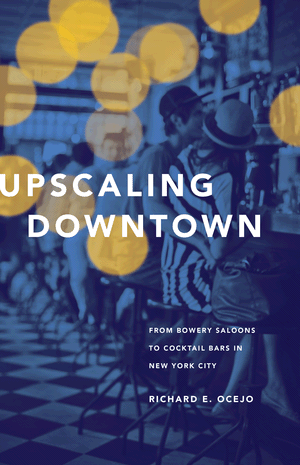
Last year Rich Ocejo published his book Upscaling Downtown, an excellent description of the changing bar scene in and around the Bowery/EV/LES, the nightlife pressure towards commercial gentrification and residential pushback against it. It's an important case history of a neighborhood in transition.
http://press.princeton.edu/titles/10396.html
 While it's a great read -- he provides a broad view of the many divisions within the community and it's fun to recognize the many locals he interviewed -- the theoretical background assumptions inherited from the standard academic literature on gentrification occasionally undermine the specificity of the case history. This is not Ocejo's fault; it's the failure of the academic theorists.
It's assumed that because gentrified neighborhoods are preceded by artists and other marginal white misfits, that their presence causes gentrification. But if you look at the facts of history, you find a different and more complex story. When artists and marginals arrived in both the Bowery and the Lower East Side (including what's now called the East Village and Alphabet City), the neighborhoods continued to decline. The artists and misfits did not attract money or commerce. They attracted more misfits and artists.
To blame artists and marginals (Vietnam veterans, the homeless, substance abusers, prostitutes, ex cons, the chronically unemployed, lost youth) for gentrification on the grounds of having preceded gentrification is like blaming the rain on dry streets because dry streets precede rain. The academic theorists have invented a mechanism employing the classic fallacies -- confusing correlation with causation and post hoc ergo propter hoc. In their desperate search for a grandiose theory that will explain all instances, they've drawn hasty, blanket conclusions without looking carefully enough at the details and specificity of the context.
Unfortunately for the big theory, the Bowery attracted misfits for two centuries without seeing any gentrification. For most of those two centuries, it declined right up to 2005 with not a hint of gentrification. What changed the Bowery was city planning, in particular, the Chrystie Avalon complex. Not artists, not misfits, not wayward white youth slumming. City Planning: government.
The theory of gentrification comes to us from classical Marxism, a pre macro-economic theory. It attributes all to market forces and none to government intervention. It's certainly true that the accumulation of capital in excess of any market demand for productivity could be a pressure towards gentrification. But the avenues of speculation depend on what government incentivizes. Buying luxury apartments on Central Park South is the current means. But the gentrification of the LES did not begin with big capital. It started with small time investors. Big capital didn't want to take a chance on a crime-ridden, marginal neighborhood full of weirdos and resistant anarchists.
.....
The assumption has been that whiteness itself attracts money. So Ocejo calls whites who moved to Alphabet City in the mid to late 1970's "early gentrifiers," although for years they watched as their streets continued to decline replacing older residents with shooting galleries (for heroin users), drug dealers replacing families with growing children. More complicating, while these streets declined and buildings were abandoned, burned and the remnants demolished, other parts of the neighborhood were gentrifying. The early marginals and artists did not contribute to it. On the contrary, most of them had to be displaced in order for gentrification to spread. What drew gentrifiers to those parts of the neighborhood were their amenities -- a park view or in the case of Christodora House, spectacular panoramic views. Again, not artists, nor the artistic scene.
If you look through the NYTimes archive, you'll find stories from the Bowery 1880's, the years when it began its steep decline, stories about the death of a resident who lived as a pauper but was escaping from his wealthy family. The millionaire living like a pauper-in-rags is not an urban myth. These people lived on the Bowery and in neighborhoods like the LES. To call them early gentrifiers indicates that the theory has gone astray. The notion is incoherent -- it provides no principled distinction between white people who draw money and white people who repel it -- and it's falsified by history.
Again, contrary to Neil Smith's theory, the neighborhood did not decline in order for developers to buy them cheap, nor is there a universal cyclic law of neighborhood decline followed by redevelopment. The LES declined because it was abandoned by labor when public transit made it possible for labor to leave. It's not a grand conspiracy or a cycle of capital disinvestment. A neighborhood with money need never decline -- investors renovate the housing stock or redevelop it. Contrary to Smith, landlords don't seek disinvestment, although government does -- to create ghettos in a program of segregating races by "providing" affordable housing through the market. Here Smith is particularly incoherent: he sees renovation as a means of gentrification only after the neighborhood reaches rock bottom. He forgets that renovation was always an option.
The underpinnings of gentrification theory are constructed for the convenience of broad theories that ignore the specificity of place and the serendipity of technological, political, cultural and legal transformations. The most effective law of urban development is the law of unintended consequences. A close second is government.
http://press.princeton.edu/titles/10396.html
It's assumed that because gentrified neighborhoods are preceded by artists and other marginal white misfits, that their presence causes gentrification. But if you look at the facts of history, you find a different and more complex story. When artists and marginals arrived in both the Bowery and the Lower East Side (including what's now called the East Village and Alphabet City), the neighborhoods continued to decline. The artists and misfits did not attract money or commerce. They attracted more misfits and artists.
To blame artists and marginals (Vietnam veterans, the homeless, substance abusers, prostitutes, ex cons, the chronically unemployed, lost youth) for gentrification on the grounds of having preceded gentrification is like blaming the rain on dry streets because dry streets precede rain. The academic theorists have invented a mechanism employing the classic fallacies -- confusing correlation with causation and post hoc ergo propter hoc. In their desperate search for a grandiose theory that will explain all instances, they've drawn hasty, blanket conclusions without looking carefully enough at the details and specificity of the context.
Unfortunately for the big theory, the Bowery attracted misfits for two centuries without seeing any gentrification. For most of those two centuries, it declined right up to 2005 with not a hint of gentrification. What changed the Bowery was city planning, in particular, the Chrystie Avalon complex. Not artists, not misfits, not wayward white youth slumming. City Planning: government.
The theory of gentrification comes to us from classical Marxism, a pre macro-economic theory. It attributes all to market forces and none to government intervention. It's certainly true that the accumulation of capital in excess of any market demand for productivity could be a pressure towards gentrification. But the avenues of speculation depend on what government incentivizes. Buying luxury apartments on Central Park South is the current means. But the gentrification of the LES did not begin with big capital. It started with small time investors. Big capital didn't want to take a chance on a crime-ridden, marginal neighborhood full of weirdos and resistant anarchists.
.....
The assumption has been that whiteness itself attracts money. So Ocejo calls whites who moved to Alphabet City in the mid to late 1970's "early gentrifiers," although for years they watched as their streets continued to decline replacing older residents with shooting galleries (for heroin users), drug dealers replacing families with growing children. More complicating, while these streets declined and buildings were abandoned, burned and the remnants demolished, other parts of the neighborhood were gentrifying. The early marginals and artists did not contribute to it. On the contrary, most of them had to be displaced in order for gentrification to spread. What drew gentrifiers to those parts of the neighborhood were their amenities -- a park view or in the case of Christodora House, spectacular panoramic views. Again, not artists, nor the artistic scene.
If you look through the NYTimes archive, you'll find stories from the Bowery 1880's, the years when it began its steep decline, stories about the death of a resident who lived as a pauper but was escaping from his wealthy family. The millionaire living like a pauper-in-rags is not an urban myth. These people lived on the Bowery and in neighborhoods like the LES. To call them early gentrifiers indicates that the theory has gone astray. The notion is incoherent -- it provides no principled distinction between white people who draw money and white people who repel it -- and it's falsified by history.
Again, contrary to Neil Smith's theory, the neighborhood did not decline in order for developers to buy them cheap, nor is there a universal cyclic law of neighborhood decline followed by redevelopment. The LES declined because it was abandoned by labor when public transit made it possible for labor to leave. It's not a grand conspiracy or a cycle of capital disinvestment. A neighborhood with money need never decline -- investors renovate the housing stock or redevelop it. Contrary to Smith, landlords don't seek disinvestment, although government does -- to create ghettos in a program of segregating races by "providing" affordable housing through the market. Here Smith is particularly incoherent: he sees renovation as a means of gentrification only after the neighborhood reaches rock bottom. He forgets that renovation was always an option.
The underpinnings of gentrification theory are constructed for the convenience of broad theories that ignore the specificity of place and the serendipity of technological, political, cultural and legal transformations. The most effective law of urban development is the law of unintended consequences. A close second is government.
Saturday, January 16, 2016
The mayor washes his hands on the backs of the homeless
Since de Blasio was voted in -- even before he was inaugurated -- the rich, the conservative and the middle-class comfortable have been more than grousing, more than worrying. They've been warning and predicting with the assurance of a street corner evangelist predicting Armageddon, that he'd bring New York City back to the "bad old days" of muggings and race riots.
Political executive office holders who win on a progressive ticket in this country feel compelled to show the rich, the conservatives and the comfortably middle class that their administration is not bent on destroying the fabric of society, increasing crime or allowing riots in the streets or desecrating their pristine neighborhoods.
Its a familiar story. Progressives overcompensate by being more reactionary than the reactionaries. I don't blame this on the progressive politicians. I blame it on the biased, bigoted, comfortable conservatives who complain about everything that doesn't directly benefit them and have zero faith in the potential of anyone but their own kind.
I received an email from the local councilmember passing along a particularly underhanded de Blasio effort to remove the homeless from sight under the guise of having the community "help" Homeless Services "help" the homeless. The administration wants you to identify homeless people on your street who might need "help."
To me this is just a way for the administration to harass the homeless while washing its hands of responsibility for it by blaming the community. The councilmembers no doubt can't push back against such an effort -- if they don't sign on, they look like they don't care about the homeless, and if they do collaborate, they gain the support of those who think the homeless are being helped by this city-wide street sweep of humans, as well as the support of those who just want the homeless removed from sight at whatever cost.
De Blasio already removed the homeless around the 9th Street walkway through Tompkins Square Park. Now it's getting anonymous residents to do the dirty work of fingering a homeless person so the administration can get credit for cleaning up the streets as well as "helping" the homeless.
In any institution or organization, those most vulnerable get pushed around. Denigrating them is often the license for the poor treatment. The homeless are the most vulnerable and the most easily denigrated. And out of sight, out of mind.
Friday, January 15, 2016
Authenticity in the East Village

The East Village was once an ethnic enclave -- actually several ethnic enclaves interwoven together: Polish, Ukrainian, Italian, Jewish, Puerto Rican and American-born Black ethnicities each had staked out their blocks, streets and buildings. Today it is a typically gentrified and much more homogeneous neighborhood. Its commerce caters to a different quantity of disposable money and, equally important, a different quality of money.
Old ethnic shops are one-by-one being evicted as their long-term leases come due. The greater quantity of money available in the neighborhood drives up rents, but it's really the quality of the money that makes the difference. If the local hipster were willing to pay a high price for, say, authentic pierogies, the pierogy shop could jack up its price to pay a higher rent. But the hipster search for authenticity is compromised by the search for the new and discriminating that traditional pierogies can't supply. Vegan gluten-free wasabi peirogies are not within the range of the traditional. The quality of the money -- the kinds of purchases its possessor is interested in paying for -- determines the profile of the street commerce.
Hipsters prefer new commerce run by fellow hipsters -- or at least fellow middle-class young and attractive whites. Rich Ocejo pointed out to me the interest among hipsters in the authentic barbershop experience. But the old barber on Ave. C run by a 74-year-old Puerto Rican is way too authentic. Instead the barber has to be himself a hipster, preferably not hipper than the client, and comfortably downscale to provide just enough of a sniff of slumming "authenticity."
Hipsterism has changed over time, becoming increasingly conformist, fashion-conscious, semiotic and commercialized. If you've read so far in these last few posts, you've got the point that the semiotic -- the use of objects to convey a cultural meaning -- because it is a form of communication, opens the door to deception. Utilitarian dress cannot deceive in itself. A hardhat worn by a construction worker at the worksite has a direct relation to its function. There's no room for deception. It's worn to protect from falling objects. To the extent that clothing is non utilitarian, it is available for communication as fashion. So rolled up jeans have no function but to identify a strain of hipsterism -- at the current moment. Similarly, the lumbersexual beard borrows the image of masculinity transferring it to fashion, contrary to the meaning of its raw, unshaven masculinity in which fashion purports to play no role.
The constant search for authentic signs and the removal of the authenticity by recreating those signs as fashion is a characteristic of current hipsterism. It is not benign. Look at the ad at the top. Both men are conversing across the generations sitting on a shoeshine bench. The significance to the older generation man in the three-piece suit lives in a structure of meanings that belong to an old racist culture that assumed white superiority when black men served at the white man's foot. The significance for the hipster is merely a kind of play with fashion.
And so fifty years of civil rights' struggle is effaced, erased, lost, dismissed and mocked, all in the interest of commerce, fashion and the search for distinctive identity (really just the new hipster conformism).
The ethnic, political, and artistic history of the East Village has similarly been effaced, erased, lost, dismissed and mocked. But where Chinatown is endangered by inauthentic representations of its ethnic economic base, the East Village is recreating its own new authentic economy -- the authentic search for the retro, the fashionable, the distinctive, the slumming of elitism coupled with its upscale revision of it, the clean, expensive hipster slum with great, exotic dining and deserts and diverse nightlife drinking options. It is sustainable because the hipster has sufficient disposable money to sustain it. The sole threat is the landlord who demands commercial rents above what commerce can afford.
It's difficult to describe the restructuring of meaning in hipsterism as deceptive. There's no authenticity to deceive beyond the desire to identify through consumption and display.
See also in this series:
Semiotic neighborhoods vs the authentic and anti-fragile: prestige and its deceptions and betrayals
Prestige and distortion in Chinatown
Suits and betrayal in Chinatown
The Mobility Dilemma and the Clearinghouse Effect
See also in this series:
Semiotic neighborhoods vs the authentic and anti-fragile: prestige and its deceptions and betrayals
Prestige and distortion in Chinatown
Suits and betrayal in Chinatown
The Mobility Dilemma and the Clearinghouse Effect
Tuesday, January 12, 2016
Prestige and distortion within Chinatown
The Asian American Federation, a social services and research non profit highly regarded within Chinatown, published a study of Chinatown in 2008 in which they found that East Broadway, the center of recent Fujianese immigration and a low-income area, was one of the most resilient, vibrant and successful parts of Chinatown, while much of the rest of the neighborhood was ailing commercially. Yet the study's recommendations completely disregard its findings of fact. Their recommendations all favor tourism with no recommendations that support the ethnic community.
 Most telling are the recommendation that waiters learn more English (useless for local-serving restaurants), and the absence of any recommendation that managers stop stealing waiters' tips, a wide-spread practice among restaurant owners in Chinatown. Stealing tips removes the most easily available incentive reward for waiters to improve services like learning English. Without tips for improved service, AAF's recommendation burdens the waiter entirely. The bias in favor of management is evident: compel the waiter to learn English but still take his tips. There isn't even a recommendation for free or supported English lessons.
The power of prestige and respectability is pervasive. Growth is viewed as outward-looking towards an upscale mainstream culture, not expanding and supporting the base. So, for example, here are their findings of fact:
Image and money are tied together. Semiotic neighborhoods pretend with an image for sale, much as a suit allows its wearer to pretend to an image of respectability. The base of the economy is disregarded, dismissed and invisible.
Next: semiotics and deception among the suits in Chinatown, and the struggle up from the bottom.
See also in this series:
Semiotic neighborhoods vs the authentic and anti-fragile: prestige and its deceptions and betrayals
Suits and betrayal in Chinatown
The Mobility Dilemma and the Clearinghouse Effect
Authenticity in the East Village
 Most telling are the recommendation that waiters learn more English (useless for local-serving restaurants), and the absence of any recommendation that managers stop stealing waiters' tips, a wide-spread practice among restaurant owners in Chinatown. Stealing tips removes the most easily available incentive reward for waiters to improve services like learning English. Without tips for improved service, AAF's recommendation burdens the waiter entirely. The bias in favor of management is evident: compel the waiter to learn English but still take his tips. There isn't even a recommendation for free or supported English lessons.
The power of prestige and respectability is pervasive. Growth is viewed as outward-looking towards an upscale mainstream culture, not expanding and supporting the base. So, for example, here are their findings of fact:
A number of changes in the mix of residents in Chinatown also has altered the customer base for Chinatown businesses. Over the past 20 years, growth of the Fujianese population in Chinatown, due to new immigration patterns, has generated demand for businesses supporting their food, entertainment and service preferences. Newer Fujianese-owned businesses have sprung up along East Broadway.... A lack of nightlife in Chinatown also makes it difficult for restaurants to attract evening business, and garment-industry job losses and relocations have reduced restaurants’ traditional customer base. However, restaurants catering to Chinatown’s growing Fujianese population report brisk business.... The decline in the garment industry has decreased measurably the daytime population in Chinatown, a key component of the traditional customer base. As this traditional customer base shrinks, the growth in Chinatown’s Fujianese population and the influx of non-Chinese and some returning Chinese immigrants and retirees have created a demand for products and services catering to these markets.And their conclusions:
A general lack of customer service reduces the appeal of shopping and dining in Chinatown. Limited English capabilities of staff make it challenging for people who do not speak Chinese to patronize Chinatown businesses. Gruff service from a few businesses hurts the image of all Chinatown establishments. Many stores and restaurants operate on a cash basis, which discourages those customersThe customers mentioned are tourists with credit cards, not local recent immigrants. And "image" is a problem looking to outsiders, not to locals. The sole source for this claim of gruff service and bad image comes from the Zagat Guide -- a restaurant guide published in English for English-speaking customers. There is no Mandarin, Fujianese or Cantonese Zagat for New York. If you look through all their recommendations, you'll see that they are equally outward, not inward, looking. And this is characteristic of many such studies of Chinatown. Whether they are positioning Chinatown non profits to obtain government funding for development or attracting private sector investment, they ignore the economic base and their recommendations threaten them with unstable, fragile commercial gentrification.
Image and money are tied together. Semiotic neighborhoods pretend with an image for sale, much as a suit allows its wearer to pretend to an image of respectability. The base of the economy is disregarded, dismissed and invisible.
Next: semiotics and deception among the suits in Chinatown, and the struggle up from the bottom.
See also in this series:
Semiotic neighborhoods vs the authentic and anti-fragile: prestige and its deceptions and betrayals
Suits and betrayal in Chinatown
The Mobility Dilemma and the Clearinghouse Effect
Authenticity in the East Village
Monday, January 11, 2016
Semiotic neighborhoods vs the authentic and antifragile: prestige and its deceptions and betrayals

Representations designed to broadcast identity for outsiders betray the people and culture that it purports to represent, so there's a correlation between broadcasting outside and economic fragility, as well as deception and betrayal. Authentic commerce, by contrast, doesn't represent and is antifragile -- it grows stronger in a crisis because the locals have more needs in a crisis, and the local commerce serve them.
Nevertheless, prestige and respectability are measured in mainstream cultural standards, far from ethnicity and authenticity, and are by nature hypocritical -- invested in presenting and maintaining themselves as prestigious, respectable and mainstream, regardless of the real ethical and moral defects of the apparently respectable -- so authority, including many city planners, administrators, financiers, developers and local community opportunists, scorns and ignores the authentic stability of the enclave's economy, endangering the future of the enclave. Although an ethnic enclave can thrive and grow despite outside catastrophes like terrorist attacks, hurricanes and recessions, it is vulnerable and threatened by internal and external authorities seeking to gentrify it. Already gentrified neighborhoods seek representations of authenticity that betray the authentic roots of the neighborhood. They are stabilized by luxury commerce dependent on upscale trends.)
What is a semiotic neighborhood? Simply put, a neighborhood full of signs. Any commercial street will be lined with signs that draw to its consumers. Delancey Street signs draw to the low-income residents nearby. Times Square draws to an international tourism consumer, advertising the entire city -- that's why the signs are so large, so bright, on-the-pulse and sexy. The signs can be read as an indicator of the character of the consumer.
But semiotics of a neighborhood is not just commercial signage. There are no commercial signs on Park Avenue north of 59th Street, but the stone and stately architecture, the spareness and cleanliness of the streetscape, the absence of commerce, all send a message that this is both a residential neighborhood and a wealthy, exclusive one.
Semiotic neighborhoods can be divided among those that broadcast their signs outside the neighborhood, and those that look inward. Broadcasting neighborhoods use their signs to create an identity for outsiders, an identity they can easily read. It can be a bit of a contradiction: an ethnic neighborhood can broadcast an identity that belongs to the outsiders -- self-stereotyping -- instead of being authentically ethnic. The purpose of the identity after all is not to be authentic, but to draw customers. So notice that it's money that leads to the fakery and the fakery is a betrayal of its own.
Inward-looking neighborhoods have no such need to create such an identity. They are not pretending with a show of what they are. The commerce there simply serves the local community that already understands it for what it is -- theirs. Inward-looking neighborhoods are characterized by authenticity.
In the literature of semiotic neighborhoods, inwardly looking neighborhoods are not even considered as semiotic -- they don't try to speak to the general public or communicate using the broader language of the culture, the recognized stereotypes; the motivation of their signs are restricted to the needs of locals, with no thought of trying to impress anyone with an enhanced identity. Ironically, they have authentic identity -- because they're not trying.
Local-serving commerce has low costs, since the customers don't have to be enticed and brought to the door. The locals are a bit of a captive market. As long as the prices don't drive the locals to seek a better deal, the local commerce can rely on having its customer. When there's a crisis, even a catastrophe like 9-11 or Hurricane Sandy, the local commerce actually thrives. The local residents have more needs in a crisis, not fewer, and the residents are even more captive without transport. They must find their needs served locally.
While the authentic neighborhood tends to keep prices reasonably affordable (the customer is not entirely captive) broadcasting a neighborhood tends to raise prices. The intent of broadcasting is to surpass the profits available locally, otherwise it would stay local and not bother broadcasting at all, since broadcasting incurs advertising and presentation costs. And advertisement and image-creation must be ongoing to keep up with outside trends.
In a crisis, a semiotic neighborhood can be devastated.This happened in parts of Chinatown after 9-11. Mott Street, which had been outward-looking with antique stores and Chinese souvenir shops, lost many stores, and has only recently recovered.
East Broadway, the center of the recent immigration and lined with local-serving stores, has not been devastated in the wake of 9-11 or even the Great Recession. It's been crowded and bustling, the commerce vital and thriving.
To be continued...
See also in this series:
Prestige and distortion in Chinatown
Suits and betrayal in Chinatown
The Mobility Dilemma and the Clearinghouse Effect
Authenticity in the East Village
Friday, January 08, 2016
Should be interesting:

Wednesday, January 06, 2016
Marginalizing the Homeless
Last night I attended a town hall on homelessness and homeless services. As would be expected, the local electeds and the city administration spoke mostly about public safety -- they have to appease the local residential voters. Only Gail Brewer, the Borough President, addressed her comments to the needs, rights and interests of the homeless themselves. Props to her.
In the Q&A, a couple of middle-aged white men asked pointed, testy questions about public safety. A few graceful senior white women made constructive suggestions on how the homeless could be better served. Not surprisingly, the most trenchant comments were made by the homeless themselves -- several members of Picture the Homeless were present: Why doesn't the city ask the homeless what they need rather than funnel them into the modes convenient to the city. Why solve a housing problem with a policing answer? Why is all the affordable housing in the mayor's housing program way beyond the means of a minimum wage worker?
I complained to the council members present that the Parks Department continues to marginalize the homeless in Tompkins Square Park (Parks last month installed a ping pong table right smack in the middle of the space where the homeless regularly gathered), a public park that has been for many decades a place for the homeless to socialize with their friends, feel at ease and enjoy. They have every right to be there. What they don't have is the political clout to protect their right.
Afterward, a well-intentioned rep from a city agency said to me, giving me her card, "If any of your homeless friends aren't being served, please contact me." IOW, 'help me funnel your friends.' My take-away: the people who've been funneled are the people working for the city.
The city is focused on dragging street people off the street.into shelters. They wanted residents to be complicit in this, distributing to the audience maps for residents to pinpoint places where they could identify "problems" (aka a homeless human that the resident wants to have disappeared into the system). Presumably that gives the police the excuse to forcibly remove the human. Providing homes seems to be way down their list below the level of constituency politicking.
Wednesday, August 21, 2013
Division
[Cross-posted at http://chinatownforchinatown.wordpress.com/]
There are two sides debating in the Chinatown Working Group. Some want to see more tourists in Chinatown to support business. Developers, financiers, some business owners, the Business Improvement District, for example, sit on this side and arts purveyors as well. On the other side stand the labor and tenant adovocates who want business to serve the local residents. You might ask, why not have both, local services and toursim?
If only the sustainable market forces were balanced. But they’re not. Gentrification is an opportunistic tide that, once it gains an entry, will flood the locality resistlessly. To use urban planning to help the juggernaut of monopolistic market forces is unnecessary. The empowered need no help.
In any economy, there are vulnerable sectors even among the most sustainable. Local services are actually highly sustainable since local residents have consistent, reliable purchasing needs. You see those needs reflected in the streets of Chinatown. As long as the community remains, the local services will be sustainable.
Although they are highly sustainable, local services are also highly vulnerable to attack from giant outside capital which has more resources, government connections and mobility. Ironically, the least vulnerable — giant capital, developers, big businesses, chain stores — are also the least reliable because they are mobile and least tied to the locality. Like a corporation that protects itself in bad times by laying off labor, giant corporations are most capable of protecting themselves at the expense of the locality, whereas small local servers depend on the locals.
Tourism is closely tied to development and big capital — high prices and upscale values that can be marketed to upscale spending. Local services, especially in Chinatown, depend on low prices and high volume. If giant capital gains a foothold, commercial rents will rise, replacing local services, and gentrification will displace the community, killing the viability of any remaining local services. It’s a snowball effect.
This is not to say there shouldn’t be tourism in Chinatown. There’s always been tourism in Chinatown back all the way to the 19th century. But here’s the paradox of tourism: people come to Chinatown not to see a spectacle staged for them but to experience Chinatown as it is, a lively working community, culturally distinct from the rest of New York because it serves its own. Cater too much to the tourist, and you lose the Chinatown that tourists come for. You’d then have to market Chinatown as a brand, constantly hoping that that brand doesn’t go out of fashion. Chinatown business becomes the slave of an outside community that it has no control over, and it turns a community with businesses in it into a business with no community in it.
In planning, as everywhere, there are empowered sectors that need no help, and disempowered groups that need support. Were it not for the 1% predators, the 99% disempowered would be fully sustainable. That’s why planning should always keep as its goal protecting the disempowered and avoiding giving ground to giant capital.
Thursday, August 15, 2013
The rent gap: a logical gap
Neil Smith attempted a predictive theory of gentrification within a Marxist frame with a close examination of the phenomena in the US, particularly in NYC during the period since the word "gentrification" was coined around 1964 by Ruth Glass. Smith observes that when property values decline to its bottom, investors see an opportunity to buy low in the expectation of revalorizing the property to reach its potential. The rent gap -- the gap between the low rent of a devalued property and its potential -- opens an opportunity for capital to fill in.
The notion is at best post hoc predictive, which is to say, not predictive at all. Consider Detroit. Property values have declined, but the properties are not ipso facto an opportunity for capital to invest at the bottom under the assumption that the values can't go anywhere but up. A property's potential is not a determinable quantity.
Property potential depends on many factors: cultural or economic interest in the location; government subsidies or incentives; a housing crunch in upscale neighborhoods driving money to seek options in less upscale locations. Speculation is not one of those. Real estate has speculated on neighborhoods before without raising values. The construction of Harlem around 1900 is the most obvious case in point. Built for the wealthy, it didn't take hold and declined.
Gentrification might not be so much a reflex of capital as of policy, including zoning (creating a housing crunch, e.g.), incentives and subsidies. A too abstract economic view of gentrification will miss the role of government policies that reflect conflicting interests, especially where the owners of capital live.
One might say that as long as population grows, just about every location has a rent gap. But this does not imply that properties must decline before they achieve the gap. Neighborhoods can gentrify even if they have never declined. Glass coined the word to describe the spread of gentry, displacing and transforming working class neighborhoods. Working class neighborhoods are not all the result of decline. Some working class neighborhoods are built for the working class, and appreciate as the neighborhood grows more dense. That was certainly true of the LES in the 19th century.
The urban decline that Smith observes is more an effect of transportation than the age-decline that he attributes it to. The automobile and mass transit allowed the opening up of suburbia and the downward spiral of white flight in the 1950's and 60's.
Though it isn't stated explicitly, Smith's analysis predicts that Park Avenue should turn into the next slum. I think that's possible, but not because the buildings will age-out. Age does not entail decline. There are older buildings in Greenwich Village which attract even wealthier owners. If Park Avenue declines, it'll be because wealthy owners have been attracted to the single-family tenement. Park Avenue can't keep up with the scale of income inequality. The new New York will be full of these repurposed, culturally valued mansions that we are beginning to see in the EV. Three years ago, 47 E. 3rd was an aberration. Today there are four such single-family tenements here. Trends take a while and appear at first as insignificant. Give it time...
Friday, August 02, 2013
Margaret Chin, the developer's candidate
Margaret Chin is taking money from the Real Estate Board of New York's Political Action Committee. You'd want to ask, why would the founder of Asian Americans for Equality welcome large campaign support from real estate?
Affordable housing is built in NYC through incentives given to developers. So if you want to get any affordable housing here, you've got to welcome a market-rate developer, otherwise you get nothing.
Does that explain why Margaret voted for the NYU development (albeit curtailed)? Maybe. Does it explain why she voted for the Chinatown BID against widespread opposition within Chinatown? Maybe. Why she voted to help First American International Bank, the promoter of the BID, demolish and redevelop 135 Bowery?
The BID benefits larger property owners, larger businesses and developers and banks. But the small property owners and the small businesses are the anchor of Chinatown. At what point does a commitment to building new affordable housing sacrifice community entirely?
The city has shoved a wedge between affordable housing and community, turning affordable housing into a tool of gentrification and displacement. Look at Williamsburg. Chinatown next? The BID is a step towards the new Downtown Hotel District (DoHo?) formerly known as Chinatown.
From Crain's http://www.
From City Council Watch, Seth Barron (writer for City & State) "Margaret Chin Progressively Awful"
Sean Sweeney in The Villager "The billionaires back Margaret Chin for City Council"
Tuesday, June 25, 2013
Rent regulations
Thinking about the construction boom and the Rent Guidelines Board rent hike, I went back to a piece I did for Met Council refuting the claim that rent regulations artificially raise market rate rents. The key insights were two: 1) in New York, newly constructed apartments are not required to be regulated, so regulation doesn't add to the tight housing market (in fact, rent regs are one of the few incentives to construct in NYC); 2) deregulation doesn't flood the market with new apartments since evicted tenants don't leave the local pool of renters, and wherever they go they tighten the housing market there, displacing lower-income renters.
Looking back, I'd want to explain explicitly why it is that displacement always shifts downward, and not just a musical chairs of apartments among renters. Deregulation eviction implies that the tenant can no longer meet the high market-rate rent. In a tight housing market, if they go to a lower-income neighborhood, they will find an apartment by displacing someone who was renting at a lower rate. The displaced renter does the same in the next lower-income neighborhood and so on.
[Update: on second thought I think I was right in the original, not as in the paragraph immediately above. Obviously deregulation evictions out of prime locations also allow high renters to move upward -- upward displacement. That displacement doesn't ease market rates: the evicted have created a tighter market down the line. On the other hand, if new upscale renters are entering the market from outside the pool, they would increase downward displacement pressure.]
Some of those deregulation-evicted tenants can pay higher rents than they'd been paying under regulation, just not quite as high as the market rent where they'd been. No one will seek a cheaper apartment -- if there was something cheaper suitable to them they'd have decamped long before deregulation. But some will seek apartments somewhat more expensive than what they'd been paying under regulation. So the only change in the economic equilibrium is the added funds available for rent among the deregulated.
At the end of the day, deregulation increases the aggregate funds available for rents taken from whatever else the regulated tenants had been spending on in the economy. All of that increase goes to the landlords. Deregulation is just a pointless shift from the non real estate economy to landlords and a downward spiral of displacement, while more upscale renters flow into the city to raise the luxury rates. With more funds flowing into the real estate market, developers construct to meet those upscale renters, who then recreate the commercial economy in their own image, buying upscale items.
So rent regulation is just a restriction on upscale real estate speculation and upscale commerce. It doesn't raise market rate rents, but actually dampens them. And it's good for non upscale commerce.
So here's the article. The point about the rent pool seems to have grown legs -- I've heard it repeated by lawyers as well New Yorkers on the street.
So here's the article. The point about the rent pool seems to have grown legs -- I've heard it repeated by lawyers as well New Yorkers on the street.
Why Rent Regulations Don't Raise Market Rents
Published:
June 2011
"If rent decontrol would mean a fairer, less insane market, then it is a just cause," the libertarian-conservative Cato Institute argues.
In every debate over rent regulations, someone—often an angry tenant paying outrageous rent—argues that regulations are responsible for pushing market-rate rents way up. If those regulated rents were brought into the free market, the market would level down, allowing a fair rent for all.
This argument has had wide currency among conservatives in their effort to undermine rent regulation and promote developers and landlords, the market suppliers in the real-estate industry. It appeals directly to people who, bitter over their heavy rent burden, welcome a convenient scapegoat: their own neighbors. And the authority, the landlord, is conveniently exculpated.
This argument is false. It is based on these premises:
1) Rent regulation discourages housing construction, restricting housing availability;
2) landlords make up their losses on regulated rents by gouging market-rate renters; and
3) deregulation would level the playing field, lowering high rents
Its conclusions have been demonstrated to be empirically, factually untrue. It is time to put this claim to rest.
Let's start with the basics. Not only conservative think tanks like the Cato Institute, but the consensus of economists, even the liberal Paul Krugman, accuse rent regulation of discouraging new housing construction. Without new apartment units, the supply can't keep up with demand, and fierce competition for the few remaining units pushes market rates up.
Their observations are true where rents for new construction are regulated. But in New York, it isn't.
New construction is exempt from rent regulation in New York. Building new affordable housing is entirely voluntary in New York, and developers only provide it where the city gives them special incentives, such as allowing construction beyond the zoning restrictions or giving tax breaks. In fact, rent regulation encourages new construction, as the Citizens Budget Commission has pointed out, since new units can garner far higher rents than older regulated units. If landlords can't cash in on regulated units, the only other means to make money is to build new, unregulated units. Rent regulation is an incentive for construction.
The difficulty of building in the city has many causes—the cost of land and construction, restrictive zoning laws, building codes, permits and bids, and, not least, the private and political graft involved. Nevertheless, New York continues to see housing construction. Even during the recession year of 2008, the city issued 33,911 permits for new housing, the greatest number since 1972. In a city of obstacles to construction, rent regulation is one of the few encouragements to build.
The second premise contends that if landlords can't raise regulated rents, they will raise rents on unregulated units to make up for the lost revenue. Unfortunately for the landlords, the free market doesn't work that way.
Market rates depend on renters' willingness to pay, not on owners' costs or losses. Rents can't rise above what renters are willing and able to pay, and the nature of the profit motive ensures that market-rate rents will rise exactly to that level of renter willingness, regardless of what other renters are paying.
In a city where construction lags behind demand, it may be legitimate to ask whether deregulation would free up apartments and ease the market down—the third false premise. Quite aside from the consequences of displacing individuals or even whole communities, the answer is a surprising no.
Rent deregulation, believe it or not, raises market-rate rents. The conservative Manhattan Institute, in its 2003 study of deregulation in Cambridge, Massachusetts, found that, following deregulation, landlords invested in improvements to attract the highest possible market-rate renters. The result of the 1994 deregulation in Massachusetts has been better-quality housing, but higher market rents across the board.
That shouldn't be surprising. A tight housing market implies that many renters can't find apartments in their preferred locations. That's the meaning of a housing crunch. Renters can't find the spaces they want, and the ones they have to live in become overpriced. But when vacancies appear, those renters are willing to pay exorbitant rents for the locations they prefer, and landlords will meet their willingness.
The market value depends on three general factors: demand, supply, and the aggregate available funds for rents. If regulated renters are paying less than their available rent funds (the excess of which presumably goes into the goods and services economy), when they are forced to pay more, it will increase the aggregate funds going to landlords as rents, since most of those renters are tied to the metropolitan area by work, family, or preference. If their rents are deregulated, these people will force rents up wherever they go in the metropolitan area.
That's a recipe for disaster. When renters can't afford their location as a result of deregulation, they move to lower-rent neighborhoods, where they create a tighter rent market, raising the rents there and even gentrifying the area. Some of the longtime renters in those neighborhoods will be priced out and move to even lower-income neighborhoods, tightening those locations in turn.
More affluent longtime renters will see their rent increases as an opportunity to move to a more desirable location. But wherever they go, landlords will raise their rents as high as they are willing to pay. If the market is tight and people are not leaving the metropolitan area, the market rates will remain high.
Market rates only go down if demand goes down—if people leave the city entirely or excess housing is built. But New York's population is increasing, not decreasing, and construction is costly and difficult. Deregulation here will not ease the market any more than it did in the Boston area.
It's not even certain that in a tight market like New York, landlords would invest widely in improvements, as they did in Boston and Cambridge. Unregulated renters have few rights, so if they complain to the city about lack of services or repairs, the landlord can retaliate by refusing to renew their lease when it expires. Regulated renters can compel repairs without that fear. So it is possible that deregulation in a tight market would result in lowered quality of housing and a degrading of services, as well as higher market rents. That's exactly what happened in New York when vacancy decontrol was imposed in 1971.
Regulated rents actually help to depress market rates. Renters who pay exorbitant rents may think it's unfair that regulated tenants pay so much less than they do, but the source of exorbitant rents is not regulation. It is landlords' profit motive and New Yorkers' desire to live here. We are the market that sustains high rents.
So what is the effect of deregulation? It provides a cheaper means of placing money into landlords' hands than construction does. The chief effect of deregulation is an increase in the aggregate funds available for rents. It doesn't ease the market, it won't improve the quality of housing in New York, and it won't create more housing. It will give more money to landlords, it will raise rents all over the city, and it will wreak havoc on communities as markets are tightened even in low-income neighborhoods, causing a spike in gentrification and displacement.
Rent regulation does create an unfairness—the lucky get to spend their money on the local economy, not just on rent, while their market-rate neighbors have to suffer. But forcing everyone to suffer doesn't solve the suffering of the overpriced. It just makes life worse for everyone. Two wrongs don't make a right. Deregulation is a lose-lose.
Monday, June 24, 2013
Boomtown
Matt Yglesias comments on US cities leading in construction spending. New York is not only way ahead, it's an outrider way ahead (though not quite at a Pareto distribution -- construction is expensive here, so that may be why there's no Pareto), and it's not correlated (pace Yglesias) with population; LA is next most populous, Chicago, then Houston, all on a Pareto distribution, but LA is low on construction; Dallas is constructing more than Houston even though Dallas doesn't have much more than half Houston's population size. In fact Dallas is about one seventh the size of NYC, but it's constructing at the absolute rate of 60% of NYC's.
In any case, NYC is booming. Given the high cost of construction in NYC, this boom means developers see huge money in development. How much of that do you think is affordable housing?
It also means that developers are not worried about diluting the luxury market. Why? Do they expect high-renters/owners to abandon older housing stock to move into new? Or locations further from the center into closer? Either of those would be good news for low-income neighborhoods -- less displacement pressure on them. But if developers simply expect more high-paying population in the city, then no one benefits but the developers.
Friday, June 21, 2013
AALDEF publishes new data on Chinatown land use
From AALDEF (Asian American Legal Defense and Education Fund):
[scroll down for the pdf of the study]
June 21, 2013 – The Asian American Legal Defense and Education Fund (AALDEF) is releasing land use data on New York City’s Chinatown, as a preview of its forthcoming three-city study of Chinatowns and surrounding areas in Boston, New York, and Philadelphia.
"We have assembled data on the make-up of small businesses and properties in Chinatown that will enable us to document the effects of gentrification on Asian immigrants, who have been fighting for their community for decades,” said Bethany Li, staff attorney at AALDEF.
AALDEF, in collaboration with community partners, academic institutions, and hundreds of volunteers, spent a year recording block by block and lot by lot the existing land uses in Boston, New York, and Philadelphia Chinatowns and surrounding immigrant areas. Today’s initial release of land use data, combined with detailed analysis of Census data from the 1980s, provides a snapshot of the existing uses of New York’s Chinatown and describes its startling transformation in the past three decades.
New York’s Chinatown has served as the gateway for thousands of immigrants from Asia and is home to a thriving network of low-income residents and small businesses. However, property values in Lower Manhattan have increased substantially, and gentrification is threatening the neighborhoods’ historical and cultural significance. According to Census data, the overall population in New York’s Chinatown decreased 7% between 1990 and 2010 (from 125,574 to 116,722 people) due largely to the increase of non-family households and a decrease in family households -- a significant indicator of gentrification. As a result, many Asian immigrants face the prospect of displacement.
For example, AALDEF's study indicates that an overwhelming majority of commercial use in New York’s Chinatown consists of small businesses (94%), approximately 12% of which is classified as “high-end.” However, our survey shows that the most significant cluster of “high-end” businesses is in the area between Houston and Delancey Streets, where students and young professionals have displaced immigrant families in the past decade. "High-end" stores also dot the landscape along Allen and Orchard Streets heading towards more traditional parts of Chinatown.
“Gentrification threatens to transform these previously neglected neighborhoods into tourist centers and destroy the places where Asian immigrants have lived and worked for decades,” said Li. “We hope this data can be used to support organizing and planning efforts that help retain resources for New York’s Chinatown for current and future immigrants.”
This data was collected with the assistance of AALDEF’s community partners including Chinese Progressive Association and Boston Chinatown Neighborhood Center in Boston, Chinese Staff & Workers’ Association in New York, and Asian Americans United in Philadelphia. The University of Pennsylvania’s City and Urban Studies Department provided technical assistance on mapping and data analysis.
Contact:
Subscribe to:
Posts (Atom)

 Posts


