Showing posts sorted by relevance for query OWS. Sort by date Show all posts

Wednesday, October 12, 2011

OWS Disturbs the EV Comfort Zone

A Voice reporter contacted me to ask me about the neighborhood comments on Penley's Occupy Tompkins Square Park at EVGrieve's blog, and what it means for the EV. I won't bother to rehearse the lamentable loss of historical memory over the illustrious history of TSP protests from the 1850's to the 1990's and their significance. What I find particularly telling is that the comments appeared on Grieve. Who reads and comments on Grieve now, and why? Here's my personal, angry take on them (disclaimer: none of this applies to the many thinking, socially aware newcomers to the EV) --

This new breed of Lower East Sider comes to enjoy a sense of urban authenticity in Manhattan. Of course, it's not authentic at all, but a kind of faux authenticity, pretend authenticity: the EV feels like it's hip, it imagines itself to be hip, it has lots of youth who style themselves as hip, but in reality, they are just children of wealth seeking $700 a month more hipness and urban pretend-authenticity than they would get in Queens. It's that measured thrill (the oxymoron is intended) they seek -- just enough for them to congratulate themselves for not living in a forgettable neighborhood like Kips Bay, but not too much to lose sleep over the noise of a late-night drum circle.

The mere suggestion of being arrested for a principle of justice arouses such unconscious fear that they respond with political condescension and smug personal disdain. Note how they fail to understand the OWS movement itself: they attribute to it whatever they disagree with, so that, conveniently, they can dismiss it, don't have to be bothered with it and don't have to confront its potential. It is, if you forgive another oxymoron, aggressive apathy. Call it proactive apathy, to use one of the redundant and useless epithets of their generation.

They read Grieve because reading some local foodie restaurant blog would show themselves in their mirror as exactly themselves, mere gentrifiers -- but Grieve is cool, Grieve is hip, Grieve is an insider, so they can feel insiders without ever getting inside anything in this place. That's who reads Grieve today. Bob Arihood died just in time. He'd have seen it as every good deed's punishment. Grieve has, no fault of his own, become the entertainment for the gawkers of authenticity. 

Grieve's readers consider themselves East Village old-timers if they've lived here for six years, long since gentrification settled in. They have no conception of the meaning of this once unique place, not a clue. It is beyond their capacity to imagine, let alone understand. They have lived all their lives with property values and social control. They have no sense of the freedom that follows property abandonment and its vacation of all ownership control, often described as anarchy. They are the children of entitlement. The great difference between the trustfund babies of the EV and the overeducated campers in Liberty Plaza is that the latter are unemployed and drowning in student-loan debt, while the former enjoy mixology at Death & Co.

The campers have been successful at keeping momentum and visibility by holding new events each day or so. The occupation of TSP sounds like a useful part of that program. I don't see it as unduly disruptive. If OWS has the potential to shift the balance of politics in this country, issues of local noise, garbage and crowding hardly seem worth mentioning in the broad narrative arc of history. Maybe we have become too accustomed to complaining about bars. But, seriously, barflies are not making history; they're just making noise. I mean, here is an opportunity to change the voice and profile of our polity, and the news media and the local residents are worried about noise? What happened to these poor rich people's values? What kind of sorry excuse are they for humanity? Are they so comfortable and jaded that they can't care about anything but their own comfort? Is this neighborhood truly no more to them than the latest ice cream parlor tasting? Is this what the LES has come to?

OWS has stepped into the muddy stream of American democracy, pronounced it a river of shit, which it is, and have called for a dam: enough. They have pointed to the naked emperor -- the wide disparity in both our politics and economy. They have as yet no program, no solution except the goal of obtaining a more equitable distribution of democratic power. They are not exculpating Obama by targeting Wall Street. They are not supporting any party. Unlike the Tea Party which began as an knee-jerk revolt against the color of the president, finding its libertarian justification after the fact to legitimize its acid racism, OWS started with principles. You can tell the difference by their resistance to any political party, while the Tea Party jumped quickly into Republican habit. Theirs was never anything but partisanship. OWS is, as many have suggested, something new. It's not a demonstration; it's not a third party. It's a social movement focused on the failure of American democracy itself.
I have no expectations, nor any predictions for its success, but I am not so ironic as to view every honest effort as naive, silly, childish or risible. Irony is the privilege of the abstract, the distant, the uninvolved. It suits the comfortable, the secure, those who can afford to be indifferent. If we all regarded our political process with irony only, there'd be no place for democracy at all. The OWS process is all about participatory democracy. It is so pure and purged of irony that its principled participation cannot close on its demands. That's one reason why it hasn't gotten involved with any party or against any party, why it hasn't projected any specific solutions. It is a movement discontented with our democracy. 
The only campaign poster I've seen at Liberty Plaza is for Ron Paul. Now, several of Grieve's commenters seemed to think that OWS should attack gov't rather than Wall Street. Well, that's Paul's message, and it's there at OWS, along with many other messages. You won't see any Obama posters there, that's for sure. So I think the commenters, as most ugly commenters are, uninformed, biased loudmouths. The content of their comments are of little merit but of revelatory sociological curiosity. Look at who they are, or what they are. I take them very seriously, but not what they think, if they think. It looks to me more like avoidance, complacency and self-congratulations than thought. And it's all so close to the sentiment summed up in Let them eat cake.

Le yuppie


Trustfund-baby hispter wannabe

Sunday, June 02, 2013

From shopping mall to political transformation

The protest in Turkey, like Occupy Wall Street, began with middle class discontent. OWS was ostensibly about money in politics, welfare for banks too big to fail and income inequality, but the pocketbook issues were student debt and unemployment. Critics thought these were spoiled, over-educated, middle-class kids, but we learned that they were economically and socially not the EV gentrifiers. When Penley tried to bring OWS to Tompkins Square Park, EV newbies howled and screamed: not in our backyard (here, also see the negative comments on Grieve's post.)

In Istanbul the protest started as a defense of a local green space from another shopping mall. It almost sounds like a bourgeois NIMBY story from Greenwich Village protesting NYU. Police repression fanned the flames into a much broader anti-government repression movement. But the central issue is still community self-determination. From RT: 
"...respect must come back to the political approach and implementation… That has to do with the way people feel fed up with the interference, micromanagement of their lifestyles." -- Istanbul-based political columnist Yavuz Baydar 

Tuesday, February 02, 2016

Talking this Sunday at OWS Altbank (Alternative Banking) Group on zoning and displacement

I'll be giving a talk on zoning, its consequences and how it plays out in local politics. Here's a brief outline.

The Amenties Dilemma

I'll be starting with what I call the "amenities dilemma": whenever some amenity that improves the quality of life is brought into a low-income neighborhood or ethnic enclave, whether it's better plumbing or a nicer sidewalk, it raises real estate values and attracts investment. It's not just a quantity of money that flows into the neighborhood, but the color of money, which is not green. Money in America is white, and it has an affinity as well as a color: it's drawn to more whiteness. Any improvement in a low-income neighborhood tends to whiten it and drive out the color. It's called gentrification and its consequence, community displacement.

Why should money harass the color out of a neighborhood? Is it greedy maximization of profit?

I dislike the use of "greed" as an economic explanation. It implies that there are some defective people who are to blame for what's wrong in the world. That sort of psychological essentialism -- some people are greedy, others not -- leads to a misunderstanding of how economies and societies work, and leads away from any meaningful solutions to its problems. What we call greed may be less affective, personal or psychological than mere opportunity. If there is no opportunity to make money out of some place, thing or person, people are pretty chill about that person, place or thing. It's when there's some kind of opportunity to gain from a place, person or thing that the feeding frenzy begins.

When the Lower East Side was an abandoned slum, it took my landlord eight months to bother to try to evict me for non payment, because the rent was so low that getting the rent or replacing me with another low renter was hardly worth the trouble. Today if I am five days late with my rent, the landlord files eviction proceedings and assesses a late fine onto my rent. Where there's money to be made, the pressure becomes irresistible and fierce.

The amenities dilemma -- leaving the ghetto in poverty preserves the community but ensures their poverty, while improving the ghetto just shifts the community to a new place of poverty (the dilemma was observed way back by Friedrich Engels in his "The Housing Question")  -- is the big problem for zoning designed to create affordable housing. That's what the talk is mostly about. But first I want to look at how zoning came about, what its goals were and are, and how it works.


The origin of zoning

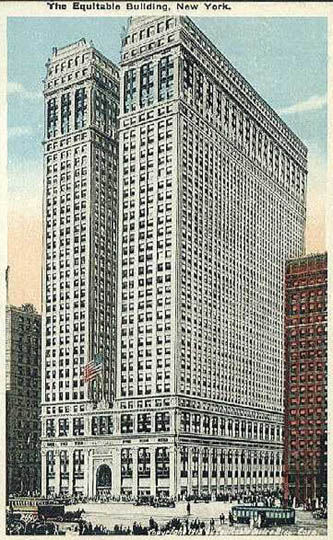
In 1915, Equitable Life built an office tower designed to be the largest such space in the world. Taking up a huge lot, the building rose straight up 38 stories, casting a shadow a quarter of a mile. This was a time before Wall Street was covered with skyscrapers. The buildings there were much more modest and natural light was still available. Commercial buildings were structured to use natural light. Cast iron, favored for commercial buildings, allowed maximal window coverage with minimal structural support. The Equitable Building's shadow instantly depressed real estate values all around it. Landlords and real estate speculators throughout the city were terrified and infuriated, not just over the building, but the possibility that other corporate giants would build near their lots. The real estate industry demanded that the city respond with a permanent fix so that this never happen again.
The very next year the city implemented its first zoning law. Note that the city responded immediately. The disastrous 1879 Tenement Housing Act that created dangerous and unsanitary conditions in the ghetto wasn't fixed for twenty-two years. Zoning took a matter of months. The difference? Money and investors vs immigrant labor. Note also that the housing need for the ghetto was dangerous and unsanitary structural designs inducing life-threatening diseases and fire; the needs of the real estate industry were investment.

The zoning had two new requirements. One was a restriction on types of uses so that factories couldn't be built along residences. Factories bring noise and stench and worse, laborers, who are also noisy and smelly that destroy the real estate value of a residential neighborhood. The city came up with the idea of creating residential zones where commerce was allowed but not manufacturing. There'd also be commercial zones where some residences were allowed, and manufacturing zones where manufacturing and some commercial buildings but not residential buildings could be built.

The second idea was a design innovation. Any tall building had to attenuate -- as it grew higher, it had to be more slender. The idea was to prevent the skyscraper from blocking out all the sunlight, while still allowing developers to build big to cash in on rental space. This requirement of attenuation is easily visible in the most familiar and identifiable NYC skyscrapers. The Empire State Building took its design not from any fashion, but from the strictures of the law. In fact, the real estate industry hired an architectural draftsman, Hugh Ferriss, to interpret the legalese to the architects.

These gradual attenuations are called setbacks.

Both of these innovations were specifically designed to protect the interests of real estate industry -- landowners and developers.

Next up, tower-in-the-park zoning, modernism -- design with a social conscience and unintended consequences -- and developmental rights or how gov't creates property and value for the landowner out of thin air.