Showing posts with label 19th century. Show all posts

Sunday, January 31, 2016

The new politics and reform

Maybe I haven't made clear the first fact to know about tenement history: the very first apartment building was built for the immigrant labor ghetto at a time when every respectable New Yorker lived in a house. Apartment buildings did not exist until the ghetto. It is a creation of the ghetto and of ghetto real estate, the abandonment of land value by its owner for the exchange value of exploitation. Times change, of course, but it is worth remembering that nearly everyone today dwelling in Manhattan -- which was New York City before the consolidation of the five boroughs in 1898 --  now lives in a structure invented specifically for landlords and developers to exploit labor. Meet and greet yourself. Mirror, mirror on the wall, who is the most exploited of them all? New Yorkers, fool, New Yorkers are exploited, all. 

Back to history. Before New York became the nation's industrial center with a vast immigrant labor force living in it, politicians were elite patricians, stewards of the entire city, not representing one or another constituency. They were somewhere between a pastor and a business owner. Of course they did represent their elite business interests, but the paternalist view held that the elite knew what was best for everyone, not just for some.

With the growing mass of voting immigrant labor, the possibility of winning office by appealing to a particular constituency emerged. A Democrat politician, Fernando Wood (he was named after a fictional romance hero, no ethnic implication), seized the opportunity, becoming New York's first populist mayor, winning election by catering to the working class.

This was a new kind of politics, a new kind of rule of administration and a new game of playing one group against another. It incited fierce political divisions since the interests were no longer ordered from the top, but pitted against one another, wealth against poverty, top against bottom, native against immigrant, laborer against owner,  and in the fray every interest in between had now a card to play. Fernando Wood was the first modern New York politician.

He's usually depicted as a racist opportunist. He was, of course, but this is a naive view. He was first and foremost a champion of labor. He created the first public works project to give immigrants jobs at a time when those immigrants were mostly Catholics and deeply despised, disparaged and resented. No doubt for him it all fed his opportunism, but that's modern politics, isn't it? Constituency opportunity -- that's what he brought to the table. No more Platonic paternalism of the wise elite ruler, politics is now sheer power of numbers of the voting block. It was a political revolution, for better or worse.

It led to violence and a bitter antagonism between the city and the state, which was not interested in the city's Catholic working class. Following the police riots -- the city police force fought with the newly created state police on the steps of City Hall -- New York was left spectator to police rivalry until it became lethal in the Dead Rabbit riots in the heart of the ghetto. The entrenched antagonism between immigrant and native, Catholic and Protestant, labor and elite, Democrat and Republican, recast the meanings of New Yorkers and the profile of the city's character and fate. When Wood first took office he found it an ordered, integral city of class distinctions of rich owners and poor laborers; he left it a battle ground of class struggle and complex political divisions based on that struggle.

He was also an anti-abolitionist. During the Civil War he recommended the city secede from the Union in order to remain neutral in the war and to continue trade with the South. How could he be so progressive on labor and still support slavery? The South was New York's biggest trade partner. Labor -- white labor -- relied on it.
Today Americans wonder what happened to the Republican Party that had been the party of Lincoln and Teddy Roosevelt and is now the party of Bushes, , Cheney, Kochs, Cruz and even Trump. But there really was no change -- it's our perception that has changed. The Republican Party has always been the elite party even when Lincoln was its candidate. Abolitionism among whites was an elitist movement. Labor was against it. Labor viewed it as divisive and therefore unpatriotic, destroying the unity of the nation. It was also perceived as bad for labor in the North which depended on the clothing trade and cotton. Labor saw abolitionism as a moral extravagance of the wealthy who lectured overseas on the moral turpitude of American society (see Burroughs&Wallace's Gotham). In short, labor viewed abolitionists as traitors who cared more about slaves than wage-laborers.

These differences erupted in the Draft Riots, a race riot cum attempted labor revolution. Following the riots, the Democratic Party seems to have recognized that Christmas turkeys did not suffice to buy labor's vote. Tammany Hall had to produce. The result was a series of housing laws to improve the quality of living in the ghetto. It was the beginning of the transformation of the tenement culminating in the New Deal, those nation-wide reforms first initiated in NY -- all from its origin in the Draft Riots, probably the most important event in the city's history and certainly its turning point and perhaps a turning point for the progressive movement towards the modern welfare state; without the Draft Riots, no New Deal.

Saturday, January 30, 2016

Summary so far: internal design vs external design -- unrelated motivations, unrelated principles


So the principles that govern the external appearance of the tenement are not about money or class, but fashion and function (it's a residence not a bank, gov't building, church or commercial office); the principles that govern the interior of a tenement are exclusively about money, class and purpose (reaping profit from others using it rather than using it or living in it oneself).

Purpose is the underlying motivator of the ghetto and its most enduring gift to New York, the apartment building -- in legal technical terms, tenement (I'll have a post on the interesting  and complicated permutations of the meaning of the word later on). If you build a house for yourself, you yourself will attempt to ensure that it will be pleasant, sanitary and sound. If you build for the free market, you will attempt to assure that what you build will appear to be pleasant, sanitary and sound to attract the highest possible rent -- the goal is not to live there but to profit. But if you build for a captive market, then you ensure only that it stands.
Constructing for oneself (poster made for the Chinatown Working Group) 
Constructing for profit (also a slide for the CWG)

That's the history of the ghetto in New York in brief. Where there's more money to be made, there's more grasping for it. As demand increases, the grasping becomes more frenzied. New York City is that frenzy of exploitation.

When land owners chose to give up on a piece of land as a place where he or his extended family or friends or his associates -- in other words, his class -- might live, he turned from the land to the structure built on it for rent. From that moment, the internal structure was determined by class, purpose and money-seeking. The external design remained slave to fashion and function.

You can see this distinction today. When a landlord prepares to sell an apartment building, he will spiff up the entryway and the hallways. He will not fix your plumbing or your ceiling. The external and the internal are two different games.

You can also see the significance of purpose today. Increasingly, apartments are owned by remote corporate giants which are ever more difficult to deal with. The law requiring a super living within 200 feet of the premise is gov't's attempt to mitigate the dangers of remote ownership. As more landlords skirt that law, more renters suffer loss of services more frequently and for longer periods of time.

Summing up this series so far:

The External Principles

1. Rich vs poor was not a design distinction in architectural ornament. Even when the rich tried to distinguish themselves from a common style, the ghetto immediately imitated them.

2. The degree of lavish ornament among tenements does not correlate with rich or poor but with history. The streetscape is a jumble of unrelated historical period styles, not a swimsuit competition.

3. Function, however, was very much a design distinction in architecture. Banks and gov't buildings are the most obvious examples (except for churches, which in my haste I failed to mention; they are the most purely affective structures, intended either to inspire or comfort and often to signify sanctuary by being distinctly archaic or harmonious or grandiose or all of those). If banks propagate public confidence in stability borrowed from  Roman lack of fashion changes, the gov't building to impress and intimidate, and the church to inspire or comfort, the residential building provides a stylish surround, consistent with the cultural norms of decor.

4. The history of modern architecture is a fabric of fashion, not money or class. (In this, architecture is distinct from attire. The male gentry uniformly dressed in puritanical, dignified black, their women in exuberant extravagance. Male labor flaunted wild colors while their women, to avoid being mistaken for streetwalkers, dressed like humble peasants. Again, cultural function trumps fashion.)

The Internal Principles

5. The back house is an indication that the landlord has given up on the value of the land, replacing it with the value of the structure on the land -- a shift from a personal dwelling in a desirable neighborhood to a commodity for others to rent in a ghetto for those who cannot rent elsewhere. That shift is pervasively explanatory. If I build for myself, I'm going to be sure that it's pleasant, sanitary and sound. If I build it just to make money from a captive consumer, the I care only that it's sound.

6. The captive market results in declining amenities as demand and rent increase, the opposite of a free market. At first, tenements were built with natural light and fresh air along the model of a townhouse, just taller. As demand increased, space, light, air and privacy were increasingly lost to rent-seeking -- packing the immigrants in as densely as possible.

7. The height and depth-in-the-lot of the tenement correlates closely with the growth of the city's population, especially of labor growth.


In short, the lesson of ghetto real estate is the shift from land value to structure value -- personal dwelling (amenities assured) to money-making for a captive consumer. The result is the inverse law of ghetto real estate: as exchange value increases (rent and demand), its use values declines (the amenities of space, privacy, light, air). It's the opposite of the free market where exchange values and use values rise together. Once the landlord doesn't want to live there, it's just a business. Ownership from afar is particularly harsh on housing. We see this today, where landlords are increasingly giant corporations remote from the needs of renters.

Okay, we're about a third way through this series. We've still got to look at why the first tenement built was also the tallest -- it seems to have held the longest record (40 years?) for tallest building in the city, although I don't believe it is recorded in the Museum of the Skyscraper; how laws changed the tenement structure; why corner buildings are usually built after 1901; when historians shouldn't be trusted; when writing on the wall should be disregarded; how to tell one period from another; why preservationists don't know the difference. That'll keep me busy for a couple of weeks at least.

Next up: gov't intervention in this inversion of the market. It begins with Fernando Wood and the often misunderstood elitist origins of the Republican Party prior to the Civil War.
Slide of my favorite terra cotta the cultural complexity of which will occupy its own post

Thursday, January 28, 2016

Ghetto real estate

I'm cheating here. I posted this about a year ago, but it fits into the series exactly right here, and I'm short of time anyway. It starts the story of how landowners --the original New York City gentry -- encountered a vast landless immigrant labor force drawn to an industrializing city...

Concerning the history of real estate in the slum

Trying to attribute gentrification to the real estate industry, Neil Smith came up with an analysis that distinguished ground rent from building rent. It's an echo of David Ricardo, whose brilliant analysis of rent distinguished the value of the land from the value it produced in an agricultural economy. Smith's distinction is inventive and imaginative, but maybe not reflective of any economic reality. I think he conflated potential with real. To explain why I think so, I'm going back in time to the roots of slum real estate.

In her Manhattan for Rent (Cornell 1989)Elizabeth Blackmar recounts how Henry Rutgers, in the 18th century, leased out a piece of his land to a contractor, specifying exactly the size of the house the contractor could build. Too small a house might attract poorer tenants, too large might attract boarders, in either case altering the character of the neighborhood for the worse, degrading the value of his land.

In old New York, the gentry leased land to a contractor who would build a structure and rent it out to a single-family tenant. The building owner then extracted the rent on the residential tenant and in turn paid rent on the land to the landowner. Rutgers' specifications recognize that the value of land depends not just on the rent of whatever structure is built on it, but on the value of the land itself. For Ricardo, the value of the land depended on the demand for the best soil for cultivation. In a city, and for Rutgers, it's the demand for the best neighborhood, the cultivation of preferred neighbors.

So far Smith's analysis works well. The value of the land can be discussed independently from the rent of whatever is built on it. What I question is whether the value of the land can differ from the value of the buildings on it or their revenue.

The drawing at the top shows the Five Points neighborhood, lower Manhattan's notorious slum of the mid-19th century. The artist gives the impression of the topsy-turvy discord of the place, a kind of bizarro-New York. Wooden houses are sinking into the ground at different rates, street fights abound, a white gentleman is kicking a woman, presumably a prostitute, into the street while the only dignified character is the black gentleman in a top hat. Prominent among the incongruities is a tenement building, standing like a Trump Tower amidst a tattered Detroit street.

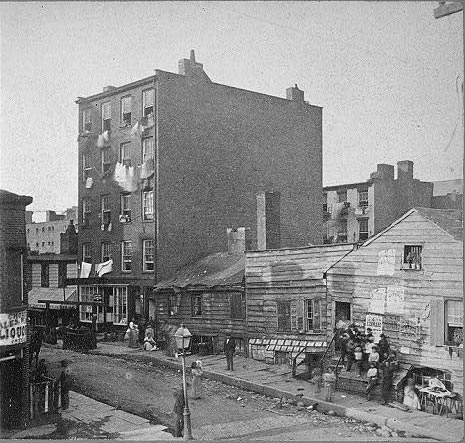
Here's a photo of the same street taken probably a few years later. You can see that the shack next to the tenement has sunk even deeper. In the drawing it's a two story structure, but the photo shows the ground floor window below the street level.


Charles Dickens had visited this very corner only seven years prior. He complains about the knee-high garbage in the gutter, and that's actually how this photo can be dated. The streets of Five Points were so filthy the city decided to "scrape" them clean in 1855. The story goes an Irish immigrant commented on seeing the newly washed streets of her neighborhood, "I had no idea there was cobblestones down there."

The cleaning of the foulest quarter of New York must have been quite the news. Five Points was not just the city's troubling social problem -- no one had ever seen such poverty, density or desperation in the city before, not to mention the concentration of Catholicism -- the place had also become a curiosity, a circus-like attraction. This photo was the instagram of its day -- The streets of Five Points have been cleaned?!? Definitely got to check that out and record it! -- and here it is, Five Points recorded ironically at its only clean moment, no doubt misleading many viewers today to think "It wasn't as bad as the literary accounts of it." Among the misled may be the viewers of Scorcese's Gangs of New York which reproduces dusty but barren streets, very much like the one in the photo. Here's what the streets of Five Points normally looked like:

Easier to see with this photo of a nearby East Side street lined with ca.1865 tenements, taken prior to 1894 when Colonel Waring finally got the streets of New York clean:

Not pretty. Dickens' complaint was no literary exaggeration. (Btw, if you look at photos of NYC streets in the late 1890's, you'll typically see cute little piles of horse shit here and there. They don't indicate that the streets weren't clean effectively. They're actually the mark of Waring's success. Priorly, you couldn't tell the horse shit from the heaps of excrement of all types, as above.)

Now take a close look at the tenement in the Five Points photo and drawing, in particular, what's behind the tenement in its lot. There's a back tenement -- a smaller tenement behind the main building. That little building tells all. I'll say a lot more about the reason for and the structure of the back tenement, but for now, let's just consider the mere fact that it's there.

In his contract, Rutgers also specified that there be no back house in his lot. A back house was guaranteed to bring a bad element. Who would rent in a back lot? Who would live in a front building with no back yard?

The mere existence of that back house says unambiguoulsy that the landowner has lost faith in the neighborhood as a place where he would ever consider living in. He's abandoned its use to the exchange value of its building. That shift will send both the land and its building floating onto the current of exchange, of industrialization and immigration, and eventually to legislative reform.

And that's why it's so tall. At a time when the tallest townhouse was was three and a half stories, these tenements were the skyscrapers of its day. People of means spurned apartment buildings. Multiple dwellings -- they called them tenements, but they were just apartment buildings -- were for immigrant Catholics, not for dignified society. The decent lived in a house.

And it wasn't the tallest. But I will finish this story later. The real estate market, immigration, density, the lack of public transport, and most important, the owners' relationship with his land -- all influence the character of construction and of neighborhood. It's a story of an inverse relation between use value and exchange value that characterizes slum real estate, exactly the opposite of the non slum market where use and exchange and demand all rise together. In the slum, demand and exchange rise at the expense of use. The more demand, the higher the price, the worse the conditions and the greater the density. It explains the uniformity of the slum and its diversity over time. More soon.

Wednesday, September 18, 2013

Solving the tenement puzzle

I'll be giving the illustrated lecture Solving the Tenement Puzzle again, this time at the Neighborhood Preservation Center/Historic Districts Council, 232 East 11th Street (between 2nd and 3rd Avenues), Wednesday, September 25, 6:30pm. Light refreshments will be served.

The talk involves the whole social history of 19th century New York, New York's wild politics, economy, real estate and land use, the development of the immigrant ghetto, speculation, arts, culture and reform. Using the photography of Stefania Zamparelli and Amy Chin, we'll read it all on the face of the tenements. And we'll debunk popular - and even historians' - misconceptions about the tenement.

I'll also address the surprising paradoxes of the immigrant real estate economy in which land rent declines as building rent rises, and the quality of living space (a use value) declines as price (exchange value) increases, contrary to the market outside the immigrant quarter. 

Solving the Tenement Puzzle: dispelling myths and misconceptions of an architecutral vernacular. 
Inline image 1