Monday, January 11, 2016

Semiotic neighborhoods vs the authentic and antifragile: prestige and its deceptions and betrayals

(These remarks elaborate an informal presentation I gave as guest speaker at a Columbia University Urban Planning Master's Program class last year. I was asked to discuss Chinatown and the East Village as semiotic neighborhoods. The basic idea is that in ethnic enclaves, the commerce that serves local residents is more resilient than touristy commerce. 

Representations designed to broadcast identity for outsiders betray the people and culture that it purports to represent, so there's a correlation between broadcasting outside and economic fragility, as well as deception and betrayal. Authentic commerce, by contrast, doesn't represent and is antifragile -- it grows stronger in a crisis because the locals have more needs in a crisis, and the local commerce serve them. 

Nevertheless, prestige and respectability are measured in mainstream cultural standards, far from ethnicity and authenticity, and are by nature hypocritical -- invested in presenting and maintaining themselves as prestigious, respectable and mainstream, regardless of the real ethical and moral defects of the apparently respectable -- so authority, including many city planners, administrators, financiers, developers and local community opportunists, scorns and ignores the authentic stability of the enclave's economy, endangering the future of the enclave. Although an ethnic enclave can thrive and grow despite outside catastrophes like terrorist attacks, hurricanes and recessions, it is vulnerable and threatened by internal and external authorities seeking to gentrify it. Already gentrified neighborhoods seek representations of authenticity that betray the authentic roots of the neighborhood. They are stabilized by luxury commerce dependent on upscale trends.)

What is a semiotic neighborhood? Simply put, a neighborhood full of signs. Any commercial street will be lined with signs that draw to its consumers. Delancey Street signs draw to the low-income residents nearby. Times Square draws to an international tourism consumer, advertising the entire city -- that's why the signs are so large, so bright, on-the-pulse and sexy. The signs can be read as an indicator of the character of the consumer.

But semiotics of a neighborhood is not just commercial signage. There are no commercial signs on Park Avenue north of 59th Street, but the stone and stately architecture, the spareness and cleanliness of the streetscape, the absence of commerce, all send a message that this is both a residential neighborhood and a wealthy, exclusive one.

Semiotic neighborhoods can be divided among those that broadcast their signs outside the neighborhood, and those that look inward. Broadcasting neighborhoods use their signs to create an identity for outsiders, an identity they can easily read. It can be a bit of a contradiction: an ethnic neighborhood can broadcast an identity that belongs to the outsiders -- self-stereotyping -- instead of being authentically ethnic. The purpose of the identity after all is not to be authentic, but to draw customers. So notice that it's money that leads to the fakery and the fakery is a betrayal of its own.

Inward-looking neighborhoods have no such need to create such an identity. They are not pretending with a show of what they are. The commerce there simply serves the local community that already understands it for what it is -- theirs. Inward-looking neighborhoods are characterized by authenticity.

In the literature of semiotic neighborhoods, inwardly looking neighborhoods are not even considered as semiotic -- they don't try to speak to the general public or communicate using the broader language of the culture, the recognized stereotypes; the motivation of their signs are restricted to the needs of locals, with no thought of trying to impress anyone with an enhanced identity. Ironically, they have authentic identity -- because they're not trying.

Local-serving commerce has low costs, since the customers don't have to be enticed and brought to the door. The locals are a bit of a captive market. As long as the prices don't drive the locals to seek a better deal, the local commerce can rely on having its customer. When there's a crisis, even a catastrophe like 9-11 or Hurricane Sandy, the local commerce actually thrives. The local residents have more needs in a crisis, not fewer, and the residents are even more captive without transport. They must find their needs served locally.

While the authentic neighborhood tends to keep prices reasonably affordable (the customer is not entirely captive) broadcasting a neighborhood tends to raise prices. The intent of broadcasting is to surpass the profits available locally, otherwise it would stay local and not bother broadcasting at all, since broadcasting incurs advertising and presentation costs. And advertisement and image-creation must be ongoing to keep up with outside trends.

In a crisis, a semiotic neighborhood can be devastated.This happened in parts of Chinatown after 9-11. Mott Street, which had been outward-looking with antique stores and Chinese souvenir shops, lost many stores, and has only recently recovered.

East Broadway, the center of the recent immigration and lined with local-serving stores, has not been devastated in the wake of 9-11 or even the Great Recession. It's been crowded and bustling, the commerce vital and thriving.

To be continued...
See also in this series:
Prestige and distortion in Chinatown
Suits and betrayal in Chinatown
The Mobility Dilemma and the Clearinghouse Effect
Authenticity in the East Village

Friday, January 08, 2016

Should be interesting:

A rare opportunity to learn the labor perspective in Chinatown. And Peter Kwong is an authority on Chinatown. Sunday, Jan. 10, 3pm, 345 Grand Street at Chinese Staff and Workers Association.

Thursday, January 07, 2016

The consequences of unaccountability

The Parks Department closed the basketball court all summer to resurface it even though there were no complaints about the old court and there was no community need for a resurfaced court. The Community Board did not request a resurfacing. Calling it a "repair," the Department proceeded without consultation, consent, or process.

The Department also renovated the nearest basketball court on Avenue D at the same time, closing out basketball to the community youth for nearly the entire summer.

The placement of ping pong tables in the park was also done without process beyond finding a space. The installation of a police surveillance station: also without process or consultation. Both of these targeted the homeless in Tompkins Square Park who've been part of the park community for decades.

The police station was installed after an article appeared in which a new young white person complained about the homeless in the park. The article appeared in the New York Observer, owned by Donald Trump's son-in-law Jared Kushner, who owns at least 36 buildings in the neighborhood. The homeless are clearly an obstacle to financial appreciation of his holdings and his vision for the neighborhood, one that is cleansed of anything but wealth and whiteness.

The park is the center of the Alphabet City neighborhood and community. It is being transformed without any accountability. I often hear the simplistic analysis that gentrification is the inevitable the result of global capital accumulation seeking a place to develop new markets. But gentrification doesn't happen without government complicity. Parks, development, real estate taxes, zoning restrictions, housing availability and regulation, services -- all these are within government purview. Gentrification is as much a policy choice as a pressure from capital.

The government in a democracy purports to be us. But when a government agency -- whether it's Parks and Recreation or the NYPD -- or the mayor himself changes the landscape without process, that's where gentrification gets in the door.

Wednesday, January 06, 2016

Marginalizing the Homeless

Last night I attended a town hall on homelessness and homeless services. As would be expected, the local electeds and the city administration spoke mostly about public safety -- they have to appease the local residential voters. Only Gail Brewer, the Borough President, addressed her comments to the needs, rights and interests of the homeless themselves. Props to her.

In the Q&A, a couple of middle-aged white men asked pointed, testy questions about public safety. A few graceful senior white women made constructive suggestions on how the homeless could be better served. Not surprisingly, the most trenchant comments were made by the homeless themselves -- several members of Picture the Homeless were present: Why doesn't the city ask the homeless what they need rather than funnel them into the modes convenient to the city. Why solve a housing problem with a policing answer? Why is all the affordable housing in the mayor's housing program way beyond the means of a minimum wage worker?

I complained to the council members present that the Parks Department continues to marginalize the homeless in Tompkins Square Park (Parks last month installed a ping pong table right smack in the middle of the space where the homeless regularly gathered), a public park that has been for many decades a place for the homeless to socialize with their friends, feel at ease and enjoy. They have every right to be there. What they don't have is the political clout to protect their right.

Afterward, a well-intentioned rep from a city agency said to me, giving me her card, "If any of your homeless friends aren't being served, please contact me." IOW, 'help me funnel your friends.' My take-away: the people who've been funneled are the people working for the city.

The city is focused on dragging street people off the street.into shelters. They wanted residents to be complicit in this, distributing to the audience maps for residents to pinpoint places where they could identify "problems" (aka a homeless human that the resident wants to have disappeared into the system). Presumably that gives the police the excuse to forcibly remove the human. Providing homes seems to be way down their list below the level of constituency politicking.

Sunday, September 20, 2015

A march to save Chinatown

I'll be joining a march to protect Chinatown from gentrification and displacement Friday, September 25, 4pm, starting at 227 Cherry Street and marching to City Hall.

If you want to join: 227 Cherry St. is near the FDR Drive on the north side of the Manhattan Bridge; nearest subway station is the F train at East Broadway & Rutgers St. See the map below.

As Chinatown is threatened with luxury development -- the new Extell tower will rise 71 stories -- the mayor has rejected the community's protective plan that reflected 7 years of research, discussion and hard work with nearly 60 local community organizations contributing, including residents, labor, small businesses, social services and advocacy groups.

The Department of City Planning has dismissed the community proposal without any research whatsoever, by its own admission (I asked them point blank at a meeting with them). Instead, DCP has clearly indicated to us that it wishes to develop within Chinatown and around it.

March in solidarity with fellow New Yorkers 
to protect and defend Chinatown 
from gentrification and community displacement:
Friday, September 25, 4pm
227 Cherry Street to City Hall
(227 Cherry St. is near the FDR Drive on the north side of the Manhattan Bridge; nearest subway: F train ​​to East Broadway & Rutgers; see the map below)

​
The march flyer:

Wednesday, August 06, 2014

Franchisee labor win

The NLRB (National Labor Relations Board, the agency that rules on labor issues) has decided that employees of a franchisee can name the corporate franchisor in complaints, strengthening labor's voice and requiring greater responsibility from corporate giants. It should be good for the franchisees as well to have the franchisor taking responsibility for labor relations. It's astonishing that MacDonalds previously had not been accountable for labor violations in their franchise stores.

Tuesday, July 15, 2014

Piketty and immigration

Just finished Piketty's Capital in the 21st Century. His central claim is that the ratio of capital/labor increases as the rate of economic growth decreases because the rate of return for capital remains constant, and, he claims further, the growth rate will decline through the rest of the century as the population rate (the rate, not the absolute population) declines.
He recommends a tax on wealth/capital. But if he's right that the rate of growth will decline ceteris paribus, seems to me his wealth tax is not the only option: opening the borders should slow wealth inequality. Open borders w/naturalization would also counterbalance the political influence of wealth, Piketty's underlying complaint against wealth accumulation.
His tax could happen in Europe, but not likely here in the US. How would a push for immigration fare as a means to grow the economy? With an alliance of business with immigrants? After all, Piketty's prediction is a ratio, not an absolute quantity of wealth or its buying power. r>g holds when g increases, even though the ratio of wealth-income decreases. It would be a win-win for business and immigrants. It should not hurt unions in the long run either, although in the short run it might hurt a lot. 

Friday, June 20, 2014

Rent regulation, Krugman, Yglesias and reality

A couple of years ago, when the city rent regulations were up for renewal, I wrote an analysis for Met Council to rebut Paul Krugman's standard but flawed complaint against rent regulations. In it I supressed a key force in the development market largely because it seemed at the time too pessimistic. But this morning it occured to me that there's much more to be said about it, and it's worth saying, especially now when there's no rent battle.

First to recap: Krugman's column was focused on San Francisco without recognizing -- or perhaps not knowing -- legal and market distinctions between that city and ours crucial to a clear understanding of the market and regulations here.

On his classic liberal economic view of rent regulations, it is assumed that regulations dampen development, suppressing supply so raising rents. It is also assumed that deregulation will push out current residents, increasing the supply of rentals, so lowering market rents. Rent regulations, on this familiar view that Krugman followed, are the cause of the city's housing crunch and the consequent excessively high market rates.

In the Met Council piece, I showed that both of these assumptions are false in New York City. Because they do not apply to new construction, NYC rent regulations do not dampen development. On the contrary, they are one of the very few incentives to develop in this city, rather than just price up existing apartments, a much cheaper option than construction. Deregulation prices up existing rents, so it de-incentivizes construction. So the first assumption is plainly false.

The second assumption is a bit less plain. When tenants are evicted by a rent hike, the tenants typically don't leave the local rental pool. Employment, family or cultural preferences tie them to the locality (for us, the larger metropolitan area). Instead, many move to cheaper neighborhoods, where, especially in a city where the supply is limited, they increase the demand for housing in those neighborhoods, raising rents there and in turn displacing the prior tenants.

The overall effect is one of musical chairs, not surplus. When everyone has found a seat and settled in, the rents should be exactly as high as before. And as long as newcomers arrive, the rents will continue to rise. with no relief to existing tenants.

The economic difference will be an increase in the aggregate funds available for rent as the formerly regulated tenants devote more of their income to rent and those who can afford more rent move up into those deregulated apartments. The increase goes to landlords.

If deregulated tenants have less disposable income as a result, they may contribute less to the consumer economy or contribute more to the workforce. Both are undesireable: the former dampens the economy, the latter, if it's significant, lowers wages in the workforce, which can also dampen the economy and increase inequality.

Both Krugman and Yglesias agree that construction would ease the market. That is certainly true, as far as it goes (and that is as far as I went in the Met Council piece). But this is liberal market utopianism: deregulate and the invisible hand of the market will provide through the balancing of the individual interests of both developers and residents. There is a diminishing return on construction. Once the supply exceeds the demand, construction will end and developers will seek greener pastures. Developers are mobile, so the construction market in NYC depends on the construction market elsewhere. The tight market everywhere serves the rentier.

Worse, NYC, unlike most places in the world, has a well of demand with no visible bottom. Build it and the wealthy will come. Upzoning, Yglesias' solution, brings newly constructed units to NYC but does not ease market rates, it merely upscales the city. Since apartments respond to cultural fetishes, the more new units constructred, the more old neighborhoods become attractive. A city, like any cultural artifact, defines itself by a value structure of differences as well as of uses suited to distinct motivations. The Lower East Side, once a ghetto (explicitly named as such in maps in the 1920's) for industrial labor and a place to avoid as a utilitarian necessity, now attracts urban youth who would find a penthouse in a glass building culturally sterile.

If, in NYC, new luxury rents were set at market rate and then regulated thenceforward, the incentive to construct might not be too much curtailed. But this will yield more luxury constuction, not more affordable housing, nor easing of the rental market.

When New Yorkers complain that the rents are too high, they forget that landlords charge the highest possible rate that tenants are willing (or, at the bottom, can) pay. Rents are "high" because renters (those above the bottom) want to pay (the bottom have to pay). They are at a negotiating disadvantage, since landlords hold multiple options including warehousing, while renters are mere individuals, unorganized.

If Krugman and Yglesias are wrong -- that is, are deregulation of rents or zonings ineffectual -- is there any way to lower rents? Regulating profit margin might work. It has an interesting precedent in city government. (Thanks to Bill Cashman who pointed this case out to me). Abu Dhabi, the owners of the Chrysler Building, pay its land owner, Cooper Union, the assessed real estate tax on the land. As a non profit, Cooper Union pays no tax. So the rent on the land is in effect determined by the city and state. The Rent Stabilization Board also regulates landlord profit, but it doesn't do this individually, and landlords' books are not open.

A simpler answer would be to place all land and buildings into public hands. If the city could extract a reasonable rent from the 1%, they'd easily be able to manage effectively the current NYCHA properties and even build more affordable housing. If renters were allowed to strike, landlords would eventually abandon their buildings and the city would inherit them. Too bad it'll never happen. It's the only sane solution to "the rent is too damn high!"

Wednesday, June 18, 2014

Concerning the history of real estate in the slum

Trying to attribute gentrification to the real estate industry, Neil Smith came up with an analysis that distinguished ground rent from building rent. It's an echo of David Ricardo, whose brilliant analysis of rent distinguished the value of the land from the value it produced in an agricultural economy. Smith's distinction is inventive and imaginative, but maybe not reflective of any economic reality. I think he conflated potential with real. To explain why I think so, I'm going back in time to the roots of slum real estate.

In her Manhattan for Rent (Cornell 1989), Elizabeth Blackmar recounts how Henry Rutgers, in the 18th century, leased out a piece of his land to a contractor, specifying exactly the size of the house the contractor could build. Too small a house might attract poorer tenants, too large might attract boarders, in either case altering the character of the neighborhood for the worse, degrading the value of his land.

In old New York, the gentry leased land to a contractor who would build a structure and rent it out to a single-family tenant. The building owner then extracted the rent on the residential tenant and in turn paid rent on the land to the landowner. Rutgers' specifications recognize that the value of land depends not just on the rent of whatever structure is built on it, but on the value of the land itself. For Ricardo, the value of the land depended on the demand for the best soil for cultivation. In a city, and for Rutgers, it's the demand for the best neighborhood, the cultivation of preferred neighbors.

So far Smith's analysis works well. The value of the land can be discussed independently from the rent of whatever is built on it. What I question is whether the value of the land can differ from the value of the buildings on it or their revenue.

The drawing at the top shows the Five Points neighborhood, lower Manhattan's notorious slum of the mid-19th century. The artist gives the impression of the topsy-turvy discord of the place, a kind of bizarro-New York. Wooden houses are sinking into the ground at different rates, street fights abound, a white gentleman is kicking a woman, presumably a prostitute, into the street while the only dignified character is the black gentleman in a top hat. Prominent among the incongruities is a tenement building, standing like a Trump Tower amidst a tattered Detroit street.

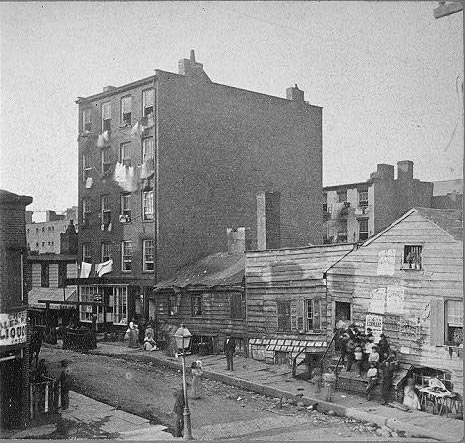
Here's a photo of the same street taken probably a few years later. You can see that the shack next to the tenement has sunk even deeper. In the drawing it's a two story structure, but the photo shows the ground floor window below the street level.


Charles Dickens had visited this very corner only seven years prior. He complains about the knee-high garbage in the gutter, and that's actually how this photo can be dated. The streets of Five Points were so filthy the city decided to "scrape" them clean in 1855. The story goes an Irish immigrant commented on seeing the newly washed streets of her neighborhood, "I had no idea there was cobblestones down there."

The cleaning of the foulest quarter of New York must have been quite the news. Five Points was not just the city's troubling social problem -- no one had ever seen such poverty, density or desperation in the city before, not to mention the concentration of Catholicism -- the place had also become a curiosity, a circus-like attraction. This photo was the instagram of its day -- The streets of Five Points have been cleaned?!? Definitely got to check that out and record it! -- and here it is, Five Points recorded ironically at its only clean moment, no doubt misleading many viewers today to think "It wasn't as bad as the literary accounts of it." Among the misled may be the viewers of Scorcese's Gangs of New York which reproduces dusty but barren streets, very much like the one in the photo. Here's what the streets of Five Points normally looked like:

Easier to see with this photo of a nearby East Side street lined with ca.1865 tenements, taken prior to 1894 when Colonel Waring finally got the streets of New York clean:

Not pretty. Dickens' complaint was no literary exaggeration. (Btw, if you look at photos of NYC streets in the late 1890's, you'll typically see cute little piles of horse shit here and there. They don't indicate that the streets weren't clean effectively. They're actually the mark of Waring's success. Priorly, you couldn't tell the horse shit from the heaps of excrement of all types, as above.)

Now take a close look at the tenement in the Five Points photo and drawing, in particular, what's behind the tenement in its lot. There's a back tenement -- a smaller tenement behind the main building. That little building tells all. I'll say a lot more about the reason for and the structure of the back tenement, but for now, let's just consider the mere fact that it's there.

In his contract, Rutgers also specified that there be no back house in his lot. A back house was guarenteed to bring a bad element. Who would rent in a back lot? Who would live in a front building with no back yard?

The mere existece of that back house says unambguoulsy that the landowner has lost faith in the neighborhood as a place where he would ever consider living in. He's abandoned its use to the exchange value of its building. That shift will send both the land and its building floating onto the current of exchange, of industrialization and immigration, and eventually to legislative reform.

And that's why it's so tall. At a time when the tallest townhouse was was three and a half stories, these tenements were the skyscrapers of its day. People of means spurned apartment buildings. Multiple dwellings -- they called them tenements, but they were just apartment buildings -- were for immigrant Catholics, not for dignified society. The decent lived in a house.

And it wasn't the tallest. But I will finish this story later. The real estate market, immigration, density, the lack of public transport, and most important, the owners' relationship with his land -- all influence the character of construction and of neighborhood. It's a story of an inverse relation between use value and exchange value that characterizes slum real estate, exactly the opposite of the non slum market where use and exchange and demand all rise together. In the slum, demand and exchange rise at the expense of use. The more demand, the higher the price, the worse the conditions and the greater the density. It explains the uniformity of the slum and its diversity over time. More soon.

Tuesday, June 17, 2014

CB3

Went to CB3 last night. The liquor licensing committee seems to have improved its method of operations. The agenda indicated the time each item would be presented.

I didn't stay around to observe the action. The Distrcit Manager, as always, insulted me in her usual manner by telling me to get out of the way while I am actually not in her way as she walks right passed me with plenty of space to spare. She does this to me every time I attend a meeting, even though I never block an entry. Stupidly, I fell into the trap of responding to her incivility with my own, which, of course, doesn't do any good but just makes everything worse. I left feeling angry at her, angry at myself for being unpleasant to someone in her own workplace on her work time, and full of the frustration of having to want to justify myself yet still not being able to understand why she can't be civil and why I don't know how to let it roll off my back.

Of all the places I find myself, the Community Board 3 is without doubt the most unpleasant. The things that people have done there to me, the things that I have done there -- it's just a hellhole that somehow brings out the worst of human nature. At CUNY, where I'm teaching, the department is welcoming, considerate and fun, the students, despite all the pressures on them, are with few exceptions wonderful to be around, all the employees, from security to custodial staff, all charming to a fault, even the administration is at least pleasant and cooperative. Everyone seems to make an effort to please. Why is the community board so unpleasant?

Going to Community Board 3 reminds me of encountering the body builders who worked out on the chin-up bar in the park twenty years ago. They couldn't talk to you without telling you what to do, how to do it, that you're doing it wrong because you're not doing it their way, even though they weren't paying any attention at all to what you were doing, and what they were doing was limited at best. That's the community board in a nutshell.

Sunday, June 15, 2014

Saturday, January 18, 2014

The Big Shrill

I moved to Loisaida in 1978 because it was hidden from mainstream New York, abandoned by ownership, undiscovered by commerce. The storefronts that weren't lived in were empty, aside from a very few store survivors from the past. No one thought the lack of commerce was a problem. To the contrary, anarchists railed against the threat of gentrification, although their target was the police, go figure.

Today the community board worries about filling every storefront as if the welfare of landlords, who most benefit from commercial rents, were a matter of public community concern. And what moves community activists today is SantaCon, as if a single day of silliness merited anyone's trouble. SantaCon is good for a laugh, but at least the Santas don't throw eggs as the kids used to decades ago on Halloween. This neighborhood sounds like the Upper East Side complaining about an ethnic parade down 5th Avenue.

The sign that the LES is truly gone and buried is this character of its activism. When did the defense of anarchy and difference turn into defending middle-class vaules of quiet, normality and the absence of disruption?

Sunday, December 15, 2013

Left and right knee jerks

If I'm playing devil's advocate, it's because the liberal arguments put forward for raising the minimum wage have not been pro-labor. I'm thinking of these two: it will stimulate the economy (Stiglitz and Reich among others) and it will disburden the taxpayer who is subsidizing the welfare safety net for minimum wage earners (even Occupy's Cathy O'Neil seems to buy this argument). There's even the argument that Wal-mart and McDonalds would benefit by a raise because their employees would spend more money there (the Henry Ford business model). The only pro-labor argument points to the fact that a family can't survive on minimum wage. But the raise that Obama has proposed is not enough of a raise to solve the problem for minimum wage-earning families. 

It seems clear then that Obama's proposal is intended not to improve the welfare of low-income wage earners -- especially those with multiple jobs who will lose their medicaid or food stamps -- but to provide a mild stimulus to the economy without increasing unemployment (small increases in minimum wages have been shown not to increase unemployment, as studied by Card & Kreuger -- I've posted their work before here and here -- and more recently, Dube, Lester & Reich) and without increasing federal spending or taxes. In other words, Obama has found a expedient means to appear progressive without alienating conservatives -- and without actually being progressive. An expansion of the welfare net would be truly progressive, especially if it were met with a commitment to free public housing (Occupy has been working on this by occupying foreclosed properties) and free higher education.

This nation is incredibly wealthy despite its long relative decline, its dependency on dollar devaluation and debt financing. It's instructive to me that the current recession was not caused by a business cycle but by deregulation and overspeculation. It wasn't caused by higher taxes (they had been lowered, in fact) or spending (the economy was growing through two hugely expensive wars). That suggests to me that the economy can withstand all sorts of Keynsian measures including both higher taxes and more government spending. 

Transformation requires a shift from playing the political-economic game to demanding change, and that requires a shift in our discourse. In a world of knee-jerk conservatism, knee-jerk libertarianism, knee-jerk liberalism and knee-jerk leftism, that's not likely outside obscure blogs that don't matter. 

Saturday, December 14, 2013

The confusion

To assume that any policy is by definition pro- or anti-labor is a mistake of knee-jerk liberalism. A policy isn't pro-labor if it throws laborers out of mediciad and food stamps. Wal-mart shows a structural contradiction in our current capitalist economy, driving both wages and prices down. Raising the minimum wage does nothing to resolve that structural contradiction. Expanding food stamps and medicaid, and similar welfare state policies, do.

To be plain, I'm pointing out that labor activism has two directions that are in important respects incompatible: socio-economic transformation (including revolution) and socio-economic entry. Union activism succeeded in bringing labor into the middle class, a material improvement, but not a transformation. It's an expansion of conformity of the individual as commodity and consumer-of-commodities. The New Deal social welfare state was transformative, protecting people as they are, leaning the nation towards a socialized society.

The social safety net seems to me the visionary direction. Why shouldn't food and health care be as much a right as public education, public libraries and public parks? Why not public housing as well? It's not just libertarians who object to the social safety net. Liberals also don't seem to get that expanding the net is liberatory. Maybe they're afraid of it. Liberals seem much happier supporting a unionism that shepherds its people into middle-class consumerism than allow them any measure of real freedom beyond their own horizon. 

I'm much more sympathetic to liberatory transformation. But even if I weren't, in an economy that is increasingly stacked against the 99%, requiring ever more debt, I'd be wary of the entry game. And I think labor ought to take a stand on it in favor of expanding the social safety net. Since Reagan-Thatcher everyone seems afraid of the social safety net. It's the new McCarthyism. 

Sunday, December 08, 2013

Labor activism is confused

Wal-mart employees are the largest food stamp and Medicaid recipients in many states, at taxpayer cost. So labor is agitating for a raise in the minimum wage, claiming that it would not only improve the lives of low income earners, but also increase the liquidity of the economy. The latter argument is debatable, the former is just false. 

Medicaid and food stamps are great. They directly, without any economic mediation, give people who need real food and health care exactly those needs. Raising the minimum wage, on the other hand, plays into the economic equilibrium — and what economist really knows how that will play for sure? — without providing those people’s actual needs. Food stamps are much less of a relativized abstraction than cash, which is entirely abstract and relative. 

Food stamps and Medicaid paid for by higher-income taxpayers are much better and more progressive social and economic policies than either raising the minimum wage or guaranteed income.

Some small businesses with narrow profit margins will have to pay for a raise in minimum wage (that’s regressive) and both raising the minimum wage and guaranteed income play into a market equilibrium than can backfire through inflation. Why flee food stamps and Medicaid, two of the best welfare-state models we have, for the sake of subserving a wage economy without guaranteed food and health, where you’d have to buy health insurance and where the wage-earner buys discount junk food with cash at a Duane Reade rather than at a supermarket where fresh produce are at least available and encouraged by the stamps?

I can see only two advantages to raising the minimum wage: once implemented, it is not likely to be revoked or curtailed, as food stamps have been; there's a chance that it might increase the overall liquidity of the economy. But to force labor to buy its own food and health care seems a really regressive and upside down way to improve the lives of low income workers. The underlying issue of dignity notwithstanding, labor ought to be demanding increases in food stamps and medicaid, not begging to abandon them. I wonder whether Wal-mart might actually help labor in agitating for increases in social programs. That would be much more effective than just a day of labor protest.  

Wal-mart has two sides to its business model: low wages and low prices. Only small businesses object to the latter. A raise in the minimum wage might solve the price problem for those small businesses, but at the expense of the wage problem for them. So it's a wash for them. On the other hand, if government subsidizes the wages with increased food stamps and medicaid, the small businesses won't be helped, but a much larger sector of the population will be helped not only with food and health, but also with low prices. That's persuasive to me. Let the small businesses cater to the upscale. Let government subsidize labor and low prices.

Monday, November 11, 2013

Where's it all going?

It looks like NO711 is headed towards a racially divided face-off. NO711 is 100% white and mostly middle-class. Store employees are neither. 

Two months ago, when the opening seemed inevitable, I asked 7-Eleven Corp if they'd be willing to give back to the community. Their public relations consultant agreed. I suggested engaging with youth services, men's shelters, services for abused spouses and healthy food services. Together we began looking for options. But, as one local social service director explained to me, the social service organizations here depend on the good will of the local community, so it is unlikely that any service will collaborate with 7-Eleven as long as a local group like NO711 opposes it. 

Meanwhile, the 7-Eleven store opened despite a stop work order. Apparently 7-Eleven feels that their illegally placed refrigerator units and industrial fans are the building owner Jared Kushner's problem, not theirs. That's a low blow for 7-Eleven, but they've got a high commercial rent to pay, and with the rent Kushner's getting from them, it's even lower of Kushner not to resolve the stop work order immediately. But what does he care?

The store will, following standard procedure, give its outdated foods to a church soup kitchen, in this case the church on Avenue B.

So the store is here, so is NO711, an ugly race confrontation is imminent, and no community give-back beyond the pro forma. 

At a meeting with the NO711 group in June, I let the group know that I didn't want to be involved beyond cutting the checks for the grant that I got for them as the block association treasurer. I support NO711 as neighbors, but years ago I recognized that the neighborhood as it is today is nothing that I beleive strongly enough about to work to preserve.  It's a gentrified neighborhood, belonging moslty to youth of privilege. I accept that reality. I stay here only because I have an affordable apartment a block away from a park and a pleasant library I enjoy, and within walking distance of Chinatown and the East River, and I know this place and many of its people of whom I am fond. 

In September, the 11th Street ABC Block Association board asked 7-Eleven to meet with the block. They wanted to meet with our board alone (presumably to gain the credibility of having met with the block association) but would not commit to meeting with the block (presumably because it would be a public meeting and many of the explanations of their business model might not look good to the press). When we insisted on an open block meeting, they asked to meet with me alone, not as a representative of the Block Association or NO711. I agreed. That's when we got started on a community give-back. I wish it would go further. 

Lately my feelings have been all over the place. Would a zoning restriction on chain stores save the local butcher? Probably not. It would save New York for upscale restaurants. That'd be great for tourists who look to NY for a change from suburbia, but I don't feel that as something worth fighting for. I don't feel proud of washing my hands of all this, and I wish 7-Eleven had backed out long ago, but I don't see the situation now going towards good for anyone. The corporation appears to be still willing to give back to the community. But the residents around the store are unhappy and you can't blame them. 

Monday, October 21, 2013

Defacing Banksy bothers you?


Consider what graffiti means to the course of western art. It's not just raising the cry against the defacing of NYC by developers from the city admin top down -- the demolition of 5Pointz, the graffiti center -- that's just the content message. 

Transgressive is the distinctive hallmark of western culture's art -- the abiding dissatisfaction with normal, of workaday and wifery and whitesupremacy. Traditional arts of traditional cultures celebrate their normal with gods and godesses and Buddhas and bodhisattvas. Not here n the West since industrialization raped society and gave us Romanticism and angry, moralistic art from Dickens to Beethoven, desperately seeking authenticity in feeling and rebellion. 

Transgression in NYC-wide art is so much more satisfying than Christo's pretty orange banners of decorum that the mayor endorsed in his stately backyard of Manhattan's Central Park, the world's most upscale leisure ground. At last, Banksy -- the perfect hipster art: it can't be untransgressive or acceptable even if the mayor allows it or Kelly ignores it. It can be acceptable and normal only to hipsterism. Even if it becomes the popular sensation of the doucheoisie, it's still illicit graffiti art -- transgressive art of the mischievous kid, pre-adult pre-normal culture, marginal to the emotional-death-in-normality and alienation. 

There is no affect in normal. Only a western mind could write "The key to joy is disobedience." Banksy is the latest NY cronut and defacing his art scrawls all over Bloomberg's signature on this city and repos his Midas touch that silenced all urban pulse. Silence is Death; Speakout=Deface.

Banksy is clever and cool. Defacing his art repossesses graffiti and the city from Bloomberg's self-congratulations. 

Tuesday, September 24, 2013

Over capacity

The Historic Districts Council informs me that seating for the lecture "Solving the Tenement Puzzle" has reached capacity and there is already a waiting list.

Wednesday, September 18, 2013

Solving the tenement puzzle

I'll be giving the illustrated lecture Solving the Tenement Puzzle again, this time at the Neighborhood Preservation Center/Historic Districts Council, 232 East 11th Street (between 2nd and 3rd Avenues), Wednesday, September 25, 6:30pm. Light refreshments will be served.

The talk involves the whole social history of 19th century New York, New York's wild politics, economy, real estate and land use, the development of the immigrant ghetto, speculation, arts, culture and reform. Using the photography of Stefania Zamparelli and Amy Chin, we'll read it all on the face of the tenements. And we'll debunk popular - and even historians' - misconceptions about the tenement.

I'll also address the surprising paradoxes of the immigrant real estate economy in which land rent declines as building rent rises, and the quality of living space (a use value) declines as price (exchange value) increases, contrary to the market outside the immigrant quarter. 

Solving the Tenement Puzzle: dispelling myths and misconceptions of an architecutral vernacular. 
Inline image 1

Monday, September 16, 2013

Jewels

LES Jewels, the most transgressive man I know: indifferent to safety, security, health, decorum, decency, police, imprisonment, violence, or any protection from all the dangers we fear, the dangers we hide from to crawl nightly into our narrow caves to sleep in beds of denial, dreaming our small worries. He loved to wear crazy jewelry and would always show off his latest, wordlessly. Arihood admired him to no end. The spirit of the old neighborhood lived in him.