Thursday, June 10, 2010

Another historic loss on the Bowery, and an illegal demolition?


206 Bowery, a Federal row house from the early 1800's -- maybe as early as 1800 -- is being prepared for demolition. The residential tenant has been given 6 days' eviction notice, the commercial tenant has already left and the boiler has been shut off. And there are no filings with the Department of Buildings to demolish.

photo:curbed.com

Another illegal demolition to pre-empt any effort to landmark the building, like the Henry Street demolition February? We've already lost the Germania Bank building on Bowery. History is losing fast. The barbarians are here.

Sunday, May 30, 2010

The Emperor's clothes

Look carefully at the 3rd&4th Avenues rezoning:
current zoning
proposed zoning


Clearly, the 3rd&4th Avenue rezoning will not serve its purpose. The voluntary middle-income provision lacks incentive: it won't be built. The 120-foot height cap will continue to encourage development, and the huge 57% increase in residential density will target every small old building for demolition -- eviction -- and redevelopment.

In the craze for contextual zoning, no one seems to understand that under the old zoning, huge overdeveloped towers were typically built by purchasing air rights from smaller buildings. Those smaller buildings, once having lost their development rights, have no room to develop. That protects them and their tenants.

In the rezoning, the old commercial allowable floorspace (6 FAR) is unchanged. The 6.5 community facility (dormitories) is unchanged. The only change is the huge increase from 3.44 residential FAR to 5.4, a whopping 57% increase. Instead of a few towers protecting its smaller neighbors, this rezoning will eventually replace every old building with 57% larger ones rising up to 12 stories. This is an improvement? Who is benefiting besides developers and their minions?

The EV/LES rezoning balanced upzoning with downzoning, development with preservation. But this 3rd&4th Avenues rezoning includes only upzoning, no downzoning, more development, zero preservation. And the voluntary middle-income housing has no incentive: developers get only an additional 5% market-rate if they develop the 20% affordable units. Why would a developer build affordable housing just to get 5% more market-rate space when he just got 57% for free, no strings attached? Not without a kickback.

Sunday, May 23, 2010

gratuitous travesty


P.S. 122 has renovated with a pristine surface of white poured stone. It's clean and new, but undistinguished. Dull in its glaring brightness, fawning and monkeying the commercial success of the clean edge, it proudly flaunts banality. Sadly, it covered one of the most poignant, beautiful and resonant façades in all Manhattan, including its crumbling brownstone Romanesque-Dutch influenced entryway.

Ruins can't be made: they become, despite themselves. That's their essence and their point. They tell us that we cannot control our world, that time and nature rule, that human genius is an ambition not an accomplishment, that foiled hubris can be noble and admirable and beautiful because it is an attempt at the infinite in a finite world. Ruins have pathos. And ruined hubris too: otherwise it would be oppressive triumphalism, like glass and steel.

Whenever I walked past P.S.122's, I always thought immediately of the painting in the early Flemish room at the Metropolitan Museum, variously attributed over the years (I think it's now Petrus Christus, but I can remember when it was a Hubert van Eyck, or school of van Eyck, and who knows next) strangely depicted from an aerial and oblique view showing a pristine church surrounded by the green, natural world. Between the constructed and the earthy sward lies a single step, degrading. The painter has taken great effort to render the details of this step, its smooth, worn-away surface as well its cracks and clefts and its exfoliated layers. Stone chips lie scattered on the earth before it.

It seems the painter wants to show a contrast between the fallen world of human fashioning and the perfect world of god's kingdom embodied in this perfect church building. But the church is much less interesting and appealing than this one stone step. The church is pretty enough, so is the surrounding foliage and the angel and Mary there, but the step is mesmerizing. The more you look, the more you think: about human frailty, human failure, about history and inevitability, time and loss. And while you think and muse, you also feel, more and more, and soon and near, that this step is familiar, welcoming and warm. It holds no pretensions, it demands no expectations. It's where we live; it's where we die. It's most us.

P.S.122 could have protected the public from its flaking sandstone with a modest awning or eave, but instead, it swallowed it up forever. Demolishing an old townhouse to build a hotel will at least benefit someone -- the owner, with personal profit. But covering this ruin of over a hundred years, benefits no one. It's a completely gratuitous act.

It's not a humanitarian disaster, but if we provide for basic needs of humanity without providing a human environment, what have we accomplished? A while back I took a group of inner city 19-year-olds from a prison halfway house to tour the neighborhood, showing them how history, economy and social structure explain the form of the buildings. They ate it up and assimilated the knowledge instantly, but when I pointed out an old tenement covered with terra cotta, they went bananas. "Look at the detail!" "That's MAD detail!" I couldn't get them away from it. Later, at the end of the tour, talking with one of the kids, I asked him what he wanted to do with his life. The answer: "I think I want to be an architect."

Don't tell me only the rich care about architectural beauty, the plebs don't. That's just bigotry and the true snobbism of paternalism.

Wednesday, May 12, 2010

Only in New York

A request for evaluation (RFE) had been submitted to the Landmarks Commission for these two historic buildings, 22 and 24 Henry Street in January. On February 4, the owners filed for a construction shed. Now the buildings are gone.

The old town houses were much smaller than the zone allowed, which means that the owner can build a much larger structure now. It is common for a developer to demolish an old structure to avoid a landmarking designation.

This happened on the Bowery only a couple of months ago. The developer, intending to build a large hotel or condo complex, bought three adjacent parcels, on one of which stood a historic structure. Of the three buildings on those parcels, only the historic structure (an early Germania Bank building) has been demolished:


In the world of real estate development, history and aesthetic value must be destroyed, otherwise it stands in the way of "progress" (defined as personal gain). But crap is okay. Crap is great. Crap doesn't threaten money. There's no protection for crap or against it. One piece of crap can easily be transformed into another piece of crap for profit. As long as the city is full of crap, developers can play freely. So it's important for them to build as much crap as possible, and leave as much crap as possible, their own or their predecessors, producing a great, expansive, comprehensive and complete heritage of megalopolictic crap. This is the architectural second law of developodynamics: all value tends towards crap.

Monday, May 10, 2010

More on 24 and 22 Henry

The two buildings were both listed on the National Register of Historic Places as part of the Two Bridges Historic District. Unfortunately, the National Register does not protect buildings as the city Landmarks Preservation Commission can. The owners filed in February for "minor alterations" with "no change of use, occupancy or egress." There is no filing for demolition at the Dept. of Buildings.

Justin Ferate, the renowned urban, social and architectural historian, supplies this photograph to give a better sense of the period (these are landmarked in Brooklyn Heights):


Zella Jones, founder of the NoHo Alliance, provides this recent photograph of 24 Henry, the older of the two buildings demolished:


For structures largely ignored for two centuries, they were in remarkably good shape, and because they eventually were surrounded by a slum -- part of New York's oldest slum -- they were neglected and so largely unaltered. But the neighborhood -- Henry, Madison and Monroe Streets around Catherine and Market Streets -- has seen newly built developments.

Sunday, May 09, 2010

Too late

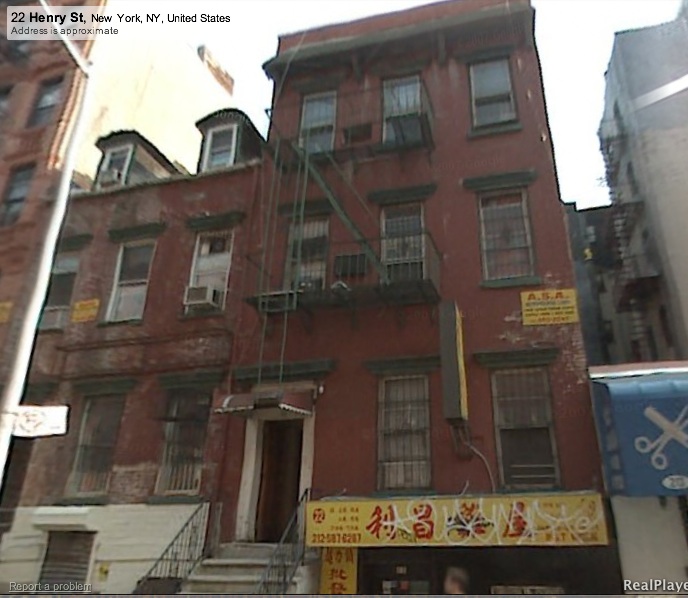
Two of the oldest structures in New York were just demolished on Henry Street, 22 and 24: a four story row house and, next to it, a diminutive, narrow town house. Both must have dated at least as back as the 1820's; the town house may have dated back further. I did not have time to inquire about what is replacing it, but there is a girder structure up already.

The screen caps attached, cut from google street maps, don't do justice to them. They were a striking little piece of the early 19th century, unusual because of the pairing of a town house-with-dormers adjacent to a row house with a fully built fourth floor covered by a unique wood awning in lieu of a cornice. I always took visitors to see them on the Chinatown/Five Points tour. After the Mooney House, they were the oldest buildings around, and almost unaltered.

The demolition of a town house in Greenwich Village would spark a protest, an outrage and an angry movement, but far to the east in Chinatown, no preservationists seem to notice or care. And yet, these two small buildings were probably older than anything in the Village, and in a neighborhood with a much longer and complex history.


Wednesday, April 14, 2010

NYU strokes the EV with massage, fantasies and sweet-talk

NYU tonight opened its expansion plan with three parcels of feel-good massage: 25th Street & 1st Avenue next to Bellevue hospital, well away from the East Village; the MetroTech center in downtown Brooklyn, an area so empty of community that no one would even notice a new skyscraper there if it fell over on it; and Governor's Island, the sole impact of which on Manhattan is a ferry landing next to another ferry landing and a helicopter landing. And throughout their presentation, no plans for the East Village at all. Sounds good?

BUT if you look just a little more closely, you see that the the presentation is fantasy designed more for propaganda than genuine plan. The site south of Bellevue is already occupied and owned by Hunter College. Although Hunter announced a bid for the land two years ago, it hasn't followed up for a variety of reasons which will not likely change for quite a while, if ever. NYU, if prodded, admits that these 1mil. sq.ft. are mere speculation on a wish of a shadow of a building complex they can't control at all. (They're actually planning a Nursing School building across the street, but it's quite small in the scheme of things: 140,000sf).

The Governors Island plan requires a huge commitment that they are not yet prepared for, and also requires other entities to make that isolated island palatable to any but the most reclusive academics hermits. Until there's something there there, there's no there there besides the nothing that isn't there, and NYU, the university of the "New York Experience" is all about being here, not there. The Mayor would like to see it happen, but governments have been wanting to see something happen there for over a decade, and the only thing that has so far happened is a recreation area that's become so popular that the public wants to keep it for themselves unchanged. NYU claims with one tongue that their buildings will be set away from the recreation area untouched, but with the other tongue admits that there will have to be attractions elsewhere on the island before anyone is willing to reside, teach and learn all on that little military campground. When everyone finally gets all excited about Governors Island, of course that's when NYU shows up and drags in its entourage as well.

The MetroTech center is the only parcel that NYU could build tomorrow with no strings. But they don't need or want all that space way off in Brooklyn (all they own there is the little PolyTechnic school) so they'd have to rent out a piece of it, and in this economy, that won't happen.

Altogether that's several million square feet of feel-good fantasy that will probably end up as real concrete and students in our neighborhood, sooner or later.

Scarier still is their silence on the East Village. Looking at the fantasies-afar, you know it's going to pop up here, but they don't give a clue as to where.

The vocal anger of East Villagers prompted the creation of this NYU Expansion Task Force and all these open house presentations. It's good to know that NYU is still so afraid of the East Village that they don't want to tell us where they are looking for East Village real estate. Unfortunately, little else is good.

Monday, March 22, 2010

Purple Plans

NYU will present its
2031 Expansion Plan
Wednesday, April 14th, 5:30 to 8pm
Kimmel Center, 10th floor,
60 Washington Square South (at LaGuardia Place)

At the last presentation, they informed us that their campus will expand 6million gross square feet within the next two decades. And they showed us their lovely new neighborhood:
words fail me

Sunday, March 14, 2010

New liquor bill: a wash

The State Senate has passed a bill to add requirements to the liquor licensing process. It's a mixed bag, and reason for concern. The Assembly will consider it next.

If passed by the State Assembly, the State Liquor Authority would necessarily consider the public convenience and advantage of the license, and would necessarily determine that the license is in the public interest before awarding a license.

So far so good. But the "public interest" is no longer tied to "the community." So the public interest would include, for example, state revenue from liquor, or commerce generally beyond the community's local benefit.

The current law considers the "public interest of the community." Deleting those three words allows a revenue-starved government to bypass community concerns. And once a bar strip is installed, it doesn't disappear when the recession ends and the government no longer needs its revenue. The strip remains, displacing local commercial diversity, local services and community character.

Scroll down to see the exact language of the bill.
Its first line is a step advancing towards commercial diversity and community protection. The last line, unfortunately, voids it.

The law has always had a list of "public convenience and advantage" clauses, but they were optional considerations. This bill changes the "public convenience and advantage" clauses from
"may consider any or all"
to
"SHALL consider ALL"
problems of noise, traffic, density of bars, among others.

The bill still does not define the public interest, and weakens it by deleting "of the community." So the public interest loophole remains in this bill, and now it's even wider.

Almost anything might be in the public interest. For example, if the bar includes a toilet, the success of the bar might be in the public interest, since the public might use the toilet, say, to vomit in, the public having drunk too much liquor at the bar.

More typically, bars argue that the jobs they create are in the public interest. Even more pertinently for the State, the SLA might find that the license renewal fee itself might be in the public interest since that money goes to the government, and the government by definition is, of course, the public interest.

It is impracticable to list every instance of public interest relative to each context. In a depressed neighborhood, jobs might be in the public interest. But in a blue-collar family neighborhood near local workplaces, nightlife might not be the optimal replacement for those local workplaces.

In a recession, government desperately needs revenue and, since nightlife survives a recession better than almost any business, the government may consider liquor licenses very much desirable as a revenue flow, despite no local community interest is served.

So this bill is a mixed bag and there's work to be done. Here's the bill itself. I've highlighted the important changed clauses in red [brackets in brown are the old law being deleted, UPPER CASE red are new words]:


6-a. The authority [may] SHALL consider [any or] all of the following

in determining whether public convenience and advantage and the public
interest will be promoted by the granting of [licenses and permits for
the sale of alcoholic beverages at a particular unlicensed location] A
LICENSE PURSUANT TO THIS SECTION:
(a) [The] THE number, classes and character of licenses in proximity
to the location and in the particular municipality or subdivision there-
of[.];
(b) [Evidence] EVIDENCE that all necessary licenses and permits have
been obtained from the state and all other governing bodies[.];
(c) [Effect] EFFECT of the grant of the license on vehicular traffic
and parking in proximity to the location[.];
(d) [The] THE existing noise level at the location and any increase in
noise level that would be generated by the proposed premises[.];
(e) [The] THE history of liquor violations and reported criminal
activity at the proposed premises[.]; AND
(f) [Any] ANY other factors specified by law or regulation that are
relevant to determine the public convenience and advantage [and public
interest of the community] AND NECESSARY TO FIND THAT THE GRANTING OF
SUCH LICENSE SHALL BE IN THE PUBLIC INTEREST.

Tuesday, February 23, 2010

Good news and bad

The good: Bloomberg has seen the light that new affordable housing wedded to market-rate development leads only to net upscaling and displacement, whereas preserving affordable housing preserves communities as they are.
http://www.nytimes.com/2010/02/22/nyregion/22housing.html?ref=todayspaper

The bad news: MTA plans to discontinue the M8 bus on weekends. A hearing will be held on cuts in Manhattan at FIT (Fashion Institute of Technology), Haft Auditorium, 7th Avenue, Thursday, March 4, at 6pm. Further details:
http://www.mta.info/news/stories/?story=11

Monday, February 15, 2010

Tom Angotti teaches on community control and the real estate crisis

Tom Angotti, one of the great urban planning analysts, is teaching a course on The Housing Question: Real Estate Crisis and Community Control of Land at the Brecht Forum. He will be addressing, among other issues, "how many seemingly progressive housing reforms end up reproducing instead of solving the problems." It's the quandary of the Giuliani-Bloomberg era.

The Housing Question: Real Estate Crisis and Community Control of Land
a 4-session class starting Thursday, February 18, 2010 from 5:30 to 7:30 pm
taught by Tom Angotti
at the Brecht Forum
451 West Street
New York City

The latest burst in the financial bubble left our neighborhoods with
abandoned construction sites, bankrupt slumlords, struggling tenants,
foreclosed homeowners, and more homeless people. The Housing Question by
Friedrich Engels, though written in the late 19th century, helps us
understand how these problems are endemic to capitalism and, more
importantly, how many seemingly progressive housing reforms end up
reproducing instead of solving the problems. Four workshops look at The
Housing Question and its relevance to community organizing today, ending
with a review of strategies for gaining community control of land.

1. Engels and The Housing Question

2. Finance capital and real estate in the neoliberal city

3. Anti-capitalist community struggles for land

4. New strategies for community control of land

Tom Angotti teaches at Hunter College in the Department of Urban Affairs
and Planning. He is the author of New York for Sale: Community Planning
Confronts Global Real Estate, Metropolis 2000: Planning, Poverty and
Politics, and Housing in Italy. He is a Fellow at the American Academy in
Rome, co-editor of Progressive Planning Magazine, and participating editor
for Latin American Perspectives and Local Environment.

Tuition--sliding scale: $45/$65
Pre-register online at
http://brechtforum.org/civicrm/event/info?id=11560&reset=1

Wednesday, February 03, 2010

Benefit for Ray's

Ray's on Avenue A just north of 7th Street is the heart and soul of this place. It used to be the gathering spot for all the local anarchists and squatters, every evening, spilling out onto the street. It was so much a unique part of the EV. Ray's still is, just the crowd is thinner.

EVGrieve has the lineup set for DAY OF RAY, Saturday, Feb. 6, from noon to 6pm at Sidewalk Cafe, 6th&A.

Meanwhile, check out a bit of the authentic Ray's in photos at NietherMoreNorLess.

Saturday, January 30, 2010

Town Hall on the Future of Chinatown

This Monday evening, the Chinatown Working Group, a group open to all stakeholders in Chinatown, will hold a town hall on its plans for the future of Chinatown. The Group has not decided on the boundaries of Chinatown, so their plans may include and affect areas far beyond narrow, antiquated notions of Chinatown of the last century, and may be relevant to your own neighborhood.

The question for the Working Group is: how can Chinatown both preserve itself and thrive. The latter usually implies gentrification, adverse, typically, to the former. So there's a challenge to face.

There are many threats to Chinatown: hotel development, exorbitant commercial and residential rents, loss of industry; congestion of traffic, parking, parks; need for improved education, arts and cultural spaces, among others. These have all been treated by the Working Group in their Preliminary Action Plans. Their documents are available at www.chinatownworkinggroup.org.
Town Hall
Monday, February 1, 7pm
PS 130, 143 Baxter Street

translation will be available in English, in Chinese and in Spanish
Please distribute and post these, too.

Wednesday, January 13, 2010

More privatization of public park

Basketball City, a private gym, is installed on Pier 36 on the East River, city property. Will Basketball City serve the community as public land should? Will it hire locally?

Thursday, January 14, 6:30, the Community Board will be voting on a community benefit plan at 30 Delancey Street (BRC senior Center inside Roosevelt Park at Forsyth Street). The Community Benefit Plan includes local hiring and low prices for drop-in play for the community.


Thursday, January 14, 6:30
CB3 Parks Committee
30 Delancey Street
BRC senior Center
inside Roosevelt Park at Forsyth Street

Tuesday, December 01, 2009

The sacred and the profane

I read a book today that I probably should have read forty years ago -- Eliade's The Sacred and the Profane, not the first book you'd think of in considering gentrification, but surprisingly relevant. It's mostly about the sacred, but he likes to insist that the non religious experience is -- well, he thinks it's informed by the religious, but I think that's a bit contentious; I'd settle for "analogous to" the religious.

Among his examples: no matter how secularized you are, the place where you grew up holds a special significance for you, distinct from other, more mundane, spaces. It's akin to a sacred space. Eliade goes on to describe the religious experience of the home village as a kind of holy space; those who attack the home village appear to the religious as demons.

In Manhattan, although the place where you grew up may be sacred -- or, at least, specially significant -- it's most likely either not there anymore, or if still there, transformed beyond recognition. Eliade doesn't attempt any analysis of the forces of the profane, but in the city you don't need to be a prophet to see them. They are developers, their political support, and all their minions from landlords on down, tagging along and swaggering around our mayor like the devil's entourage in The Master and Margarita, eager to ride the golden calf for a good buck.

So many outside devils are invested in the sacred and profane ground of the city, it's hard to imagine keeping them at bay. And the spirit of the city, even that ground itself, seems to reject roots. It's not enough to preserve the sacred places -- brash new renters rush to fill old, storied buildings here. It's not enough to preserve the community -- communities themselves transform occupationally, educationally, economically and culturally in this fluid ecology.

What needs preserving in a city is the sense of place. Later on in his book, Eliade describes initiation rites through which adults enter into a sacred relation with their environment and learn the true names of the deities. In the city, even these names are easily hidden. They are the names of the families who lived here, of the communities who built here, of the artists who created here, of the children that grew up here. Who remembers them? History in Manhattan wanders the streets like a phantom unseen, unheard, unnoticed, except by the occasional flaneur, the ghost-seer who posts on his blog the latest loss of yet another sacred place, unnoticed by the armies of the profane.

I am continually impressed with the sense of place among the residents and former residents of Chinatown. Of all Manhattan, Chinatown may retain the strongest sense of place. It is a world apart from the rest of New York, not because it is an ethnic enclave, but because it is a space that still belongs to the community that lives there. But it's a community divided between ownership and labor. I wonder how long it will last.

Saturday, November 21, 2009

Critical moment for Chinatown

Upscale nightlife locations serving a non local patronage are popping up in the heart of Chinatown; local businesses, having trouble keeping up with rising real estate values, are giving way to chain stores; swank hotels are replacing residential and office space, displacing the local community.

Can the Chinatown Working Group come up with a plan to protect Chinatown from real estate speculation? Can the group forge a coherent vision for the future of Chinatown that doesn't repeat the failures of every other Chinatown in the U.S.?

The question may be answered on Monday when the business and development interests meet with the preservationists to figure out how to keep the economic investment engine that has driven Chinatown from bulldozing Chinatown. The future of the Chinatown Working Group process and of Chinatown itself depend on whether the conflicting needs of economy and of community and culture can be addressed.


Monday, Nov. 23, 7pm
Joint Working Team Meeting,
Zoning, Cultural/Historic Preservation, Economics & Transportation
Community Board 1, 49-51 Chambers St, Rm. 709


-- a joint meeting of the Economic & Transportation Teams with the Zoning & Cultural/Historic Preservation Teams to discuss their respective goals and vision and
to share their expertise in preparation for a town hall on CWG plans for Chinatown.

Thursday, November 19, 2009

Seducing Shelly Silver

Following up on the this little comment exchange in the Lo-down's article about CB3's ongoing troubles planning for the Seward Park Urban Renewal Area --the large tract of undeveloped land along the south side of Delancey Street that has been left vacant for forty years while Sheldon Silver, who lives nearby among his most loyal constituents, continues to block any development:

the way to Sheldon Silver's heart is through his loyal voters. Bring the Grand Street community to the table and you may be able to sway the old man's mind. He'll still be wary of building housing that will bring to his district new voters with no loyalty to him, but if you give him a leadership role in creating the housing in SPURA and spin him as the hero, he might feel ready to go for it.

The Grand Street residents want to add a little spice to their neighborhood, a little action. A movie house, a theater, a sports complex, a few cafes, a couple of bars and restaurants would add value to their real estate. Right now the place has all the charm of a sprawling assisted living facility. Find out what they want and see if you can create it for them and still get what you want too in the deal.

Thursday, November 05, 2009

Books Through Bars Bingo

Books Through Bars (no, not local bars -- prison bars) is holding Bingo Night to pay its way: ABC No Rio (156 Rivington St), Friday Nov. 6th at 8pm.

Remember that a huge number of kids from this neighborhood were carted off to prison under Giuliani in the 90's to serve draconian prison sentences just when educational tuition assistance for prisoners was ended. Our prison system no longer even pretends to rehabilitate. Long-term incarceration under the Rockefeller Drug laws was just a convenient and politically expedient means to feed a dead upstate economy with prison construction and maintenance -- political patronage, while our neighbors' kids still languish in cells.

Read more about the state of education in prison and its importance from the Village Voice and the Correctional Association report here (scroll down the CA page) and press release here.

Here's Books Through Bars' announcement:

Books Through Bars is out of money, so we're playing cheap/fun/awesome Bingo to pay for postage and keep sending packages full of books to folks incarcerated in America's broken prison system.

It's free to get in, cheap ($1!) to play, and we'll have beer from the Brooklyn Brewery for sale. Plus you'll be playing for totally rad prizes from places like:

NY Adorned Tattoo Shop, Bluestockings Bookstore, Le Poisson Rouge, St. Marks Bookshop, NYC Hall of Science, the Angelika, IFC Film Center, the Beehive Collective and much more.

Dope beats from DJ No Flag, color commentary from the loudest nun you know - basically, you should be there:

Books Through Bars Bingo
ABC No Rio (156 Rivington St), Friday Nov. 6th at 8pm.

The big picture

The NY Times election analysis map shows that the Lower East Side still retains its distinctive spirit in a city elsewhere divided by race even more than by income.

The Times comments: "The mayor did well in high-income white areas of Manhattan and Queens, and also in election districts dominated by immigrants, like Flushing and Brighton Beach."

Add Chinatown to that list.

"But his vote fell sharply in black neighborhoods, especially southeast Queens, where the black middle class has been hard-hit by foreclosure."

Article:Source: Andrew Beveridge, Queens College sociology department

Wednesday, November 04, 2009

Police relations and safety

Tagging on the last post, if the police cabaret units are, as one bar owner described them, "a bunch of goons going around harassing people" (quoted in the Lo-down), that's something the community board ought to address. But the way to address it is not to lower the priority of funding the enforcement of laws designed to protect the public from an industry that disturbs the local public. The officer who drops by to ask a bar to lower the speaker volume has no effect. As soon as he's gone, the volume ups. Fines are the only disincentive.

One commenter notes that having crowds (well, to be fair, she said "people") on the streets enhances the safety of the neighborhood. Good point. But there are, aren't there, safe neighborhoods without bars? My street has none and people seem to feel safe. The safest neighborhoods in the city have none (5th-MadAve-ParkAve; Shelly Silver's hood on Grand Street; suburban spreads in Queens and elegant enclaves of Brooklyn).

Clearly the question is how to have a safe neighborhood that's also interesting. I'm not convinced there's any answer to that. When this neighborhood was most interesting, it was, sadly, most unsafe. That was true when it was the home of punk rock, the graffiti generation, the beatniks, the German anarchists.

Surely the ideal answer to crime is not transforming your neighborhood into a bar destination, driving out all the old local businesses, drawing in an upscale crowd that raises rents and incentivizes landlord harassment of tenants. That's selling the farm to save -- what, the path to the front door?

I set aside the question of whether the streets are truly safer in the wild nightlife zone or only appear safer. Bob Arihood thinks the bar scene brings violence, and Bob should know: he documents it. There's a difference between an unsafe street and a scary street. Scary isn't necessarily unsafe. Unsafe might not look scary.

For me the bar question is about gentrification, rising real estate values, displacement; about creating a community that has some depth and interest beyond the mainstream blandness that Jeremiah burlesques so mordantly on his blog.

Bars have always had a place down here. But the scene was so different. And that's the real problem and the reason the re-election of Bloomberg is so unfortunate. Most of the young people I know here have no idea of what life was like in the LES thirty years ago. They can't imagine the fluidity of the spaces, the freedom, the intimacy of the neighborhood. All they can imagine is the danger, the craziness and the hardship. But it was also easy to live here. It was cheap. There were no roof alarms; missing your rent by a few months was no big deal. That's a life that has disappeared with the density of the new city.

It's too bad. Manhattan always had pockets of alterity. South of Washington Heights, there's only Chinatown left.