Sunday, May 13, 2012

develop don't destroy

In Vanishing New York a couple of the talking heads deplored the expansion and the upscale development of New York that is displacing communities. They don't want to see any more development, they don't believe New York's population will expand, and they don't believe that development would bring jobs. Their view seems economically naive.

The documentary recognizes the reality of the loss of manufacturing, but also criticizes Bloomberg's observation that New York is a luxury economy. The loss of manufacturing has led to the reliance on luxury economy. For better or worse, it's our economic staple, aside from tourism/nightlife, and manufacturing is not likely to return.

There's actually nothing wrong with a luxury economy, as long as it doesn't destroy communities. The rich drive the New York economy. You see it everywhere. Millions make their livelihood serving them. If the rich left the city, we'd be living in one huge slum.

The problem with the rich is that they successively occupy more of our communities, displacing those communities. If developers could find a place for the wealthy, they'd leave us alone in our communities, and still employ us as we need them to.

The answer is not to curtail development, but to encourage development -- in areas where the upscale already congregate and away from older neighborhoods. Otherwise -- if there's no development -- then the wealthy will spread further into our communities and displace us and our local commerce, as they have been in the East Village and in Harlem.

on the other hand: government ownership

At a screening of Vanishing New York at Mary House (Catholic Worker), Eric Ferrara suggested that communities ought to pool their resources and buy up all the land of their neighborhoods. There's a kind of populist appeal to the idea, but I'd worry that turning everyone into property owner -- sending the entire community into the commerce of property -- would end in disaster. Cooperative boards are notoriously vicious and unhealthy, and I don't see why ordinary people would do any better in the cut-throat economy of landlords and developers. Maybe if there were rules to govern them, constraints on how people could sell and rent...

But why reinvent the wheel. The notion of community ownership already exists, and it's called Government. Of course, everyone complains about government management of housing projects, for example, so why would anyone want to expand the government into communities?

Government poorly manages housing projects because government doesn't have the budget surplus -- after spending on its priorities that mostly go to keep the wealthy around -- to spend on mere people in low-income housing. But what if the city owned the Upper East Side and the Upper West Side as well?

Here's an extreme Georgist plan: tax the hell out of upscale properties, get the landlords to disinvest and abandon their properties to the government. With sufficient funding, the city is quite effective. The parks and libraries are well managed, and upscale properties could too, especially garnering all those exorbitant rents. And instead of taking the profits off to Westchester where the landlords live now, the money could be reinvested in the city itself in, for example, housing project management.

If the city did a good job serving the rich, they'd make a bundle for its treasury. Rent-taking -- landlords, in this case -- is the black hole of every economy. It's unproductive, non-innovative, mere wealth that skims off commerce and residential incomes. Development is productive, but the city can develop too. And if the city were successful at an upscale landlord, there'd be every incentive for the city to develop and bring more rich folks into their rental economy. And the wealthy could in turn drive the rest of the economy with their needs that labor services.

Friday, May 11, 2012

how to win

If you stand up only for your side, you struggle uphill, and if you're an activist, you stand for the lesser power and will likely lose. To win, activists need to solve for their opponent. In the end, the market wins, so activists might win more battles if they'd broaden their analysis and strategy to include the entire economy.

Activists never seem to do this. The West Village spends its energy and organization protesting NYU expansion, but doesn't spend it on brokering a deal with Community District 1 to take the expansion where it would be welcome and where NYU would, given the right tax breaks, be willing to locate.

Every NIMBY struggle has this failure: it shoves the problem somewhere else, rather than solve the problem.

Tenant activists focus on the struggle for rent regulations, but don't consider the larger economic forces that resist the expansion of regulations. The only way to ease the housing market is glutting it with housing. And since only luxury housing is lucrative enough to justify construction, housing advocates should be advocating for luxury housing in neighborhoods that welcome it -- the Financial District, the ex-Flower and Garment Districts, Chelsea -- anywhere far from residential low-income community neighborhoods.  The tenant advocates should work with the developers and landlords to upzone those luxury neighborhoods, and ask for means to expedite construction in the city those neighborhoods.

Instead of complaining about real estate tax breaks for developers, tenant activists should advocate for them -- in upscale neighborhoods where renters are paying upscale rents so they can relocate at no significant cost. There should be Beeckman Towers in all those neighborhoods, drawing the wealthy away from the tenements that they gentrify in lower-income neighborhoods. Leave the older buildings to the locals. Luxury, after all, is an excess. Decent people can live well in older buildings without a doorman and elevator. I do, and I'd never want to live in an elevator building with a doorman. What for? It's disgusting. If the upscale want that, let them. 

Warehousing of luxury units should be prohibitively taxed -- equal to the rate of its rent. And yes, most upscale people would live in Manhattan and most down-scale folks would live in the outer boroughs and that's unfair. Just like now. If the city would invest in a subway system for Queens and Brooklyn that will conveniently connect them, living in the outer boroughs might actually be more fun than Manhattan.

Low-income communities -- Chinatown and Harlem in Manhattan, for example -- should be protectively zoned to retain their streetscapes and commercial vitality. And their rents should remain regulated at low levels, including commercial rents for small shops (no chains, limited banks, no expanding nightlife strips).

Unless the tenant movement can game the market, the market will gradually eliminate regulations. The alternative -- organizing renters throughout the five boroughs into a voting block -- is not being done either. Tenant advocates use tenants as foot soldiers, pawns: they bring tenants out to a demonstration once or twice a year in a meaningless and discouraging gesture.

Tenant advocates should create a city-wide tenants union where all renters can vote, communicate and run their own union. Currently, groups like Tenants and Neighbors are top-down, with paid organizers who, though knowledgeable and dedicated, are not a mass of angry voters empowered to speak for themselves in their own voice with their own organization for which they themselves feel ownership.

But if advocates could solve for the economy overall, there'd be no need to organize tenants.

The only danger I see in huge luxury construction in upscale areas is the chance that it will attract even more upscale renters from other cities, keeping the rent market tight. In that case, it would at worst not change the current market. But even so, the expansion of upscale residents in upscale areas away from smaller communities would benefit those smaller communities, since services for the wealthy create a lot of employment, which means many more waiter-artists and produce drivers and ushers and doorman and janitors and electricians and plumbers... In a city bereft of manufacturing, that's the only future, for better or worse.

But here I'd trust in the Pareto distribution that holds of cities. New York will never be more than twice the size of the next largest city -- that seems to be a generalization of human aggregation. If it doesn't hold, then we'll just have to bring back street crime and drive the rich back out, and settle for Detroit-on-the-Hudson.

Tuesday, February 28, 2012

Tenant Advocates Mourn Janet Freeman, Brilliant and Passionate Activist

The tenant movement lost one of its most effective, brilliant, dedicated, and dynamic fighters April 29, when Janet Freeman, called variously “the Jane Jacobs of our time,” “the Mahatma Gandhi of the Lower East Side,” and “the angel of Elizabeth Street,” died at the age of 60.

She was a community organizer and tenant advocate, a founder of the Croman Tenants Association, the Coalition to Protect Public Housing and Section 8, and of Co-op Watch, to prevent evictions through phony conversions. She started campaigns to organize Extell tenants and Shaoul tenants, and efforts against phony demolitions and landlord harassment. As lead organizer for the Neighborhood Coalition to Fight Proliferation of Bars, she defended the local Little Italy/Chinatown neighborhood’s character, fighting against invasive cabarets and upscale nightlife.

“I can’t see anyone filling her shoes,” says Steve Herrick, head of the Cooper Square Committee, an East Village housing advocacy organization.

Freeman was widely admired among tenant advocates for an unusual mix of impressive qualities: her intellect and insight, her personal dedication to ordinary people, her passion for their rights, and the depth, breadth, thoroughness, and accuracy of her research. She employed these in an unbroken series of actions and campaigns for the last 22 years. Protective of her independence and integrity, and averse to bureaucracy, she almost always worked as a volunteer, even refusing paid positions for the same things she did freely.

In 1989, Freeman learned about the death of Lincoln Swados, a disabled tenant who died after his landlord, as part of a co-op conversion, built a construction shed around his apartment, effectively blocking his access to the street. She became a founding member of the Coalition for Justice for Lincoln Swados. Her work there led to the creation in 1990 of Lower East Side Co-op Watch, where she organized tenants in buildings undergoing conversion and created a database to analyze and track co-op conversions—both to challenge them individually and to raise the issue to the public, the media, and elected officials. Her campaign included demonstrations, speak-outs, and workshops, collaborating with the state attorney general’s office and Met Council.

Through the mid-1990s she counseled tenants on their legal rights as a Met Council tenant advisor. Strongly believing that tenants in private and public housing should work together in one unified movement, Freeman joined the East Village activist organization the Coalition for a District Alternative (CoDA) and Margarita Lopez’s campaigns for district leader and later the City Council, working door-to-door registering voters in the neighborhood’s housing projects. In 1996, in response to a federal bill to privatize the projects, she joined with public-housing activists to create the Lower East Side Coalition to Save Public Housing & Section 8, reaching out to tenants door-to-door; creating postcard and call-in campaigns; holding meetings, rallies, and forums several times each week; and coordinating the local effort with national organizing.

In 1997, when then-state Senate majority leader Joseph Bruno announced his intention to eliminate rent regulations, Freeman teamed up with Valerio Orselli, head of Cooper Square Mutual Housing, to mobilize and educate tenants. Despite opposition from then-City Councilmember Antonio Pagan, their forum attracted so many people that the speakers had to be brought out into the street to address those who could not fit into the hall.

In 2000, after over a decade of volunteer work, Freeman accepted a part-time position with the City-Wide Task Force for Housing Court, providing legal information for pro se tenants, tenants appearing in court without the benefit of an attorney. She was also the tenant representative for a pro se tenant coalition involved in an HP action, where she set a precedent by successfully arguing in court—both in written briefs and oral arguments—that the legal stipulations that define Housing Court settlements should require that the owner correct outstanding Department of Buildings and Environmental Control Board violations.

As real-estate values rose on the Lower East Side and in Little Italy and Chinatown, Freeman organized tenants threatened by aggressive landlord-developers. She founded the Coalition of Tenants in Croman-Owned Buildings, organized tenants in Extell-owned buildings, and worked with tenants in Shaoul buildings. She also fought the commercial transformation of the neighborhood, leading the fight against the proliferation of bars and nightlife in and around Little Italy and Chinatown.

Preferring to help others to stand and speak for themselves, Freeman did not promote herself. Nevertheless, her legacy is long. “If it weren’t for Janet, I wouldn’t be here,” says Damaris Reyes, now executive director of Good Old Lower East Side, whom Freeman brought into the movement. “She never acted like a teacher. She treated me as a friend.”

Steve Herrick observed her enthusiasm for people and ability to connect with them. “When we went door-to-door to organize tenants, Janet talked to them, advised them and was always interested in their stories,” he remembers. “Sometimes I’d have to drag her out of the building, otherwise we wouldn’t get anything done. I wouldn’t ask her for small or routine tasks, because she threw herself so thoroughly into every effort.” He also notes her keen intelligence. “Janet had this ability to perceive the big picture, connecting harassment to speculation and lenders. When Extell bought seventeen parcels in the Lower East Side, Janet was the one who drew the connection with the Carlyle Group [a private-equity fund that was one of the nation’s largest defense contractors, with ties to the Bush and bin Laden families].”

Freeman’s dedication to people resonated with all those who worked with her. Gina Cuevas, Manhattan borough coordinator of the City-Wide Task Force, remembers her “working after hours, helping clients, researching. She was unbelievable. I’ve never seen anyone work so hard and so dedicated. And she knew so much.”
Her character and her activism shared a consistent personal moral underpinning, according to Harriet Putterman, a founder of CoDA. “She was an egalitarian person, as interested in the process as the outcome,” always concerned “that tenants who weren't ‘leaders’ be valued and fully included in the activity or campaign.” “She could not tolerate or stand by while the innocent were being trampled or their rights being abused,” says Toni Craddock, a longtime friend and neighbor.

Her human motives were matched with an unusually high standard of research. “With Janet there was no room for error,” recalls Wasim Lone, director of housing services at GOLES. “No stone was left unturned, no detail ignored. She researched—DHCR, HPD, DOB, the rent rolls. She was a true professional, only motivated to do the right thing and get it done well.”

“She could catch anything dishonest, disingenuous, or inaccurate,” adds Robin Goldberg, who worked with her on the local nightlife problem, “Her work was fact-based.” “You would be hard pressed to go up against her,” notes Craddock. Pat Adams, who worked with Freeman on many housing campaigns, emphasizes her gifts, “She gave people tools, she gave them confidence, and she always gave other people credit.” “She gave direction to the neighborhood,” adds Georgette Fleischer, founder of Friends of Petrosino Square, who remembers her work on invasive bars.

The constant pressure from the real-estate industry on neighborhood residents exacted a toll on Freeman’s perseverance. “She helped many, many tenants in Little Italy and Chinatown,” Rosie Wong, senior housing advocate at University Settlement, recounts. “She was enthusiastic and committed, but also she was frustrated by all the changes she saw around her and what was happening in the city.”

A native New Yorker who grew up in Stuyvesant Town, Freeman’s roots in the neighborhood were deep.  She moved to her first apartment, on Elizabeth Street between Kenmare and Spring, at the age of 17, and she remained on the block for 43 years. For most of that time, she lived in a ground-floor residential storefront distinguished by its uncompromisingly authentic exterior that gave no quarter to gentrification or the commercial upscaling of the neighborhood. Her concern for the street began with an effort to line it with trees, decades before real-estate and nightlife speculators arrived.

Like her apartment, Freeman was staunchly authentic. People rarely encountered her without her bicycle, her cigarettes, and her coffee, along with her insight, passion, humor, and enthusiasm for people. “She was the real deal,” says Goldberg. “She really got life.”
[This article was originally published in Met Council's monthly housing journal Tenant/Inquilino, July/August 2011, edited by Steve Wishnia. My thanks for Steve's always expert edits and to Val Orselli who clarified the broad chronology. And damnit, I miss Janet.]
The text of this page is available for modification and reuse under the terms of the Creative Commons Attribution-Sharealike 3.0 Unported License and the GNU Free Documentation License 

Sunday, January 22, 2012

Mary Spink

During the rezoning of the East Village, many supporters of the plan expressed their disagreement with me, often caustically. Mary only once confronted me on it.

She didn't defend her view, she didn't attack mine. She didn't mention the rezoning at all. Taking a step back, turning to me, she tossed her head up, staring right at me as if accusing, "I know what you're doing" she said. I braced for the worst. "You're standing for what you believe," and, as if she were ordering me around, "you're going to fight, you're going to fight for your principles. That's what you're doing."

We all already knew the issues. We all already knew our differences. We all already knew where we stood, and we all already knew why. What else was there to say?

Those were the best and smartest words anyone ever said to me during the rezoning of the East Village.
****
After the rezoning was implemented, I went to the Community Board in support of a social service building that Mary was planning on my block. I was the only local person who spoke. A few weeks later, she told me that that support was useful at the Borough President's review. She was immensely happy about it, and I was gratified to have played some part, however small. So she invited me to her annual award ceremony. And that's how I got to see a bit of what she had created. It was kind of wonderful -- especially the educational awards, encouraging young adults to succeed in college -- what Mary accomplished.

At the memorial, held at the Great Hall of Cooper Union, with a good few hundred in attendance, it was clear that she inspired many with the same sentiments as mine: I respected her, I admired her, I liked her a lot, and I will miss her.

Friday, January 06, 2012

NYU opposition without a plan

The opposition to NYU's current plan to build on its own campus works well for Community District 2, but not so well for the East Village and the Lower East Side. Most of Community District 2 is landmarked by varioius historic district designations and can't be developed, so if NYU's plan is defeated, NYU can't then turn to other sites around the campus to build. But they could build in Community District 3, the Lower East Side, the East Village and the Bowery, even in Chinatown. Although the recent EV/LES rezoning limits development in much of the area, the Bowery is open, and there are generous bulk allowances on Houston Street, Avenue D and Chrystie Street.

The opposition to the NYU plan points out that the financial district, Community District 1, would welcome NYU development. But no one has identified any specific sites, and no money or incentives have been offered.

To prevent NYU development in Community District 3, there must be more than just vague gestures towards the financial district. Community District 3 leadership has got to go up the ladder of authority and broker a deal with Albany -- the state legislature gives large sums for private universities, so the legislature has some leverage already, and the state can offer all kinds of incentives as well. That goes for the city too, in the form of real estate tax breaks.

Defeating NYU's plan won't curtail NYU's growth. NYU, unlike Columbia, doesn't have a huge endowment. It relies on tuition. In order to maintain the quality of its faculty and its research facilities, they draw an increasing student tuition base. So opposing any particular NYU plan is futile. It's setting a cat for every mousehole or pressing on every bubble only to watch it pop up nearby. The only solution to NYU is finding a solution for NYU.

Having said all that, I find the railing against NYU surprising. Hasn't NYU already transformed the commercial character and the residential demographic of the EV? Is there anything left to lose to NYU? NYU has already wrought its worst on real estate values and rents. What is the complaint against them? They are, on the whole, much more agreeable than the yuppies. They party less and they have more intellectual curiosity. What are East Villagers protecting? Look around. Even the hipsters are gone. 

There remains in the LES some affordable housing. That's the only piece of the community worth fighting for. Beyond that, there's only landmarking, and landmarking is just memorializing the past, not the present of the community. It's the museum of the LES.

Wednesday, December 07, 2011

Back tenements

Andrew Berman, Executive Director of the Greenwich Village Society for Historical Preservation, has posted a wonderful piece about back tenements on the GVSHP blog. There are a lot of these back houses throughout the LES, from the EV all the way to Chinatown. You can view a couple on the corner of 13th Street & Avenue B, where the corner building was cleared and replaced with a community garden, so you can look into the interior of the block, unobstructed. Right there in front of you you'll see a row of back tenements.  It was common practice to build a front tenement about 50' deep (the depth of a row house or townhouse of the day) leaving about 50' of unused back yard. To maximize the rental space, the owner would build a second structure behind the front tenement. 

Why the original owners didn't build one deeper structure, rather than two shallower ones, is, as Mr. Berman points out, the great mystery. If the back tenements were built later, there would be no mystery: the owner built the front structure on the current model of row house coverage, then as the market for housing grew, simply built a second structure rather than the more immediately expensive effort of demolish-and-build-larger. But, as Andrew also points out, many of these back tenements seem to have been built simultaneously with the front tenement. Why build two structures when one structure would have saved one stairwell and maximized the rental space? After all, tenements were built solely for rental profit.

Absent a memoir of an 1850 property owner, one can only speculate. Two considerations over the years have occurred to me: the shallow row house allows front-to-rear window ventilation; deeper structures would have required new and challenging design. As we know, when interior subdivisions without windows appeared, the city had to respond with the 1867 Tenement House Act specifically including a window in every room.

So it's my guess that owners built on the rational, shallow model that allowed rational window inclusion and ventilation. It was only when the housing market stepped up after the Civil War that owners viewed the extra stairwell as a serious economic liability, especially for single-lot owners who were stuck with only one space to maximize. Money is the father of invention: owners figured out a design to eliminate the second stairwell and the second entry and maximized the lot coverage for maximal rent.

So I view the back house as a holdover from row house design. That design made sense; it worked well enough; why change it -- why sacrifice rational ventilation just to save a little stairwell space? Only when the market upped the profit potential did the two-structure begin to look inadequate and the old methods were rethought. Until then, the back house had been a marriage of rationality and complacence.

But that's just one guess to file in the drawer of idle historical speculations on NYC architecture, social history and its interaction with the real estate economy and development practice. Mr. Berman speculates in his post, "Perhaps the conventional expectation that these still-relatively rare (and generally looked down upon) structures would at least look like a house pushed builders to use this two-building form...". I suspect there's a lot of truth to that speculation as well. It's difficult to break social conventions of acceptability, whether in development or fashion or human behavior.

Monday, October 31, 2011

Bizarro New York City

Remember Superman comics' Bizarro world where everything is backwards? Well, I visited Bizarro New York City a couple of days ago. Here's what I saw:

The police are the criminals. They commit crime everyday as part of what they consider their job duties.
Kirsten Luce for The New York Times
Instead of arresting those criminals, the police support criminality; they gather in big protests to demand more criminality.
 Viorel Florescu
When Bizarro police see law-abiding citizens, protected by law, they promptly beat them and arrest them.
Bizarro mayor, concerned about the health and sanitation of these law-abiding citizens who live outside, confiscates their heat generators the day before a predicted snowstorm, so the citizens, for their own benefit, will freeze and disappear.
Lucas Jackson:Reuters
Bizarro mayor, elected by the people, sits in a mansion holding posh galas for the wealthy 1%.
 FilmMagic
The people of Bizarro New York City, who elected him, sit in a park, unemployed, homeless and cold.
Reuters
Bizarro mainstream media don't inform the people, they try to deceive and divert them, which seems kind of pointless, since the people already know the truth. Bizarro.

Monday, October 17, 2011

The coming war over Tompkins Square Park

It'll be middle-class parents against the homeless, indigents & winos. All over a rodent. The winner? Guess.

The outcry on EVGrieve's comment box against Occupy Tompkins Square Park is only the latest sign of a gathering battle over turf that will likely gentrify the park beyond recognition. It is coming in increments, and the first struggle will likely play out over the rats.

The parents who use the Avenue A playground have organized to rid the park of rats. Sounds harmless -- no one likes rats, and there sure are a lot of them throughout the park and particularly near that playground.

But there's a problem with rat control. Rats reproduce really fast, so killing rats doesn't make a dent, unless every last rat is dead and no outside rats move in. There are only two ways to control rats effectively. One way is removing their food source. If you do that, you'll see at first the overpopulated community eating everything in sight, then eating their own new litters of young, and finally, a reduced population.

But how to limit their food source? Well, one way is to remove the soup kitchens around the park. The kitchens create a steady flow of discarded food on the lawns and over the garbage lids. But remove the soup kitchens, you remove their clients, an entire demographic in the south west corner of the park. The resolution of the rat problem will lead to a cultural and ethnic cleansing of the park, leaving it to the yuppies and the middle-class families in the park.

For now, the city administration wants to keep the local indigent population on site in the park. They are easy to observe and control in the park. Equally important, there are many social services that can minister to them conveniently in one place. So for now the city supports the soup kitchens in and around the park. But parents are adamant, narrow in their interest, focused, active and communal -- they network effectively and regularly and give each other mutual encouragement. If they don't see results to their satisfaction, they will press their interests until they win, regardless who is hurt. Parents don't mess around, especially parents with a sense of entitlement. 

The local indigents are not organized, they have no clout, and they have no support beyond themselves and the missions, which have their own institutional commitments in their relations to city administration. In other words, the locals at the southwest corner are at risk. And you know where it will end.

The other way to control rats is introducing feral cats to drive the rats off their turf. This was effective for many years prior to gentrification on my street, when we accepted cat waste on the steps as the price to pay for a rat-free building and street. But park users will object to the cat waste on the lawns, and neighbors around the park would lose sleep to their high-pitched cat-screeching. Feral cats are an effective solution, but it'll never happen in the park. 

I didn't like having rats in my apartment, when about ten years ago gentrification spurred my landlord to turn the basement into apartments and drove the rats there up into the rest of the building. But I don't have any trouble with the rats in the park. I see them every night by the parkour course and handball courts. I don't bother them, and they don't bother me.

For my part, I'd rather have either rats or cats in the park than the parents: the parents are dangerous to humans.

Wednesday, October 12, 2011

OWS Disturbs the EV Comfort Zone

A Voice reporter contacted me to ask me about the neighborhood comments on Penley's Occupy Tompkins Square Park at EVGrieve's blog, and what it means for the EV. I won't bother to rehearse the lamentable loss of historical memory over the illustrious history of TSP protests from the 1850's to the 1990's and their significance. What I find particularly telling is that the comments appeared on Grieve. Who reads and comments on Grieve now, and why? Here's my personal, angry take on them (disclaimer: none of this applies to the many thinking, socially aware newcomers to the EV) --

This new breed of Lower East Sider comes to enjoy a sense of urban authenticity in Manhattan. Of course, it's not authentic at all, but a kind of faux authenticity, pretend authenticity: the EV feels like it's hip, it imagines itself to be hip, it has lots of youth who style themselves as hip, but in reality, they are just children of wealth seeking $700 a month more hipness and urban pretend-authenticity than they would get in Queens. It's that measured thrill (the oxymoron is intended) they seek -- just enough for them to congratulate themselves for not living in a forgettable neighborhood like Kips Bay, but not too much to lose sleep over the noise of a late-night drum circle.

The mere suggestion of being arrested for a principle of justice arouses such unconscious fear that they respond with political condescension and smug personal disdain. Note how they fail to understand the OWS movement itself: they attribute to it whatever they disagree with, so that, conveniently, they can dismiss it, don't have to be bothered with it and don't have to confront its potential. It is, if you forgive another oxymoron, aggressive apathy. Call it proactive apathy, to use one of the redundant and useless epithets of their generation.

They read Grieve because reading some local foodie restaurant blog would show themselves in their mirror as exactly themselves, mere gentrifiers -- but Grieve is cool, Grieve is hip, Grieve is an insider, so they can feel insiders without ever getting inside anything in this place. That's who reads Grieve today. Bob Arihood died just in time. He'd have seen it as every good deed's punishment. Grieve has, no fault of his own, become the entertainment for the gawkers of authenticity. 

Grieve's readers consider themselves East Village old-timers if they've lived here for six years, long since gentrification settled in. They have no conception of the meaning of this once unique place, not a clue. It is beyond their capacity to imagine, let alone understand. They have lived all their lives with property values and social control. They have no sense of the freedom that follows property abandonment and its vacation of all ownership control, often described as anarchy. They are the children of entitlement. The great difference between the trustfund babies of the EV and the overeducated campers in Liberty Plaza is that the latter are unemployed and drowning in student-loan debt, while the former enjoy mixology at Death & Co.

The campers have been successful at keeping momentum and visibility by holding new events each day or so. The occupation of TSP sounds like a useful part of that program. I don't see it as unduly disruptive. If OWS has the potential to shift the balance of politics in this country, issues of local noise, garbage and crowding hardly seem worth mentioning in the broad narrative arc of history. Maybe we have become too accustomed to complaining about bars. But, seriously, barflies are not making history; they're just making noise. I mean, here is an opportunity to change the voice and profile of our polity, and the news media and the local residents are worried about noise? What happened to these poor rich people's values? What kind of sorry excuse are they for humanity? Are they so comfortable and jaded that they can't care about anything but their own comfort? Is this neighborhood truly no more to them than the latest ice cream parlor tasting? Is this what the LES has come to?

OWS has stepped into the muddy stream of American democracy, pronounced it a river of shit, which it is, and have called for a dam: enough. They have pointed to the naked emperor -- the wide disparity in both our politics and economy. They have as yet no program, no solution except the goal of obtaining a more equitable distribution of democratic power. They are not exculpating Obama by targeting Wall Street. They are not supporting any party. Unlike the Tea Party which began as an knee-jerk revolt against the color of the president, finding its libertarian justification after the fact to legitimize its acid racism, OWS started with principles. You can tell the difference by their resistance to any political party, while the Tea Party jumped quickly into Republican habit. Theirs was never anything but partisanship. OWS is, as many have suggested, something new. It's not a demonstration; it's not a third party. It's a social movement focused on the failure of American democracy itself.
I have no expectations, nor any predictions for its success, but I am not so ironic as to view every honest effort as naive, silly, childish or risible. Irony is the privilege of the abstract, the distant, the uninvolved. It suits the comfortable, the secure, those who can afford to be indifferent. If we all regarded our political process with irony only, there'd be no place for democracy at all. The OWS process is all about participatory democracy. It is so pure and purged of irony that its principled participation cannot close on its demands. That's one reason why it hasn't gotten involved with any party or against any party, why it hasn't projected any specific solutions. It is a movement discontented with our democracy. 
The only campaign poster I've seen at Liberty Plaza is for Ron Paul. Now, several of Grieve's commenters seemed to think that OWS should attack gov't rather than Wall Street. Well, that's Paul's message, and it's there at OWS, along with many other messages. You won't see any Obama posters there, that's for sure. So I think the commenters, as most ugly commenters are, uninformed, biased loudmouths. The content of their comments are of little merit but of revelatory sociological curiosity. Look at who they are, or what they are. I take them very seriously, but not what they think, if they think. It looks to me more like avoidance, complacency and self-congratulations than thought. And it's all so close to the sentiment summed up in Let them eat cake.

Le yuppie


Trustfund-baby hispter wannabe

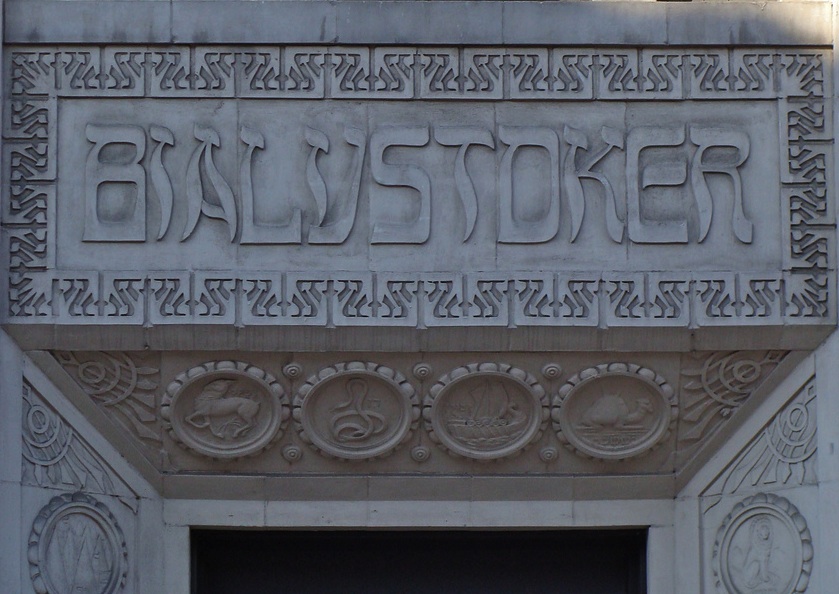
Hope for Bialystoker Home for the Aged and its residents

 Photo: Julia Manzerova

A new group has formed to save the Bialystoker Home for the Aged, which is slated for closing, eventual demolition, and the displacement of its aged residents, scattering them to distant and unfamiliar neighborhoods as a result of one of the shadiest deals in the LES. Hoping to save the building and prevent dispersal, Friends of Bialystoker Home has applied to the Landmarks Preservation Commission for designation. Landmark designation would end all plans to demolish and would obviate the Board's need to vacate the residents in the home.

The building itself is an art deco inspiration, integrating futuristic modernism with Jewish history. If you are at all susceptible to the romantic idealism of the art deco movement, its bold reinvention of all images and designs shedding classical traditions for the experimental, the medieval and the mythical, on the one hand, and on the other its aspirations for a utopian, amalgamated new-world-without-class, then you'll appreciate the Bialystoker.

The Friends are asking LESers to write to the Landmarks Preservation Commission, cc to Councilmember Chin (an opportunity for her to heal the wounds with the preservation community) urging the LPC chair to designate the structure as a city landmark.

Here's historian Joyce Mendelsohn, with details of where to send below:

Friends of the Bialystoker Home is a new group organizing a campaign for landmark designation of this important building constructed between 1929-31 to house the largest and most prominent of all the “landsmanschaftn” (mutual aid societies) on the Lower East Side.  The building survives as a major visual element on East Broadway symbolizing and recalling the Jewish history of the Lower East Side.  Designed in the Art Deco style with a golden brick façade, the ten-story structure features a unique arched entrance framed by twelve medallions representing the twelve tribes of Israel.  [The Bialystoker Center for Rehabilitation and Nursing (formerly the Bialystoker Home for the Aged) is located at 228 East Broadway at Clinton Street.]
We need your support in our drive for landmark designation of this irreplaceable structure.  Please contact the NYC Landmarks Preservation Commission to urge them to calendar the Bialystoker Center as a first step in the process of landmark designation.  Time is of the essence, since it has been reported that the building is currently up for sale and the Bialystoker Board intends to vacate the Center by the end of October.
Send your letter to:
Hon. Robert B. Tierney, Chair                                                                                                         
NYC Landmarks Preservation Commission                              

One Centre Street, 9th floor north                                                                                                     
New York, N.Y. 10007 OR e-mail: rtierney@lpc.nyc.gov                              

Please copy all written messages toFriendsOFTheLES@gmail.com  and Council Member Margaret Chin: mchin@council.nyc.gov

Photo: LuciaM

Monday, October 10, 2011

The relevance of the Bowery, the dishonesty of the NYTimes

The Times, reporting on efforts to preserve the Bowery, quotes Arun Bhati, the developer who demolished 35 Cooper Square, the 1825 townhouse, "Not all in this neighborhood are looking to preserve the past. Cities need to grow and make some changes to be relevant.”

Quite right, some just want to get rich on the destruction of history and character of New York. In quoting him, the NYTimes carefully hides the fact that he demolished a historical townhouse. Here's the full passage:

“Not all in this neighborhood are looking to preserve the past,” said Arun Bhati, a developer who owns a vacant lot at 35 Cooper Square, where an 1825 Federal house built by a descendant of Peter Stuyvesant was torn down this year, despite protests from preservationists. “Cities need to grow and make some changes to be relevant.”

Note the passive voice, "was torn down this year," not mentioning that Bhati himself tore it down turning it into that vacant lot he now owns.

To assess his quote, the reader needs to know that he demolished it himself for himself, not for the relevance of the city. Was he overwhelmed with petitions to "please demolish this 1825 townhouse so New York will be relevant"? Commercial developers demolish buildings with no regard for the relevance of the city, for its past or its future. The comment about relevance is a post factum excuse to pour perfume over his waste. He demolished the building for himself.

Meanwhile, the NYTimes turns him into a spokesperson for "the relevance of the city" by hiding his personal financial interest. Is this journalism, objective reporting, accuracy, information? It's journalistic fraud, and plain deceit. That's the New York Times I know. It's the Times acting as lickspittle for a developer. If you didn't already know this about the Times, now you do.

Am I the only person disgusted by it?
Compare the Bowery Alliance of Neighbors. They have no financial interest in the Bowery whatsoever. They want to preserve the Bowery because they know the history, appreciate it, and they love their New York. Even if you don't share their principles, you can't but recognize that their position is a principled position beyond any personal gain. It's not a self-serving motive, and they are not trying to hide their motives with lies and BS.

Which comes to my point. The neighborhood is now drawing people like Mr. Bhati, people who are there to prey upon the neighborhood for their personal, selfish gain, not for the benefit of anyone or anything else, relevant or irrelevant. They are there for themselves. They are not there to save the relevance of the city and certainly not for its history or its long-term commercial viability or its future. They are there for a fast buck today. What happens tomorrow? What do they care?

Same for the First American International Bank about to demolish 135 Bowery. In that case, the bank led Councilmember Chin by the nose who didn't even try to find a better deal for their air rights. This was a marriage of convenience -- for the bank, not for the neighborhood or for affordability. She could have gotten much more affordable spaces with the air rights shifted onto Chrystie Street if she exercised her vision, did her own work instead of doing the bank's work. Such a blatant case of the bank leading the elected official. This one belongs on a poster in Occupy Wall Street's Liberty Plaza. It's exemplary. That's relevant.

Saturday, October 01, 2011

no words

bob arihood is gone.
his incomparable blog

Friday, September 23, 2011

The personal is the political

When I first saw this short film, I wondered if I too would end a relationship over differences of opinion about overdevelopment. Probably. Anyway, this filmmaker has made overdevelopment and gentrification as personal as it will ever get.

I'm not sure why he cast a guy in the role of hero and his erstwhile girlfriend as villain, but I'm guessing it was just easier for him to identify with the situation than if the gender roles had been reversed. It is, after all, a personal short, first person, self-narrated. But that poor girl really gets read for trash.

I'll bet the ex would think it's a sentimental expansion on Chase Manhattan Master Card commercials. Well, those ad folks create beautiful stuff, as here, but here it's not whoring for money, just serving beauty and truth. Now it's got me sentimental.

If you watch, wait til you get to the images accompanying Whitman. It's beautiful New York, in black & white. If you like Ric Burns, enjoy. To object to beauty for its familiarity or sentiment is to allow cynicism too far a rein. Anyway, I'm a sucker for black & white.

Phil Vasquez' Song of Relations
10 minutes


Friday, September 16, 2011

135 Bowery: going, going, GONE! -- to the lowest bid

Yesterday the City Council Landmarks subcommittee voted to deny legal landmark status to an 1817 townhouse on the Bowery, deferring to the local councilmember, Margaret Chin, who says the owner, First American International Bank, will provide a little affordable business space if he's allowed to demolish it and redevelop the site into a new seven-story building.

But Chin didn't get a written agreement from the owner or a community benefits agreement, and she didn't research the surrounding sites, particularly the ones on Chrystie Street, where the landmark's air rights could have produced much more affordable space than in situ on the Bowery and without destroying a historical site.

The councilmember didn't do her homework to find and secure the best deal. Instead, she took the first offer of the owner, without obtaining any guarantee that the community will get anything. We're in a recession. In a moment of trouble, the bank might flip the site to someone else. How long will the affordable business space remain affordable? She can't tell us.

Merely having a good relationship with a supportive bank (for the creation of future affordable housing, e.g.) is not enough for process and accountability. Now she'll never know what opportunities were lost. But we know what we'll lose -- yet another piece of the historical Bowery. The Bowery is a hot property right now. The new building will further raise the real estate values of the entire strip. We can see where this is going. She needs to raise the bar on her land use staff. A lot more work could have been done.

Chin has a long and distinguished career as a local affordable housing activist. But as councilmember, so far she's succeeded with this bank's development and with the BID, which happens to be promoted prominently by the same bank. Both accomplishments benefit business and development. Many, perhaps most, business owners in Chinatown don't actually live there or even have their headquarters there, so any indirect benefits for residents remain to be seen -- and indirect harm or secondary displacement also remain to be seen. This affair will tarnish her within her own neighborhood. That's a shame. It was unnecessary: all she needed was the homework.

Tuesday, September 13, 2011

Fast and furious

St. Mark's Bookstore may close, and 135 Bowery, a historic landmark, may be demolished (more below).

Petition to save St. Mark's Bookstore. The owners negotiate their rent tomorrow, Wednesday.

Petition to save 135 Bowery. To testify or attend the hearing: Thur., Sept. 15 at 11am at 250 Broadway, 16th floor conference room. Agenda:
http://legistar.council.nyc.gov/MeetingDetail.aspx?ID=158922&GUID=FD347715-58F4-49AA-887F-B0E706AB8C15&Options=info|&Search=
Why is another landmark on the Bowery being threatened with demolition? 135 Bowery is a townhouse from around 1817, one of the oldest in New York. The Landmarks Preservation Commission has already designated it as a historical landmark. But the local councilmember, Margaret Chin, has reversed her support for the landmark on the grounds that the owner, a bank, wants to replace it with a taller structure promising a bit of affordable commercial space. Without the councilmember's support, the City Council will likely not vote the designation into protective law.

The bank that owns 135 Bowery hasn't submitted its affordable intention in writing. The bank hasn't shown any affordable rent rates; the bank hasn't produced any legally binding contract for this promised affordable commercial space or any indication how long the leases would remain affordable, or even any binding document whatsoever showing their intent. All we have is the word of the bank. (What do you think that's worth?)

I would be happy to see, for example, an SRO hotel on the Bowery for recent immigrants to live in cheap but safe quarters. But I would be a great fool if I sacrificed a historic site for an SRO promised to me by a bank without any documentation or plan or legally binding contract or even any detailed information.

So I wonder who is being fleeced by this bank? Is the Councilmember being fleeced? Or is it the public?

I will testify at the Council hearing on behalf of 135 Bowery, because I know that the owner-bank, far from intending to give back to the community, wants to get the most out of his investment regardless of the community, history, the Landmarks Preservation Commission, the City Council, the Councilmember, or anyone but themselves. They've made no commitment, let's be real. The only commitment has been verbal to the Councilmember, and we don't have a binding document of that discussion.

The Bowery Alliance of Neighbors say they want to fill the chamber with support. They also ask for more signatures on their petition.  The 135 Bowery petition again.

St. Mark's Bookstore
The great used bookstores of New York, with their overstuffed chairs, chatty patrons and patiently listening bookdealers, were places to hang and enjoy, not just for browse-and-buy. The ones in this neighborhood were truly worth saving, and they are all truly gone. Should St. Mark's Bookstore be saved?

I have made my peace with the twenty-somethings that are the present and future of this neighborhood. For better or worse, like it or not, they have transformed this place in their own image and it now belongs to them, from their dorms to our tenements to their BMW Lab. But the young are mostly transient, so they are mostly unequipped to restrain the powerful market force they themselves have brought here. Yes, they want nightlife, but they probably would also like to have a good bookstore, and the monster real estate market they've fed now won't allow it. It's about to swallow up the bookstore and leave, well, you know the story.

Cooper Union owns the site of the St. Mark's Bookstore, one of the few interesting bookstores in town. CU is raising its rent beyond the store's capacity to pay. CU, of course, can afford to give back to the community. Peter Cooper himself was all about giving back to the community. Peter must have long ago tired of spinning in his grave over what has become of his life's dream, free higher education for the working class. How many ways can Cooper Union spell "betrayal"? Surely they're not hurting for this little commercial space: they own the land on which the Chrysler building stands and the glass building on Astor Place. Seems to me they ought to buy up shares of the store and expand it as a university-community bookstore. But they'd probably betray that as well.

Frankly, I'm not convinced this neighborhood deserves to have a great bookstore. The NYU students have their own bookstore, filled with all the books they need and more than they can handle. As for the rest of the neighborhood, this place is a youth destination for children of means, not an intellectual or countercultural destination anymore. Its heart is commerce now, not anarchy. Freedom must be purchased, and it exacts many prices.

Maybe saving St. Mark's Bookstore is an exercise in anachronism or sentimental nostalgia. But if you'd like to try to preserve St. Mark's Bookstore for the benefit of the future transient youth of this neighborhood, here's a petition for you.

Tuesday, May 10, 2011

Memorial for Janet Freeman May 22

Janet Freeman was the salt of the earth, the New York salt, from way, way deep in the mine.

From CoDA:

We are saddened to tell you of the death of Janet Freeman, on April 29. Janet was a long time member of Coda, a passionate, tireless and effective community activist, especially on housing issues, and an unforgettable friend. Many of us probably think of her as a truly pure and uncorruptible Lower East Sider. A Memorial Service, arranged by Janet's sister Pixie, and her close friend Enid, will be held on Sunday, May 22, at the Chinatown Head Start School (which Janet was closely involved with), 180 Mott Street, at 2:00. All of you are invited.

Saturday, March 26, 2011

Once more with feeling

Rent deregulation, believe it or not, raises market rate rents. The conservative Manhattan Institute, in their study of deregulation in Boston, showed that, following deregulation, landlords invested in improvements to attract market-rate renters. Landlords always seek their highest rent that the renter is willing to pay. Where there is any competition, the result of deregulation is better quality housing but higher market rents.

Market rates only go down if demand goes down -- if people leave the city or excess housing is built. Rent regulation in NY doesn't hinder construction -- new units are typically unregulated anyway. And the city's population increases, not decreases. It's not even certain that in a tight market like NY, landlords would even invest widely in improvements.

Regulated rents actually help to depress market rates, although renters who pay exorbitant rents wish it weren't so. We'd all like to be able to blame the regulated renters because it seems so unfair. But the source of exorbitant rents is not regulation, but the profit motive of landlords and NYers' own desire to live here -- we are the market that sustains those rents.

The market value depends on three general factors: demand, supply, and the aggregate available funds for rents. If regulated renters are paying less than their available rent funds (the excess of which presumably goes into the goods and services economy), when they are forced to pay more, they will increase the aggregate funds available for rents, since most of those renters are tied to the metropolitan area by work or family. Once deregulated, they will raise rents wherever they go in the area and that trickles up to the luxury rents.

Paul Krugman some years ago blamed regulation on San Francisco's tight rental market. He was clearly unaware that inclusionary housing was mandated in San Francisco, hindering construction. Krugman admits in his article that his judgment was cursory and immediate and not a result of any investigation. Had he known that inclusionary housing was mandated there, he would no doubt have come to a very different conclusion.

Inclusionary housing is not mandatory in NYC. I hasten to add that mandatory inclusionary housing in a super-high market like NYC would probably not unduly hinder construction.

Sunday, March 20, 2011

Rent regulations good for New Yorkers?

Market-rate renters in New York complain that they pay exorbitant rents because their regulated neighbors underpay. In their justifiable anger, they imagine that if regulated neighbors paid more, market rates would ease down.

Unfortunately, markets depend not on cost, but on demand. When an entire neighborhood destabilizes and goes market rate, demand actually increases. Market rates increase. All rents go up.

Rent deregulation doesn't lower market rates with a housing flood, it just displaces a whole lot of long-time community residents, upscaling the neighborhood and spreading present and future transiency. Renters also lose their legal protections against landlords and landlord harassment, which also adds transiency. Deregulation is the landlord's wet dream. Landlords get all the cards, renters none.

It's been studied by no less a deregulation advocate than the conservative Manhattan Institute, summarized here. The study itself here.

More regulation means less investment, not higher market rents. Real estate disinvestment in NY? Not likely. Not a worry. Increased investment raising rents? That's a true worry for anyone who isn't in real estate.

Want to save communities and affordability for all New Yorkers? Tell the governor to include stronger rent regulations in the state budget. You can call his office at 212-681-4580

When a city deregulates, the aggregate money available for rent actually increases. Those who were underpaying now will pay more they were paying with few exceptions. If they squeeze into lower-income neighborhoods, they raise rents there. Meanwhile, those who now see an opportunity to live in tonier neighborhoods, pay up the exorbitant market rates, which keeps the market rate rents up. The aggregate demand increases all over the city, unless people stop liking the city and leave. When the aggregate money for rent increases, rents increase, as long as people stay in the city. Why do you think landlords so much want to deregulate the market? To ease your market rate rents? Wake up!

The future of Chinatown?

Detailed account of what's happening in Chinatown from Roland Li of Real Estate Weekly.

Lots of perspectives included, but Jones' comment about affordable housing advocates being against commercial incubators requires unpacking. On the one hand, her "commerce" is a misleading euphemism for development. Anti-gentrificationists in Chinatown do not oppose all commerce, they oppose the out-of-scale development that will transform and gentrify Chinatown, displacing the current community. On the other hand, affordable housing advocates are not at all opposed to development: they are the most enthusiastic proponents of development in Chinatown, aside from the developers themselves. Cross subsidies for market-rate development provide the only means of new affordable housing units. That's the debate in a nutshell. Wisest comment: CWG chair Mae Lee.