Wednesday, October 12, 2011

OWS Disturbs the EV Comfort Zone

A Voice reporter contacted me to ask me about the neighborhood comments on Penley's Occupy Tompkins Square Park at EVGrieve's blog, and what it means for the EV. I won't bother to rehearse the lamentable loss of historical memory over the illustrious history of TSP protests from the 1850's to the 1990's and their significance. What I find particularly telling is that the comments appeared on Grieve. Who reads and comments on Grieve now, and why? Here's my personal, angry take on them (disclaimer: none of this applies to the many thinking, socially aware newcomers to the EV) --

This new breed of Lower East Sider comes to enjoy a sense of urban authenticity in Manhattan. Of course, it's not authentic at all, but a kind of faux authenticity, pretend authenticity: the EV feels like it's hip, it imagines itself to be hip, it has lots of youth who style themselves as hip, but in reality, they are just children of wealth seeking $700 a month more hipness and urban pretend-authenticity than they would get in Queens. It's that measured thrill (the oxymoron is intended) they seek -- just enough for them to congratulate themselves for not living in a forgettable neighborhood like Kips Bay, but not too much to lose sleep over the noise of a late-night drum circle.

The mere suggestion of being arrested for a principle of justice arouses such unconscious fear that they respond with political condescension and smug personal disdain. Note how they fail to understand the OWS movement itself: they attribute to it whatever they disagree with, so that, conveniently, they can dismiss it, don't have to be bothered with it and don't have to confront its potential. It is, if you forgive another oxymoron, aggressive apathy. Call it proactive apathy, to use one of the redundant and useless epithets of their generation.

They read Grieve because reading some local foodie restaurant blog would show themselves in their mirror as exactly themselves, mere gentrifiers -- but Grieve is cool, Grieve is hip, Grieve is an insider, so they can feel insiders without ever getting inside anything in this place. That's who reads Grieve today. Bob Arihood died just in time. He'd have seen it as every good deed's punishment. Grieve has, no fault of his own, become the entertainment for the gawkers of authenticity. 

Grieve's readers consider themselves East Village old-timers if they've lived here for six years, long since gentrification settled in. They have no conception of the meaning of this once unique place, not a clue. It is beyond their capacity to imagine, let alone understand. They have lived all their lives with property values and social control. They have no sense of the freedom that follows property abandonment and its vacation of all ownership control, often described as anarchy. They are the children of entitlement. The great difference between the trustfund babies of the EV and the overeducated campers in Liberty Plaza is that the latter are unemployed and drowning in student-loan debt, while the former enjoy mixology at Death & Co.

The campers have been successful at keeping momentum and visibility by holding new events each day or so. The occupation of TSP sounds like a useful part of that program. I don't see it as unduly disruptive. If OWS has the potential to shift the balance of politics in this country, issues of local noise, garbage and crowding hardly seem worth mentioning in the broad narrative arc of history. Maybe we have become too accustomed to complaining about bars. But, seriously, barflies are not making history; they're just making noise. I mean, here is an opportunity to change the voice and profile of our polity, and the news media and the local residents are worried about noise? What happened to these poor rich people's values? What kind of sorry excuse are they for humanity? Are they so comfortable and jaded that they can't care about anything but their own comfort? Is this neighborhood truly no more to them than the latest ice cream parlor tasting? Is this what the LES has come to?

OWS has stepped into the muddy stream of American democracy, pronounced it a river of shit, which it is, and have called for a dam: enough. They have pointed to the naked emperor -- the wide disparity in both our politics and economy. They have as yet no program, no solution except the goal of obtaining a more equitable distribution of democratic power. They are not exculpating Obama by targeting Wall Street. They are not supporting any party. Unlike the Tea Party which began as an knee-jerk revolt against the color of the president, finding its libertarian justification after the fact to legitimize its acid racism, OWS started with principles. You can tell the difference by their resistance to any political party, while the Tea Party jumped quickly into Republican habit. Theirs was never anything but partisanship. OWS is, as many have suggested, something new. It's not a demonstration; it's not a third party. It's a social movement focused on the failure of American democracy itself.
I have no expectations, nor any predictions for its success, but I am not so ironic as to view every honest effort as naive, silly, childish or risible. Irony is the privilege of the abstract, the distant, the uninvolved. It suits the comfortable, the secure, those who can afford to be indifferent. If we all regarded our political process with irony only, there'd be no place for democracy at all. The OWS process is all about participatory democracy. It is so pure and purged of irony that its principled participation cannot close on its demands. That's one reason why it hasn't gotten involved with any party or against any party, why it hasn't projected any specific solutions. It is a movement discontented with our democracy. 
The only campaign poster I've seen at Liberty Plaza is for Ron Paul. Now, several of Grieve's commenters seemed to think that OWS should attack gov't rather than Wall Street. Well, that's Paul's message, and it's there at OWS, along with many other messages. You won't see any Obama posters there, that's for sure. So I think the commenters, as most ugly commenters are, uninformed, biased loudmouths. The content of their comments are of little merit but of revelatory sociological curiosity. Look at who they are, or what they are. I take them very seriously, but not what they think, if they think. It looks to me more like avoidance, complacency and self-congratulations than thought. And it's all so close to the sentiment summed up in Let them eat cake.

Le yuppie


Trustfund-baby hispter wannabe

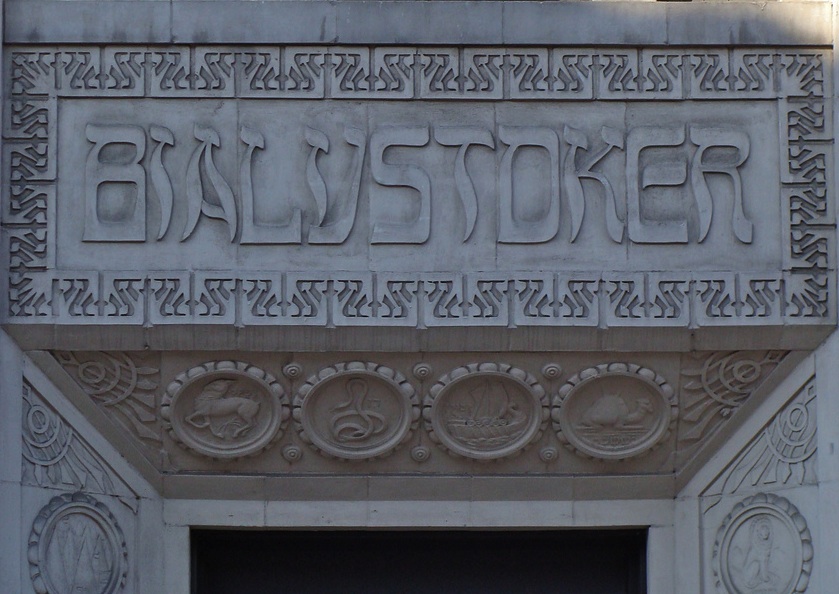
Hope for Bialystoker Home for the Aged and its residents

 Photo: Julia Manzerova

A new group has formed to save the Bialystoker Home for the Aged, which is slated for closing, eventual demolition, and the displacement of its aged residents, scattering them to distant and unfamiliar neighborhoods as a result of one of the shadiest deals in the LES. Hoping to save the building and prevent dispersal, Friends of Bialystoker Home has applied to the Landmarks Preservation Commission for designation. Landmark designation would end all plans to demolish and would obviate the Board's need to vacate the residents in the home.

The building itself is an art deco inspiration, integrating futuristic modernism with Jewish history. If you are at all susceptible to the romantic idealism of the art deco movement, its bold reinvention of all images and designs shedding classical traditions for the experimental, the medieval and the mythical, on the one hand, and on the other its aspirations for a utopian, amalgamated new-world-without-class, then you'll appreciate the Bialystoker.

The Friends are asking LESers to write to the Landmarks Preservation Commission, cc to Councilmember Chin (an opportunity for her to heal the wounds with the preservation community) urging the LPC chair to designate the structure as a city landmark.

Here's historian Joyce Mendelsohn, with details of where to send below:

Friends of the Bialystoker Home is a new group organizing a campaign for landmark designation of this important building constructed between 1929-31 to house the largest and most prominent of all the “landsmanschaftn” (mutual aid societies) on the Lower East Side.  The building survives as a major visual element on East Broadway symbolizing and recalling the Jewish history of the Lower East Side.  Designed in the Art Deco style with a golden brick façade, the ten-story structure features a unique arched entrance framed by twelve medallions representing the twelve tribes of Israel.  [The Bialystoker Center for Rehabilitation and Nursing (formerly the Bialystoker Home for the Aged) is located at 228 East Broadway at Clinton Street.]
We need your support in our drive for landmark designation of this irreplaceable structure.  Please contact the NYC Landmarks Preservation Commission to urge them to calendar the Bialystoker Center as a first step in the process of landmark designation.  Time is of the essence, since it has been reported that the building is currently up for sale and the Bialystoker Board intends to vacate the Center by the end of October.
Send your letter to:
Hon. Robert B. Tierney, Chair                                                                                                         
NYC Landmarks Preservation Commission                              

One Centre Street, 9th floor north                                                                                                     
New York, N.Y. 10007 OR e-mail: rtierney@lpc.nyc.gov                              

Please copy all written messages toFriendsOFTheLES@gmail.com  and Council Member Margaret Chin: mchin@council.nyc.gov

Photo: LuciaM

Monday, October 10, 2011

The relevance of the Bowery, the dishonesty of the NYTimes

The Times, reporting on efforts to preserve the Bowery, quotes Arun Bhati, the developer who demolished 35 Cooper Square, the 1825 townhouse, "Not all in this neighborhood are looking to preserve the past. Cities need to grow and make some changes to be relevant.”

Quite right, some just want to get rich on the destruction of history and character of New York. In quoting him, the NYTimes carefully hides the fact that he demolished a historical townhouse. Here's the full passage:

“Not all in this neighborhood are looking to preserve the past,” said Arun Bhati, a developer who owns a vacant lot at 35 Cooper Square, where an 1825 Federal house built by a descendant of Peter Stuyvesant was torn down this year, despite protests from preservationists. “Cities need to grow and make some changes to be relevant.”

Note the passive voice, "was torn down this year," not mentioning that Bhati himself tore it down turning it into that vacant lot he now owns.

To assess his quote, the reader needs to know that he demolished it himself for himself, not for the relevance of the city. Was he overwhelmed with petitions to "please demolish this 1825 townhouse so New York will be relevant"? Commercial developers demolish buildings with no regard for the relevance of the city, for its past or its future. The comment about relevance is a post factum excuse to pour perfume over his waste. He demolished the building for himself.

Meanwhile, the NYTimes turns him into a spokesperson for "the relevance of the city" by hiding his personal financial interest. Is this journalism, objective reporting, accuracy, information? It's journalistic fraud, and plain deceit. That's the New York Times I know. It's the Times acting as lickspittle for a developer. If you didn't already know this about the Times, now you do.

Am I the only person disgusted by it?
Compare the Bowery Alliance of Neighbors. They have no financial interest in the Bowery whatsoever. They want to preserve the Bowery because they know the history, appreciate it, and they love their New York. Even if you don't share their principles, you can't but recognize that their position is a principled position beyond any personal gain. It's not a self-serving motive, and they are not trying to hide their motives with lies and BS.

Which comes to my point. The neighborhood is now drawing people like Mr. Bhati, people who are there to prey upon the neighborhood for their personal, selfish gain, not for the benefit of anyone or anything else, relevant or irrelevant. They are there for themselves. They are not there to save the relevance of the city and certainly not for its history or its long-term commercial viability or its future. They are there for a fast buck today. What happens tomorrow? What do they care?

Same for the First American International Bank about to demolish 135 Bowery. In that case, the bank led Councilmember Chin by the nose who didn't even try to find a better deal for their air rights. This was a marriage of convenience -- for the bank, not for the neighborhood or for affordability. She could have gotten much more affordable spaces with the air rights shifted onto Chrystie Street if she exercised her vision, did her own work instead of doing the bank's work. Such a blatant case of the bank leading the elected official. This one belongs on a poster in Occupy Wall Street's Liberty Plaza. It's exemplary. That's relevant.

Saturday, October 01, 2011

no words

bob arihood is gone.
his incomparable blog

Friday, September 23, 2011

The personal is the political

When I first saw this short film, I wondered if I too would end a relationship over differences of opinion about overdevelopment. Probably. Anyway, this filmmaker has made overdevelopment and gentrification as personal as it will ever get.

I'm not sure why he cast a guy in the role of hero and his erstwhile girlfriend as villain, but I'm guessing it was just easier for him to identify with the situation than if the gender roles had been reversed. It is, after all, a personal short, first person, self-narrated. But that poor girl really gets read for trash.

I'll bet the ex would think it's a sentimental expansion on Chase Manhattan Master Card commercials. Well, those ad folks create beautiful stuff, as here, but here it's not whoring for money, just serving beauty and truth. Now it's got me sentimental.

If you watch, wait til you get to the images accompanying Whitman. It's beautiful New York, in black & white. If you like Ric Burns, enjoy. To object to beauty for its familiarity or sentiment is to allow cynicism too far a rein. Anyway, I'm a sucker for black & white.

Phil Vasquez' Song of Relations
10 minutes


Friday, September 16, 2011

135 Bowery: going, going, GONE! -- to the lowest bid

Yesterday the City Council Landmarks subcommittee voted to deny legal landmark status to an 1817 townhouse on the Bowery, deferring to the local councilmember, Margaret Chin, who says the owner, First American International Bank, will provide a little affordable business space if he's allowed to demolish it and redevelop the site into a new seven-story building.

But Chin didn't get a written agreement from the owner or a community benefits agreement, and she didn't research the surrounding sites, particularly the ones on Chrystie Street, where the landmark's air rights could have produced much more affordable space than in situ on the Bowery and without destroying a historical site.

The councilmember didn't do her homework to find and secure the best deal. Instead, she took the first offer of the owner, without obtaining any guarantee that the community will get anything. We're in a recession. In a moment of trouble, the bank might flip the site to someone else. How long will the affordable business space remain affordable? She can't tell us.

Merely having a good relationship with a supportive bank (for the creation of future affordable housing, e.g.) is not enough for process and accountability. Now she'll never know what opportunities were lost. But we know what we'll lose -- yet another piece of the historical Bowery. The Bowery is a hot property right now. The new building will further raise the real estate values of the entire strip. We can see where this is going. She needs to raise the bar on her land use staff. A lot more work could have been done.

Chin has a long and distinguished career as a local affordable housing activist. But as councilmember, so far she's succeeded with this bank's development and with the BID, which happens to be promoted prominently by the same bank. Both accomplishments benefit business and development. Many, perhaps most, business owners in Chinatown don't actually live there or even have their headquarters there, so any indirect benefits for residents remain to be seen -- and indirect harm or secondary displacement also remain to be seen. This affair will tarnish her within her own neighborhood. That's a shame. It was unnecessary: all she needed was the homework.

Tuesday, September 13, 2011

Fast and furious

St. Mark's Bookstore may close, and 135 Bowery, a historic landmark, may be demolished (more below).

Petition to save St. Mark's Bookstore. The owners negotiate their rent tomorrow, Wednesday.

Petition to save 135 Bowery. To testify or attend the hearing: Thur., Sept. 15 at 11am at 250 Broadway, 16th floor conference room. Agenda:
http://legistar.council.nyc.gov/MeetingDetail.aspx?ID=158922&GUID=FD347715-58F4-49AA-887F-B0E706AB8C15&Options=info|&Search=
Why is another landmark on the Bowery being threatened with demolition? 135 Bowery is a townhouse from around 1817, one of the oldest in New York. The Landmarks Preservation Commission has already designated it as a historical landmark. But the local councilmember, Margaret Chin, has reversed her support for the landmark on the grounds that the owner, a bank, wants to replace it with a taller structure promising a bit of affordable commercial space. Without the councilmember's support, the City Council will likely not vote the designation into protective law.

The bank that owns 135 Bowery hasn't submitted its affordable intention in writing. The bank hasn't shown any affordable rent rates; the bank hasn't produced any legally binding contract for this promised affordable commercial space or any indication how long the leases would remain affordable, or even any binding document whatsoever showing their intent. All we have is the word of the bank. (What do you think that's worth?)

I would be happy to see, for example, an SRO hotel on the Bowery for recent immigrants to live in cheap but safe quarters. But I would be a great fool if I sacrificed a historic site for an SRO promised to me by a bank without any documentation or plan or legally binding contract or even any detailed information.

So I wonder who is being fleeced by this bank? Is the Councilmember being fleeced? Or is it the public?

I will testify at the Council hearing on behalf of 135 Bowery, because I know that the owner-bank, far from intending to give back to the community, wants to get the most out of his investment regardless of the community, history, the Landmarks Preservation Commission, the City Council, the Councilmember, or anyone but themselves. They've made no commitment, let's be real. The only commitment has been verbal to the Councilmember, and we don't have a binding document of that discussion.

The Bowery Alliance of Neighbors say they want to fill the chamber with support. They also ask for more signatures on their petition.  The 135 Bowery petition again.

St. Mark's Bookstore
The great used bookstores of New York, with their overstuffed chairs, chatty patrons and patiently listening bookdealers, were places to hang and enjoy, not just for browse-and-buy. The ones in this neighborhood were truly worth saving, and they are all truly gone. Should St. Mark's Bookstore be saved?

I have made my peace with the twenty-somethings that are the present and future of this neighborhood. For better or worse, like it or not, they have transformed this place in their own image and it now belongs to them, from their dorms to our tenements to their BMW Lab. But the young are mostly transient, so they are mostly unequipped to restrain the powerful market force they themselves have brought here. Yes, they want nightlife, but they probably would also like to have a good bookstore, and the monster real estate market they've fed now won't allow it. It's about to swallow up the bookstore and leave, well, you know the story.

Cooper Union owns the site of the St. Mark's Bookstore, one of the few interesting bookstores in town. CU is raising its rent beyond the store's capacity to pay. CU, of course, can afford to give back to the community. Peter Cooper himself was all about giving back to the community. Peter must have long ago tired of spinning in his grave over what has become of his life's dream, free higher education for the working class. How many ways can Cooper Union spell "betrayal"? Surely they're not hurting for this little commercial space: they own the land on which the Chrysler building stands and the glass building on Astor Place. Seems to me they ought to buy up shares of the store and expand it as a university-community bookstore. But they'd probably betray that as well.

Frankly, I'm not convinced this neighborhood deserves to have a great bookstore. The NYU students have their own bookstore, filled with all the books they need and more than they can handle. As for the rest of the neighborhood, this place is a youth destination for children of means, not an intellectual or countercultural destination anymore. Its heart is commerce now, not anarchy. Freedom must be purchased, and it exacts many prices.

Maybe saving St. Mark's Bookstore is an exercise in anachronism or sentimental nostalgia. But if you'd like to try to preserve St. Mark's Bookstore for the benefit of the future transient youth of this neighborhood, here's a petition for you.

Tuesday, May 10, 2011

Memorial for Janet Freeman May 22

Janet Freeman was the salt of the earth, the New York salt, from way, way deep in the mine.

From CoDA:

We are saddened to tell you of the death of Janet Freeman, on April 29. Janet was a long time member of Coda, a passionate, tireless and effective community activist, especially on housing issues, and an unforgettable friend. Many of us probably think of her as a truly pure and uncorruptible Lower East Sider. A Memorial Service, arranged by Janet's sister Pixie, and her close friend Enid, will be held on Sunday, May 22, at the Chinatown Head Start School (which Janet was closely involved with), 180 Mott Street, at 2:00. All of you are invited.

Saturday, March 26, 2011

Once more with feeling

Rent deregulation, believe it or not, raises market rate rents. The conservative Manhattan Institute, in their study of deregulation in Boston, showed that, following deregulation, landlords invested in improvements to attract market-rate renters. Landlords always seek their highest rent that the renter is willing to pay. Where there is any competition, the result of deregulation is better quality housing but higher market rents.

Market rates only go down if demand goes down -- if people leave the city or excess housing is built. Rent regulation in NY doesn't hinder construction -- new units are typically unregulated anyway. And the city's population increases, not decreases. It's not even certain that in a tight market like NY, landlords would even invest widely in improvements.

Regulated rents actually help to depress market rates, although renters who pay exorbitant rents wish it weren't so. We'd all like to be able to blame the regulated renters because it seems so unfair. But the source of exorbitant rents is not regulation, but the profit motive of landlords and NYers' own desire to live here -- we are the market that sustains those rents.

The market value depends on three general factors: demand, supply, and the aggregate available funds for rents. If regulated renters are paying less than their available rent funds (the excess of which presumably goes into the goods and services economy), when they are forced to pay more, they will increase the aggregate funds available for rents, since most of those renters are tied to the metropolitan area by work or family. Once deregulated, they will raise rents wherever they go in the area and that trickles up to the luxury rents.

Paul Krugman some years ago blamed regulation on San Francisco's tight rental market. He was clearly unaware that inclusionary housing was mandated in San Francisco, hindering construction. Krugman admits in his article that his judgment was cursory and immediate and not a result of any investigation. Had he known that inclusionary housing was mandated there, he would no doubt have come to a very different conclusion.

Inclusionary housing is not mandatory in NYC. I hasten to add that mandatory inclusionary housing in a super-high market like NYC would probably not unduly hinder construction.

Sunday, March 20, 2011

Rent regulations good for New Yorkers?

Market-rate renters in New York complain that they pay exorbitant rents because their regulated neighbors underpay. In their justifiable anger, they imagine that if regulated neighbors paid more, market rates would ease down.

Unfortunately, markets depend not on cost, but on demand. When an entire neighborhood destabilizes and goes market rate, demand actually increases. Market rates increase. All rents go up.

Rent deregulation doesn't lower market rates with a housing flood, it just displaces a whole lot of long-time community residents, upscaling the neighborhood and spreading present and future transiency. Renters also lose their legal protections against landlords and landlord harassment, which also adds transiency. Deregulation is the landlord's wet dream. Landlords get all the cards, renters none.

It's been studied by no less a deregulation advocate than the conservative Manhattan Institute, summarized here. The study itself here.

More regulation means less investment, not higher market rents. Real estate disinvestment in NY? Not likely. Not a worry. Increased investment raising rents? That's a true worry for anyone who isn't in real estate.

Want to save communities and affordability for all New Yorkers? Tell the governor to include stronger rent regulations in the state budget. You can call his office at 212-681-4580

When a city deregulates, the aggregate money available for rent actually increases. Those who were underpaying now will pay more they were paying with few exceptions. If they squeeze into lower-income neighborhoods, they raise rents there. Meanwhile, those who now see an opportunity to live in tonier neighborhoods, pay up the exorbitant market rates, which keeps the market rate rents up. The aggregate demand increases all over the city, unless people stop liking the city and leave. When the aggregate money for rent increases, rents increase, as long as people stay in the city. Why do you think landlords so much want to deregulate the market? To ease your market rate rents? Wake up!

The future of Chinatown?

Detailed account of what's happening in Chinatown from Roland Li of Real Estate Weekly.

Lots of perspectives included, but Jones' comment about affordable housing advocates being against commercial incubators requires unpacking. On the one hand, her "commerce" is a misleading euphemism for development. Anti-gentrificationists in Chinatown do not oppose all commerce, they oppose the out-of-scale development that will transform and gentrify Chinatown, displacing the current community. On the other hand, affordable housing advocates are not at all opposed to development: they are the most enthusiastic proponents of development in Chinatown, aside from the developers themselves. Cross subsidies for market-rate development provide the only means of new affordable housing units. That's the debate in a nutshell. Wisest comment: CWG chair Mae Lee.

Wednesday, February 23, 2011

Momentous vote last night

A momentous vote last night at Community Board 3: they voted, in effect, to curb the trend of commercial real estate speculation that has been decimating local-serving businesses and speeding up yuppie gentrification, which, unlike family-gentrification, creates neighborhoods of upscale transients displacing community without replacing any community at all. CB3 voted to phase out automatic liquor license transfer approval. It may be the most significant policy vote they've ever made.

Under the old dispensation, when a bar owner decides to sell the business, a new owner of that business can 'buy' the liquor license. The CB, treating the bought license as if there were no change in management, effectively guarantees the financial value of the license. That sends a message to prospective bar owners everywhere that a license is guaranteed -- insured -- in this community district. You don't have to face the community, you don't have to face the Board members. If the street on that business has over time filled with new bars, you don't have to worry about increased community objections. You are guaranteed, as long as you don't violate the law by selling to minors or sell cocaine there (sorry, I mean get caught selling cocaine) or, say, murder the residents above you.

Of course, bar owners on the CB lobbied for automatic transfer so that they could sell their licenses at the highest value to new owners. It was a kind of municipal corruption: the CB would insure the value of the license against change in the community, in particular, against the proliferation of local bars. The State Liquor Authority recognizes that bar density (defined as more that three within a 500 foot radius) is a reason to deny a new license, if the bar can't demonstrate some public benefit. So guaranteeing transfer approval was a way for the bar owners to get CB approval despite greater density.

You can see the effects in our neighborhood. The 500-foot rule is flouted all over the EV/LES. And because bars can pay higher rents than most businesses, this bar program has choked out local-serving small businesses in favor of non-local-serving trendy bars. The bars in turn bring a transient young, single, professional clientele to the local residential stock. They gentrify the neighborhood, raising local rents; gentrification in turn encourages landlords to harass older, stable, more long-term lower-rent tenants, and the new upscale transients don't create any new community of their own.

The CB vote last night will eventually pull back that trend. If prospective bar owners know that they must face the community to get license approval, they will be less likely to buy that business, especially here in areas of bar density, where there will be the most community objection. If bars are reluctant, landlords can't count on high-rent bars for their commercial spaces, and will have to settle for lower-rent businesses. That will lower commercial rents and bring commercial diversity.

The next battle is to prevent chain stores and banks from filling in the place of the bars. That's a difficult struggle, though not impossible: special zoning can limit types of commerce, though with chain stores it can be tricky.

One note: the vote last night was a compromise. The policy doesn't apply to current bar owners. Their licenses will be guaranteed for their sale (as long as they don't violate the law). It's only the new buyers who will not have that guarantee. In other words, the bar owners on the Community Board will be protected, insured and underwritten. Such is the virtue of being a community board member. Makes me almost want to become a CB member so they can guarantee my personal rent against any local raises.

Monday, February 21, 2011

More on the Bowery

Candlelight vigil for 35 Cooper Square
Tuesday, Feb. 22 from 5:30 to 6:30pm
(btwn 5th & 6th Streets where the Bowery meets 3rd Avenue)

Bowery History exhibit at the Whole Foods at Houston Street & the Bowery
on the 2nd floor free public space, Chrystie side
CLOSING THIS WEDNESDAY

On The Bowery
Lionel Rogosin's 1957 groundbreaking documentary/drama
"Rogosin is probably the greatest documentary filmmaker of all time." - John Cassavetes
Back again for a third engagement at IFC
Fri, Sat, Sun 11am

and...

The Bowery: a history of Grit, Graft and Grandeur
Eric Ferrara's latest book with new and surprising research and many archival illustrations
at Amazon

Monday, January 24, 2011

Save 35 Cooper petition

From the Bowery Alliance of Neighbors

The information below explains why
several community and preservation groups
are having a press conference & rally to
support landmarking 35 Cooper Square .
Also, please sign the petition:
"Designate 35 Cooper Square a NYC landmark"
http://www.ipetitions.com/petition/landmark35coopersquare/


Designate 35 Cooper Square a NYC Landmark!

Event: Press Conference & Rally
Date: Jan 28 (Friday) at 4:30
Place: 35 Cooper Square (btwn 6th & 5th St .)
Participants: Historic Districts Council,
Greenwich Village Society for Historic
Preservation, Lower East Side Preservation
Initiative, Bowery Alliance of Neighbors,
Two Bridges Neighborhood Council,
East Village Community Coalition,
East Fifth Street Block Association,
6th and 7th Street Block Association...

Tell the Landmarks Preservation Commission to:

Landmark 35 Cooper Square !

The oldest building on Cooper Square , and one of the oldest
buildings of the original Bowery, this charming Federal style
building with the traditional gambrel roof, twin-pedimented
dormers, and large end chimneys also boasts historical and
cultural associations ranging from a direct descendant of
Peter Stuyvesant to much later habitation by Diane DiPrima,
the most influential woman of the Beat Generation.

“…when I first laid eyes on 35 Cooper Square , I knew it was
the fulfillment of all those fantasies of art and the artist’s life,
la vie de boheme. . .it was my dream house.”
--Diane DiPrima, Memoirs of a Beatnik

This much-beloved little building has been both a significant
participant and a surviving witness to New York City history
for nearly 200 years! Under the stipulations of the
Landmarks Law, it qualifies on architectural, historical and
cultural criteria for designation as a NYC individual landmark.
For both historical and cultural reasons, losing this house would be a
significant loss for the East Village/Lower East Side.


Why the need for a rally and press conference?
Responding late last year to rumors that 35 Cooper might
soon be demolished, four community preservation groups
(Historic Districts Council, Greenwich Village Society
for Historic Preservation, Lower East Side Preservation
Initiative) jointly wrote to the Landmarks Preservation
Commission Chair Tierney urging a NYC landmarks
designation. Accompanying our appeal was a strong
support letter from City Council Member Rosie Mendez,
who also met on site with Mr. Tierney.
Despite our efforts, we were denied even a public
hearing on the issue. The stated rationale was that
the building’s facade has undergone too much
alteration, but as historian Joyce Mendelsohn points
out in her reasonable, well-researched response,
many Federal style buildings have been
landmarked despite significant alterations.
She points out that when the much altered 511 and 513
Grand Street were designated, Mr. Tierney stated that
“These Federal-style treasures recall an important period
of New York city ’s development,” an argument that
Mendelsohn rightly suggests may appropriately be
applied to 35 Cooper Square .

Needless to say, under the circumstances a press conference and
and rally are the logical, democratic response in defense of
such an important historical resource.


Please sign the online PETITION:
http://www.ipetitions.com/petition/landmark35coopersquare/
Designate 35 Cooper Square a NYC Landmark!


Photographs of 35 Cooper Square and information about
our other efforts to preserve, protect, and celebrate the
Bowery and Cooper Square are available at:
www.boweryalliance.org

Sincerely,
David Mulkins, Chair/Co-founder
Bowery Alliance of Neighbors
184 Bowery, #4
New York, NY 10012
631-901-5435 mulbd@yahoo.com

Sunday, January 23, 2011

Rally & press conference to save one of the most historic buildings on the Bowery

From the Bowery Alliance of Neighbors:

35 Cooper Square Press Conference and Rally

Friday, 1/28

4:30 p.m.
35 Cooper Square

There will be a rally and press conference in front of 35 Cooper Square to save this wonderful Federal-style house from demolition and to push for landmark designation. It is one of the oldest houses left on the Bowery. In addition to its architectural significance, its important historical and cultural associations range from a direct descendant of Peter Stuyvesant to the building's much later habitation by Diane DiPrima, the most influential woman of the Beat Generation. This much-beloved little building has been both a significant participant and a surviving witness to New York City history for 200 years! Under the stipulations of the Landmarks Law, it qualifies on architectural, historical and cultural criteria for designation as a NYC individual landmark. Losing this house would be a significant loss to the history of the East Village for both cultural and historical reasons.

Read more about the rich history of 35 Cooper Square here at Jeremiah's Vanishing New York. Plans for demolition here (link via EVGrieve).


-1.jpg

Monday, January 10, 2011

Express support for affordable housing in Manhattan

Tuesday Jan. 11 is the deadline for community comment submissions (send to spura@cb3manhattan.org) on SPURA -- the largest vacant land area south of 96th Street -- a rare opportunity for the creation of affordable housing, and a part of Bloomberg's plan to create or preserve 165,000 affordable units, including 60,000 new units to be created. How many of these 60,000 new units SPURA will contribute depends in part on what our community says.

CB3 is currently working towards a plan of 800 affordable units, and a total residential ratio of 50% market-rate to 50% non-market-rate. The non-market-rate housing will comprise

20% low-income housing,
20% moderate (<$100,000 income) & middle income (<$130,000 income) housing, and
10% senior housing.

In other words, the CB plan, if built, would result in at least 1,600 residential units, about the size of one EV block of six story tenements.

Whether the city will respect the community agreement is an open question. Look at what happened to Atlantic Yards. SPURA stands in Sheldon Silver's district, and he has not yet commented.

The city, however, seems strongly committed: the city needs the revenue from the sale of the land, the residential and commercial taxes and residential disposable income that development will bring, as well as add to the legacy of the mayor, who has made affordable housing a goal. But before the city can move forward, it needs an agreement from the CB, as a first step. So now is the moment to express support for affordable housing in Manhattan.

View the current CB3 plan so far at CB3's website.
Send your comments to spura@cb3manhattan.org

Wednesday, December 08, 2010

Chinatown's BID Roars

Into the complex relationships of Chinatown's political economy has entered a new and powerful player: the Chinatown BID.

Last night Community Board 3's Economic Development Committee, following a long public hearing on both sides, approved a proposed Chinatown Business Improvement District (BID), supported by Councilmember Chin. A Chinatown BID will significantly enhance Chinatown's commercial clout, and it will also enhance Chinatown's powerbrokers, both within Chinatown and in Community District 3 as well as in the broad city political landscape.

Because a BID is paid for in part by a tax on property owners, several property owners questioned last night why they should have to pay for services that the city itself should supply. Their objection is not so much a financial complaint, but an issue of inclusion. These property owners do not see themselves or their interests reflected in the promoters of the BID. The BID did not originate with them, they feel the BID progressed without them, and they anticipate that the BID will commercially develop and direct Chinatown without their voice.

The BID maintains that it will be open to all voices. However, its primary promoter, Chinatown Partnership, is a creature of Asian Americans for Equality, the most politically powerful organization in Chinatown. Both are close to the councilmember -- a founder and former board president of AAFE and Chinatown Partnership. In other words, the vote last night was a consolidation of political strength in Chinatown.

A couple of observers outside the BID area raised concerns about the effects of the BID on small businesses, which will bear a burden of cost, and the focus of the BID, which seems more concerned with tourism and upscaling commerce than labor and local residential community. Will the BID promote gentrification in Chinatown as the LES BID did, overseeing the gentrification of the LES and transformation of it into a nightlife strip and construction and hotel zone for overdevelopment?

The consequences of the Chinatown BID remain to be seen. I don't see how it will solve the deeper troubles within Chinatown -- the evaporation of the garment industry that sustained Chinatown throughout its expansion, and the threat of overdevelopment and the burden of real estate taxes on the old tenements. The BID's easiest goal will be tourism, which will help some local businesses, may drive out others, and could radically transform the local character. It will be a shame if in ten years Chinatown blogs have names like "ChinatownGrieve" and "Vanishing Chinatown" routinely complaining about the invasion of outsiders. Those are my worst-case scenario worries.

Howbeit, the vote last night is a great and unequivocal victory for the councilmember. She will say, of course, it is a victory for Chinatown, and in fact, she will now have an opportunity to make good on that claim. Political strength is a relation between leader and power base, whether commercial or residential. For my part, I don't believe there is one Chinatown. There are many. This was a victory for one aspect of Chinatown. It is Margaret Chin's task to play this card into a victory for all of Chinatown. If that play will begin, it will begin with healing.

Most of the meeting was remarkably respectful and orderly. The meeting was chaired by CB3's model committee chair, Richard Ropiak. Amidst the most controversial meetings, Ropiak always manages a smooth meeting. He assiduously avoids interjecting himself into the discussion (even when you can see he would like to), yet he keeps order firmly when necessary. As a result, everyone gets heard, everyone feels the hearing process is fair.

The BID has a few remaining hurdles to clear before it is made law, but the vote last night all but assures its success.

Monday, November 29, 2010

NYU NIMBY musical chairs

While the West Village is hosting a town hall meeting on the future of NYU expansion at Our Lady of Pompeii, basement, Carmine & Bleecker, 6:30, East Villagers ought to be alarmed by NYU's decision not to build on its own campus. All voices at the town hall will ask NYU to build in the financial district, but NYU may be looking for closer locations more attractive to their students. That's would be our neighborhood.

Although the EV and the 3rd & 4th Avenue triangle have been recently rezoned to cap heights, there are still plenty of available development sites here. 3rd Avenue still allows the same bulk as prior to the rezoning, and it allows more bulk than the NYU dorm that already stands on 3rd Ave at 10th Street. (It's only 5.31 FAR. Under the new zoning, 3rd Ave allows 6.5 FAR for dormitories!) And they can build as high as 12 stories on 3rd Ave -- the current dorms there are only two stories taller than that.

And then there's El Bohio, the old P.S. 64. It's already standing, requiring minimal construction, and it is a huge lot. A dormitory there would end all hopes for a community center. So there's plenty to worry about.

When NYU unveiled its plans to build on its own campus, it seemed to me a great relief. The I.M.Pei site is already high-rise, full of wasted, unused, inhospitable concrete plaza space that feels like and looks like a wind tunnel. But NYU's ambition overreached with a plan of excessive height, including a hotel, that riled the locals.

The underlying problem for NYU is its limited endowment. Unlike universities with huge endowments, NYU depends on tuition. So it thrives more like a corporation than a university. It needs more students -- it needs expansion in a way that some other universities don't. So the problem of NYU expansion is not likely to go away. The question is, where will it go?

Wednesday, November 24, 2010

Chinatown Partnership bypasses the Chinatown planning process

Chinatown Partnership presented its Chinatown Business Improvement District (BID) proposal to CB3 Tuesday night without going first to the Chinatown Working Group (CWG), the community-wide planning process for Chinatown's future.

Setting aside whether the BID is a good or bad idea -- like most planning ideas, it is a mix of both, and judgment depends on perspective and interests -- going to the CB without going to the community seems a premature and unwise choice for three reasons:
1. it by-passes and ignores the ongoing community process in Chinatown
2. it undermines the viability and effectiveness of that community process
3. it risks dividing the community by promoting the BID without full discussion within the community.

Chinatown Partnership has been promoting a Chinatown BID to clean Chinatown streets and promote tourism and economic development. But the small businesses, who will pay for the BID, are not all in favor. Some small businesses don't see why they should have to pay for services that the city ought to supply. They also worry that a BID will create a quasi-governmental bureaucracy that will formulate policy that will not serve small businesses, but may serve big capital or power-brokers in Chinatown. Increased taxes from the BID will be passed onto small landlords who would be compelled to pass these increases to small businesses whose profit margins are already narrow. Yet these small businesses have historically been providing low prices that have benefited the local community. The increased push for tourist dollars over the small business economy that has long dominated Chinatown is not without controversy. And once a BID is created, it is almost impossible to dismantle, even if the BID turns out to be harmful to small businesses.

Tuesday night at the CB3 meeting, Margaret Chin repeated several times that the BID should be an issue of self-rule. I agree. CB3 should follow the will of the Chinatown community on this, including the local small business community and the Chinatown Working Group.

The Chinatown Working Group represents a moment of great potential for Chinatown. Members are drawn from businesses, residents, labor, social services, arts organizations, parks organizations, parents of school children -- you name it, CWG includes it. CWG is also completely open to any organization in the community. Even Chinatown Partnership is a member.

At this critical moment of great hope and expectation, Chinatown Partnership's choice to take an end run around CWG would be ill-considered. The right and fair place for the discussion and planning of a Chinatown BID should be in the CWG, where all of Chinatown interested parties can speak equally and freely to hash out the issues.

In addition, CB3 or CWG or some independent source should try to discover which kinds of businesses (large, small, restaurant, produce, boutiques, pharmacies, hair salons, wholesale supply, lumber, sidestreet, avenue, neighborhood location, etc.) support the BID and which oppose. The same should be evaluated for residents (owners, renters, neighborhood location, income, immigrant, native, working within Chinatown, working outside, salaried, temporary). A study of the consequences for all those sectors should be drawn up as well. Without full information, the BID is a shot in the dark, and many could get hurt.

Saturday, November 13, 2010

Bowery efforts and events

Two Bowery townhouses from around 1800 are immediately threatened with demolition, 206 Bowery and 35 Cooper Square. I've included a letter to the Landmarks Preservation Commission from an advocate for 206. Most of its content applies to 35 Cooper Square as well: they are both townhouses, both have been reviewed by the Commission, neither has been landmarked yet, both are in imminent danger of demolition. Send a letter, if you can.

ALSO
three Bowery events upcoming:


Tenement Talks, November 16, 6:30pm
Bowery: Past, Present & Future with David Mulkins
at the Tenement Museum Visitors Center 108 Orchard,
An illustrated talk on the legendary street by the chair of the Bowery Alliance of Neighbors co-sponsored by Bowery Boogie

Lionel Rogosin's 1957 On the Bowery
return engagement at the Film Forum Nov. 19-25
"Rogosin is probably the greatest documentary filmmaker of all time"
--John Cassavettes
(Susan Wasserman, Dir. of the Gotham Center, will speak at the Friday, Nov. 19, 7:40 screening and I'll be speaking at the 7:40 screening on Saturday Nov. 20)

Bowery History: a celebration
at Dixon Place, Nov. 30, 6pm cocktails, 7pm showtime
161 Chrystie Street
An evening of cocktails, music, performance, film and speakers
for the Bowery Alliance of Neighbors


AND

On the Bowery: an historical exhibit

at Whole Foods, Bowery & Houston, 2nd floor
by LESHP for the Bowery Alliance of Neighbors

Here's the letter to the LPC from Ralph Lewis:


November 5, 2010

Hon. Robert B. Tierney, Chair

Landmarks Preservation Commission
Municipal Building
1 Centre Street, 9th Floor
New York, NY 10007


Re: Landmark Status for 206 Bowery


Dear Chairman Tierney and Commission Members:


As a community leader who cares deeply about New York City and the community histories that make it such an incredible city, I am very concerned about the preservation of the legendary Bowery. At this critical time of change along this avenue, I want to thank the LPC for putting the Federal-style rowhouse at 206 Bowery through your rigorous landmark process. I understand that its case was recently closed, so I urge you to designate this house a NYC landmark as soon as possible.

Built in the early 1800s, 206 Bowery is one of the oldest buildings in the City not currently landmarked. A rare, actual house in Manhattan, its architecture appears today almost exactly as it was built 200 years ago; and its Federal style design is both unique and finite. This house has participated in many waves of NYC’s cultural and commercial growth, and its very existence tells an essential New York story of survival and resilience. It is extremely important to me and my community that structures of this age and character are preserved, so that future generations can understand The Bowery’s heritage through the landmark designation of buildings like this one.

I’m sure that the Commission is aware of the unplanned development currently taking hold on The Bowery with a speed not seen in other neighborhoods. The community is grateful to the LPC for equally protecting its historic character. 206 Bowery is a wonderful example of the intimacy that once was downtown Manhattan, and it stands in stark contrast to new, bigger buildings where both large and small, new and old, make each other look better by comparison. This architectural diversity will insure that The Bowery remains one of NYC’s most unique avenues.

Lastly, I want to thank you for recently designating 97 Bowery as an NYC landmark. Its addition to the growing list of landmarked Bowery buildings continues to create an historic district, making The Bowery an economic and educational destination for residents and tourists alike. 206 Bowery can only contribute to this success.

206 Bowery needs and deserves the immediate attention of preservation laws to ensure its survival, so that its special house-ness will continue to reflect the irreplaceable Bowery. With so much at stake, it is vital that the Commission act with urgency to landmark 206 Bowery.

Respectfully submitted,

Friday, November 12, 2010

chop chop buzz buzz - oh what a beautiful tree it wuzz

EV Grieve posts a story close to home -- condo owners on my street want to cut down a willow tree in their back yard. The heading above comes from one of the comments there.

Saturday, November 06, 2010

Events

Tomorrow, Sunday, the Asian American Writer's Workshop is holding its Page Turner Festival
PowerHouse Arena, 37 Main St Brooklyn DUMBO
http://pageturnerfest.org/schedule/

At 3pm, I'll be moderating a panel with Richard Price, inspirer and writer of HBO's award-winning "The Wire" and novels Lush Life and Clockers, and Henry Chang, author of the Detective Yu Chinatown Trilogy, including this year's Red Jade. We'll be discussing the impact of gentrification in the streets of the community from their writer's perspective.

ALSO

On the Bowery
, the groundbreaking 1957 realist film directed by Lionel Rogosin (founder of the Bleecker Street Cinema) IS BACK at the Film Forum, November 11 through Thanksgiving (and beyond?). It played for a week in September and was so packed they held it over and now brought it back. The newly mastered, beautiful B&W movie is accompanied with a documentary about its historic significance and the remarkable story of its making. (I'll be speaking about the documentary and the Bowery at the November 20 7:40 screening, in case you hadn't had enough of me.)

ALSO

Our exhibit on the history of the Bowery is still at the Whole Foods (yes, at Whole Foods, you don't have to tell me the irony of it) in the public space (hey, it's public space -- I say use it!) on the second floor. It's about raising awareness of the truly astonishing history of the Bowery and encouraging people to get involved in protecting the Bowery. Here's an intro youtube packed with history
http://grandstreetnews.blogspot.com/2010/11/bowery-exhibit-at-whole-foods-with-rob.html

The exhibit flyer and the exhibit card (see how many faces and places you can recognize)


Thursday, November 04, 2010

An exchange on community preservation

I'm posting an exchange between me and a commenter on this blog about landmarking and community preservation, addressing the question of whether landmarking in all contexts gentrify and raise real estate values, and to what extent landmarking can be successful in preventing eviction and preserving affordable housing. It begins with "Can the Bowery be preserved?"

Rob wrote:
If you've gone to the city's Oasis map [below, with my comments] and looked at the historic preservation in community district 2, you've seen that about three fourths of CD2 are protected by landmarking [including the soon-to-be South Village District not yet shown in the map], including the west side of the Bowery, some of which was protected only recently.

So it's possible to protect. It takes organizing and political maneuvering. But it's possible.

The Bowery is particularly sensitive: it runs deep into Chinatown, so what the city does with the Bowery has reflexes there. In contrast to CD2, there's virtually no protection in the LES/EV (CD3). Why has CD3 had so little preservation? It's not the buildings themselves: tenements were constructed during one of the most fertile moments of façade design in New York. You can see it everywhere here.

Can the community be preserved? That's much tougher. But if Chinatown is stabilized as an immigrant destination, and grows, parts of the Bowery may also be protected from rampant gentrification.

Commenter responded:
I think you're right with regard to landmarking. That is the one element of preservation that may actually succeed, not least because it's driven by wealthy people, and benefits wealthy people. It's exactly the aspect of preservation that does the least for poor/middle class people, and arguably even hurts them. Older, scenic buildings that give a neighborhood charm are valued first and foremost by residential property owners who have invested in the neighborhood. As their number goes up, landmarking goes up too. People holding down two full time jobs don't have time to attend community board meetings. I don't have the numbers, but I'd wager that the West Village has some of the highest incidence of landmarked buildings. Doesn't prevent Marc Jacobs from renting storefronts, or landlords from rolling inventory into market rate, as soon as they are able to do so. Ironically, as ugly and noncontextual as new developments can be, they actually increase the supply of housing and therefore make rents lower than what they would be otherwise. A place like Avalon Chrystie, which is 80/20 I believe, actually contributes a chunk of apartments that are "affordable" (for lack of a better term.) In other words, preserving the buildings is exactly what the gentrifiers want, and it's unclear to me that doing so has any positive effect on economic diversity in the long term.

I'm all for it, by the way, because I think they look pretty, and new buildings are mostly crap, but I don't see how it will ultimately "save" Chinatown.

Rob:
It's true that landmarking increases property value of the existing building if it's a house, like a townhouse. I'm not sure the effect on a tenement. Studies I've seen compare landmarked houses with non-landmarked houses, not tenements. More to the point, I've not seen a comparison between a landmarked house and a non landmarked house that was demolished and redeveloped into a 23-story hotel. My off-the-top guess is that the latter appreciated far more than the former.
;-)
That's the rational for landmarking a tenement: the tenants, being regulated, won't be evicted regardless of the appreciation of the tenement's landmarking designation (if tenements appreciate as houses do) as long as the owner doesn't demolish, and landmarking prevents demolition.

The most affordable housing is current affordable housing. So preserving tenants where they are has that advantage over 80/20 which brings additional gentrification/displacement pressures as well. It's hard to imagine that the tenements of Chinatown would appreciate much in their narrow streets.

In any case, the issues you address, anon, are exactly the right issues to address. We had this debate in the EV rezoning: should we welcome development for the sake of 20% "affordable" housing, or hold out for no development at all (or minimal development).

Commenter:
I think you are absolutely right that the 23 story hotel will create greater returns for the owner of that particular property, but it will likely depress values in the surrounding properties, which would benefit from a uniformity in pre-war architecture. Landmarking is almost always a burden for the owner, but a benefit to the surrounding owners who will benefit from the fact that the restricted owner will not be allowed to cash in by maximizing his asset.

The thing about affordable housing in tenements is that is only moves in one direction. People do relocate, even when they have amazing, way below market rents. People die. An apartment that was once controlled/stabilized and then brought to market rate will never go back. So it's just a matter of time, given external pressures in the neighborhood, that the tenement apartments will shift over to newcomers who pay market. It happened above Grand, and it will happen below too.

What I don't really understand is why people would want to live in a neighborhood where none of the amenities cater to them. If I were immigrant Chinese and were being priced out of peripheral Chinatown by LES gentrification, wouldn't I just rather move to Sunset Park or Flushing? I mean, what value do I get from being surrounded by hipster boutiques and oyster bars? Clearly this is far from the case in core Chinatown, and I believe core Chinatown will continue to survive in some form. But when the writing's on the wall, what's point of fighting market forces?

Sunday, October 31, 2010

More on our blogs

I owe EVGrieve an apology -- Grieve posted the Bowery exhibit with its poster and without irony.

Still, I don't see in our neighborhood the kind of policy broadsides that thrive in other neighborhoods: QueensCrap, DevelopDon'tDestroy, AtlanticYardsReport. We have only Suzannah B. Troy -- often a lone Cassandra turned from every door.

When the local blogs began to appear, I expected, unrealistically, they would represent a face of resistance or at least alterity, an East Village Otherblog, as if they would all be written by Penley and Flash. It's not the bloggers' fault -- not everyone has the resistance pathology, identifies with it or has a taste for it. Maybe this blog is supposed to be the resistance blog. I wish I had a taste for blogging.

Saturday, October 30, 2010

LES bloggers complain, missing the action

None of the local bloggers have bothered to draw attention to the Bowery Alliance of Neighbors' effort to preserve the Bowery with its historical exhibit On the Bowery. Instead, they focus on the easy, appealing, fun irony of the exhibit's venue. Irony and complaining or action, which is the value? The former are the easy choice. Isn't irony the yuppie generation's favorite mode and complaining their favorite voice? I grew up in the crude 60's, when activism had no irony.

Having complained about and ridiculed in writing the Chrystie-Avalon complex in which Whole Foods is housed, I am sensitive to the irony of curating an exhibit promoting Bowery preservation in the very place where Bowery gentrification began. The venue was not my choice. I consented to design it because it was a benefit for the Bowery Alliance of Neighbors, the only group that was active in preserving the Bowery, as distinct from the many who complain about gentrification and do nothing. (Recently other community organizations have joined BAN actively, notably Two Bridges.)

I've been working with BAN since its inception, surveying the Bowery, researching, schmoozing political office-holders, writing documentation, and now, creating an exhibit. A show at Whole Foods, with it high volume of local patrons, makes it an ideal venue for exposure. And it's in a public space that is frequented by Bowery locals -- not just shoppers (though the complainers won't know that because they are too caught in their own political correctness to recognize the urban nature of public space that real, ordinary, truly local people use). The irony of the venue seems so much less significant to me than the fact that so many people will see this exhibit and will learn not just the forgotten history of the Bowery, but also the preservation struggle, which is the thrust of the exhibit.

So while I am conscious of irony in the choice of venue, I am amused and disappointed in the unanimous blog response to the exhibit, focusing on that irony while completely ignoring that the exhibit is an important step in raising awareness of the Bowery to protect it. I appreciate that local news media concern themselves with maintaining their profile before their audience, and the hook of an irony has a much higher profile than the dull fare of asking the audience to get active -- it's so much easier to complain about gentrification than actually do something about it.

If any one of the EV bloggers had bothered to investigate the Bowery exhibit at Whole Foods, that blogger would have found that the direction and point of the exhibit is preservation. Sure, there's a grand historical narrative, and lots of intriguing characters and surprising stories, but the preservation point is doubly reinforced, clearly explained in text and graphic image.

This SaveTheLowerEastSide blog has always been focused on action and policy information, to give people the information needed to act. There have been digressions on history and occasional complaints, mostly about obstructive local politics, and occasional complaints about losses to the neighborhood. But it's mostly been about getting active -- going to a CB3 meeting, signing on to an open letter or legislative testimony -- or information explaining the technicalities of zoning or the liquor license laws. (It has been quiet on this blog lately, not because I have been inactive, but because I've been working closely on the Chinatown process, and I don't feel it appropriate to kiss-and-tell, on the one hand, and on the other, I don't want to jeopardize such an important community process.)

To me, the bloggery 'irony' response to the Bowery exhibit seems cheap -- superficial and irrelevant, self-serving and masturbatory. If the designer of the exhibit has to be the only blogger out there to tell people that BAN IS STRUGGLING TO PRESERVE THE BOWERY with, among other events, an exhibit at Whole Foods for the preservation of the Bowery as part of BAN's work to preserve the oldest and most richly historic street in New York -- then I'll be that only blogger.

The lament has a distinguished literary precedent. I admire it and appreciate it as a record. But I'm an activist. Maybe that makes me blunt, even crude. My repertory of tactics is limited to vocal criticism. It always gets me in trouble. So here it is: our LES bloggers are full of complaints that aren't helpful.
We're trying to save the Bowery,
while you are playing with yourselves,
:-)
my dear friends.

Thursday, October 28, 2010

Dept. of Blatant Self-Promotion

I wrote and designed the exhibit.
(Grateful thanks to Mike Geyer, Honey Millman and Andrea Coyle, without whose generosity and resources it would never have happened).
Go take a look. Flyer and card below.

Whole Foods, whatever you think of it, provides a public space on the second floor at a time when there are fewer and fewer public spaces in NYC. A lot of Bowery locals -- people who live on the Bowery, work there, people from the Mission -- hang out at the public space at Whole Foods every day. So I kind of like having this exhibit in this public space where local people can happen on it and enjoy it and learn about the history of the Bowery.

Reminds me of the spread of MacDonalds and Burger King. We all complained about fast-food chains coming to New York (this was in the 1970's). But if you actually spent time in the Burger Kings (not MacDonalds which was family oriented, even in its decor), you'd see circles of working-class recent immigrants hanging out there together, with a cup of coffee three hours old. Nobody bothered them. And soon enough, Burger Kings became a local working-class site.

The Whole Foods gallery space has this feeling of being a little like a park bench. It doesn't belong to anyone, no one bothers you. And, unlike a park bench, even the police aren't around.

ON THE BOWERY
a Lower East Side History Project exhibit
for the Bowery Alliance of Neighbors


ON THE BOWERY: An Historical Exhibit

At Whole Foods Market
95 East Houston St at Bowery (2nd Floor, east wing)
Open daily, 8:00 AM to 11:00 PM
October 29, 2010 through Winter 2011
FREE


Location information: http://wholefoodsmarket.com/stores/bowery/
Subway: F to "2nd Avenue/Lower East Side", 6 to Bleecker

Opening Event & Reception:
Thursday, October 28, 7:00 PM - 8:30 PM.

Light food and drink plus presentations
Come and mingle with LESHP and community friends.

Sunday, October 17, 2010

Permanent memorial for Michael Shenker

"Michael Shenker was the greatest man I ever met," said Seth Tobocman at last night's memorial. I can only copy his words: Michael Shenker was the greatest man I ever met. He was also a big piece of this neighborhood and its character.

People are considering a permanent memorial for Michael -- naming a garden after him, for example. This doesn't even remotely approach the significance of Michael Shenker. Someone coined the verb "to shenker" -- maybe for 'illicitly jimmying electricity', or 'opposing all authority flagrantly and fearlessly'. That's getting closer. Fly announced the first Saturday of October as Illumination Saturday for his electricity, literal and figurative. That's a start. There has to be more, much, much more.

Michael was not famous, not a self-promoter, not a national name nor a headliner. He was bigger than fame. Michael's life has something deep to give, and it would be a shame if that were lost to the history of a few brief moments in a corner of the city. His life had something important to say not just to us here in the LES, but for everyone in this city today and (I believe this) for humanity. The funeral banner motto sets it just right,"Would you rather be safe and live in the darkness, or take a chance and live in the light?"

As Seth Tobocman said several times last night, Michael was free and fearless. That's what should be memorialized, not just among ourselves, but everywhere, as a demonstration of the possibilities of life. Everyone should know what the LES was all about, what the LES can grow and create, what kind of courage we aspire to, what kind of independence and commitment and passion. Everyone should know who he was, how he lived and where.

At the memorial last night Seth Tobocman added that he didn't get to walk with Martin Luther King, but he did get to walk with Michael Shenker. I have the same feeling about Michael, but not because of what Michael did or accomplished, or his aspirations or his beliefs, but because he knew how to live, freely and intrepidly, and because he so comprehensively understood his intentions and motives, and expressed those intentions so brilliantly.

I admired Michael not as those who participated in his struggles, by the way. I didn't share with him one of his basic positions and I didn't participate in two of his most important occupations, the squatter's movement and the 'community' gardens. I wasn't a squatter, so I didn't get involved with the movement, and I didn't (and don't) join the garden movement, partly because gardens are not truly public, and partly because the gardens were by the time of the movement, already a sign of gentrification. I've seen many gardens lead to disputes and divisions in a small community -- disputes over space, because the space is quasi-private, not truly public. I believe open space should be wholly public, and while I don't subscribe to any ideology, to me the public parks are one of the few instances of unalloyed success of the socialist ideal: the government keeps it open to all and no one can dispute its space.

Don't get me wrong -- I admire the garden movement as a community movement, and I appreciate its work to keep green space. But by the time the garden movement had begun, most of the gardens in the neighborhood had been transformed from their original Loisaida craziness into a kind of self-gentrification of its own: conventional landscaping made to look pretty in conventional ways; carefully circumscribed plots of tomatoes and vegetable patches, assigned to this or that member. None of this was the character of the gardens when I moved here when locals were beginning to claim the empty lots left by fire and demolition.

Those early 80's gardens were each unique, crazy, original as only the LES could be. Pretty they weren't. The gardens reflected the apartments of the weird tenants: packed with the stuff of some odd mind's obsession, freely spread around. The walls of one apartment flowed with fine copper wires hanging in broad reams like a bright orange waterfall; another piled with furniture to its ceiling, unused and unusable, crowding every inch of space save a narrow passageway to the bed. The people here, their apartments and their 'gardens' had character. It was not about reproducing the comfortable or attractive spaces of the middle class, or the amenities of the suburbs. It was uniquely New York and uniquely LES.

So I didn't share a lot of the struggles that Michael passionately led, or his aspirations. In the 90's I stayed away from community activity entirely, disillusioned after participating in demonstration after demonstration through the late 80's only to watch the fight against gentrification develop into nothing more than a pointless and self-defeating rage against policemen-on-the-job -- police, the lowest arm of government lacking any policy-making, and policemen, working men with little or no understanding of the issues, faced with an ugly task, to stand against the citizen. I gave up any hope for this community's ability to organize beyond its own personal anger. I spent the 90's instead fighting for public higher education against Giuliani's intent to downsize CUNY and limit access to it. I believe in public institutions that benefit all the public. Bob Arihood rebukes me that college is pointless. If he's right, then my efforts were foolish. So who am I to cavil over others' struggles?

At the memorial last night there was a moment of difference between the audience and a speaker. I thought at first it was a blemish, but then rethought. A memorial that is nothing but blandishments and encomiums is not the truth. Michael got involved and that's staking a position. We should remember honestly the real man -- that was the extraordinary man. No one wants to remember the undertaker's make-up.

Besides, you didn't have to share Michael's beliefs to appreciate that this man had grasped the meaning of life, that by guarding his freedom, he'd let loose his passion -- in all directions. Everyone who was in contact with him felt it, judging by the accounts at the memorial last night. He made a difference; he helped a lot of people; he led a lot of struggles; he accomplished something. And he did it out of his freedom and his passion and his brilliance. That's the greatest person I've known in my time. Everyone should know about Michael Shenker. Everyone should have known him. I envy to no end all the squatters and garden folks who got to work with Michael regularly. Once he became a squatter, I didn't get to see him much anymore -- and every single time I walked through the park I hoped to encounter him. I loved to listen to his talk when I did. He should have lived longer. Long live Michael.

Thursday, October 07, 2010

Michael Shenker 1955-2010

Here is a list of memorials, thanks to EV Grieve. There are many testimonials in the comments section in Colin Moynihan's fine NY Times City Room piece.

Friday

Musical program in honor of Michael
7 p.m.; music starts around 8 p.m.
At 5C Cafe, Fifth Street at Avenue C
Burt Ekoff, Michael's piano teacher, and friends will be performing.

Sunday, October 10
Time's Up Garden Party
3:30 p.m. at El Jardin Del Paraiso
Located on Fourth-Fifth Streets between Avenues C and D
Michael was a co-founder of the More Gardens Coalition and a force behind saving NYC gardens. Reverend Billy and the choir will be at this event.

Saturday, October 16
March Around the Neighborhood
Meet in the middle of Tompkins Square Park at 5 p.m.
Friends will march around the neighborhood and arrive at his funeral.

Funeral for Michael at Mary House (Catholic Worker)
7 p.m. at 55 E. Third St.

Sunday, October 24
Celebration of Michael with Eric Drooker and Eden and John's East River Strong Band.
6-10 p.m. Location TBA

I first met Michael in the early 80’s at Hunter College in the music department. He stood out not only because he seemed to be the sharpest and most knowledgeable musician among the students, but because he seemed at once to own the department and the department couldn’t quite contain him. His natural brilliance didn’t belong in the confines of the classroom or within the distinctions of faculty and student. His character fluently spanned such lines of propriety. It was an unusual environment to see him in — college is intellectually friendly but also orderly and proper, so he was welcomed, but wouldn’t stay long: he was too independent.

Later I saw him in the neighborhood where he would overwhelm me with that outpouring of political eloquence — an irresistible river let loose. I know very few who could speak so well as Michael. That’s what I really loved about him — he could speak expansively with knowledge and resonance. I always hoped to encounter him in the street or in the park just to hear him talk again.

The neighborhood back then drew many extraordinary independent spirits who thrived in this place that was so completely abandoned by money and mainstream interests. Michael was one among the brightest lights here.

For those who didn't know him, here's Chris Flash's comment from the NY Times article to give just one aspect of his significance (he was also a key motivator and tactician in the garden movement as well as the squatters movement):

[...] Michael was an intelligent caring person who put himself on the line repeatedly — he was a real doer. Thanks to Michael’s efforts, more than a dozen abandoned buildings were opened, made habitable and ultimately “legalized” under an agreement with the city that put an end to countless HPD raids and court battles.

[...] The squatters did not steal housing from anyone. Rather, it was phony poverty pimp organizations holding buildings vacant until public financing was forthcoming and the city itself, which allowed buildings to remain vacant and crumbling rather than continue the successful homesteading (sweat-equity) program that ended just before the squatters took direct action in the 1980s.

Instead of following the so-called “housing” groups’ model of creating taxpayer-subsidized units with years-long waiting lists for “moderate-income” tenants, the squatters created immediate housing for “zero-income” tenants, all at NO cost to the city. The squatters did their own labor at their sole cost. Each member paid housing dues to cover the costs of materials and all members participated in “work days.”

The squatters did not pave the way for the subsequent gentrification on the Lower East Side that was coming anyway — for close to a decade, the squatters stood in the way of yuppie ghetto developments, ultimately winning their fight for their right to remain in their homes.

Michael was in the middle of all of this, from the earliest days of squatting in the early 80s through the present. His contribution and his wonderful presence in our lives can never be fully expressed, but those of us who knew him knew and appreciated that he was special.